Few composers have generated as many anecdotes as Johann Sebastian Bach. The ‘deathbed chorale dictation’ is one of the most famous. So what are the elements (facts) this story is built on?
The (hi)story
It does nòt begin with the obituary, as one might have expected, because it’s not there. C.Ph.Emmanuel mentions the blindness, but no ‘last composition’, nor any ‘last words’. It begins one year later, with the posthumous publication of the Kunst der Fuge (1751, procured by the ‘heirs’).
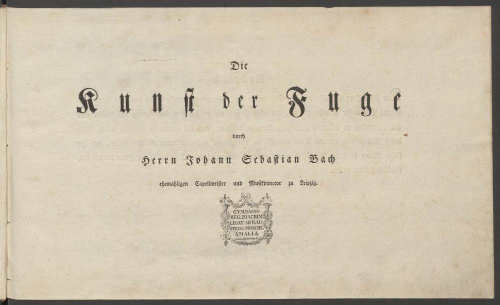
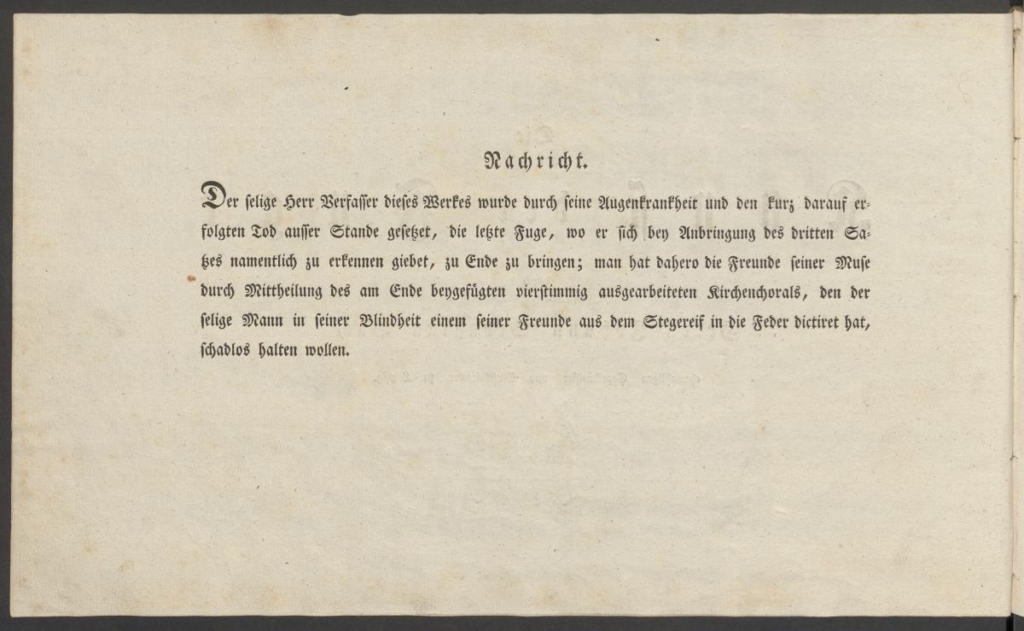
On the verso of the title page there is a small text (Nachricht) , that states:
„Der selige Herr Verfasser dieses Werkes wurde durch seine Augenkrankheit und dem kurz darauf erfolgten Tod ausser Stande gesetzet, die letzte Fuge, wo er sich bey anbringung des dritten Satzes namentlich zu erkennen giebet, zu Ende zu bringen; man hat dahero die Freunde seiner Muse durch Mittheilung des am Ende beygefügten vierstimmig ausgearbeiteten Kirchenchorals, den der selige Mann in seiner Blindheit einem seiner Freunde aus dem Stegereif in die Feder dictiret hat, schadlos halten wollen.“ (The late author of this work was prevented from completing the final fugue—wherein he identifies himself by name upon the introduction of the third theme—due to his eye ailment and his death shortly thereafter. Therefore, the editors wished to compensate the friends of his art by providing the four-part church chorale appended at the end, which the late composer, in his blindness, had dictated off the cuff to one of his friends.)
The phrase in red explains the epiphany of a four-part church chorale at the end of the publication: It’s a ‘compensation’ for the incompleteness of the final Fugue. However, the title of the chorale at the end, is not the one we expect (Vor deinem Thron) but : Wenn wir in höchsten Nöten sein, like the Fugues presented on 4 separate bars.
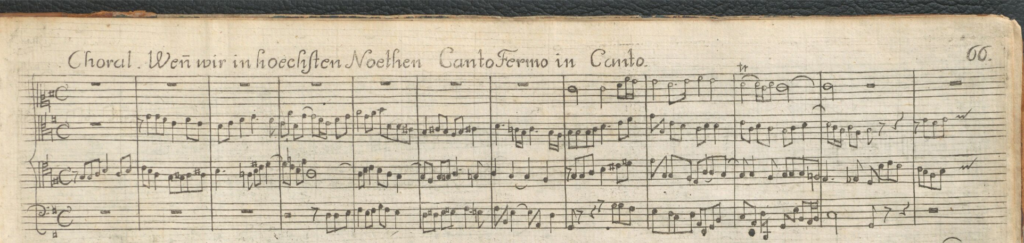
Summa: Historical research has informed us that the chorale – according to Bach’s heirs
1. was dictated to a friend
2. While Bach was blind (Bach suffered severe visual impairment from late 1749, operated March-April 1750, to no avail): late 1549 – 28 july 1750
3. It was added at the end of die Kunst der Fuge as a ‘compensation‘.
This remains the story throughout the 18th century.
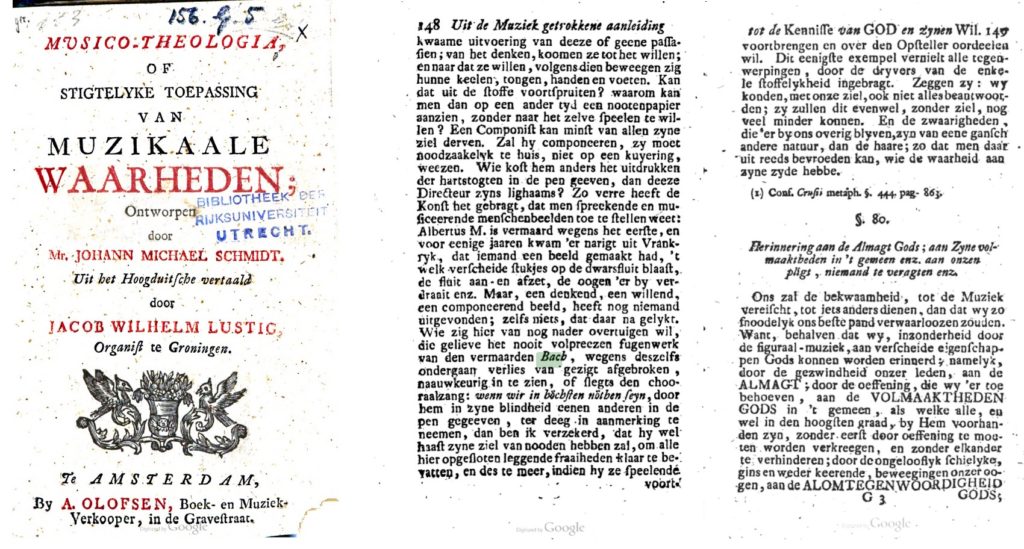
A positive appreciation of the quality of the music is added by J.M.Schmidt (Musico-Theologia, 1754), who uses Bach’s Art of Fugue, and the Chorale as a ‘proof’ that real music can only be made by man, who has ‘a soul’ (no machine will ever be able to produce such wonderful music. Just look at it, or try to play it).1 Nothing about a ‘deathbed-dictation’, or ‘last words’ whatsoever.
THE LEGEND STARTS:
Half a century later, J.N Forkel: 1802 (catalogue of Bach’s Works – Art of Fuge) writes:
“To make up for what is wanting to the last fugue, there was added to the end of the work the four-part Chorale: Wenn wir in hochsten Nothen seyn & Bach dictated it in his blindness, a few days before his death, to the pen of his son-in-law, Altnikol. Of the art displayed in this Chorale, I will say nothing; it was so familiar to the author that he could exercise it even in his illness. But the expression of pious resignation and devotion in it has always affected me whenever I have played it; so I can hardly say which I would rather miss— this Chorale, or the end of the last fugue.”
How Forkel knew that it was ‘a few days before his death’ and that the scribe was ‘Altnickol’ we don’t know. He had contact with Carl Philipp Emmanuel, but he was not present at the deathbed of his father. And did not mention anything of the sort in his Obituary.
THE LEGEND GETS ITS WINGS
Ph. Spitta (1880, Biography) fills the gaps and completes the picture:
“By his deathbed stood his wife and daughters, his youngest son Christian, his son-in-law, Altnikol, and his pupil Muthel. He had been working with Altnikol only a few days before his death. An organ chorale composed in a former time was floating in his soul, ready as he was to die, and he wanted to complete and perfect it. He dictated and Altnikol wrote. “Wenn wir in höchsten Nöten sein” was the name he had originally given it; he now adapted the sentiment to another hymn and wrote above it “Vor deinen Thron tret ich hiermit.”
Spitta did not have any other historical source than we have for ‘his story’. The people present at Bach’s deathbed are those he imagined… (could have been). He noticed that what Bach was doing was a ‘perfection’ of an already existing composition. And he saw the possibilities Wenn wir in höchsten Noten > Vor deinem Thron, that gives the story its captivating twist…
The rest is history…
The work in question published as ending of Kunst der Fuge de facto is an imcomplete revised setting of the hymn Wenn wir in höchsten Nöten sein (BWV 668), belonging to the Eighteen Leipzig Chorales, which itself was an revision of a chorale from the Orgelbüchlein (Weimar). As he did with many others. During his final years Bach apparently kept working (finetuning) on his oeuvre. Apparently these revisions were intended to incorporate it into revision of the Eighteen Leipzig Chorales, with which he was then occupied. The resulting version is catalogued as BWV 668a… However, this version is not identical with the composition that the family placed at the end of The Art of Fugue. That appendix appears to be a slightly older version of BWV 668, as it already appeared in the Leipzig Chorales of 1739–42. Confusion among the various versions seems to have begun almost immediately after Bach’s death. See scheme. Christoph Wolff has analysed it into every detail (1991: Essays). He produces a stemma diagram at the end of his article (which I have updated a bit), see above.
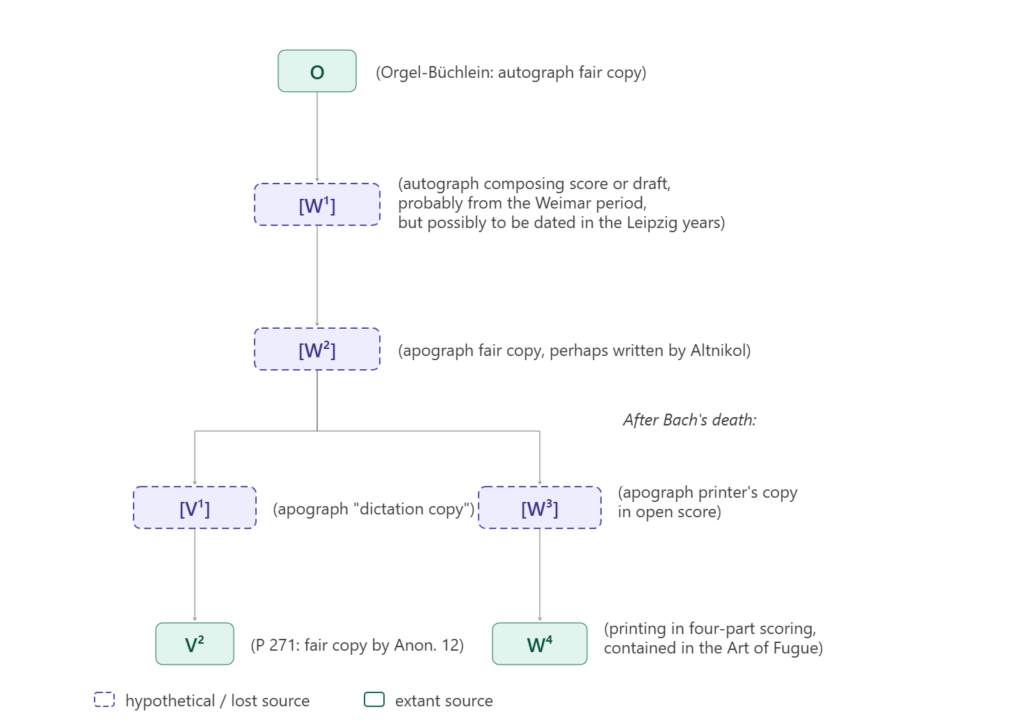
The Kunst der Fuge
Today we know that in his final years Bach was occupied with several projects, among them the B minor Mass and the Eighteen Leipzig Chorales. The Art of Fugue, whose first version dates back to the early 1740s, had already been set aside for some time. In other words, Death did not wrench the pen from the hand of genius while he was at work; the manuscript had already gathered a little dust by the time Bach died. Hypothesis: Perhaps Bach was also working on the Fugues, in order to complete them, and get them published/printed The Art of Fugue, why not: Clavierübung V, why not: submitting it as a contribution to the Correspondierende Societät der musicalischen Wissenschaften (Mizler’s Society)
This is the end. Unfinished indeed. In handwriting (C.Ph.Emmanuel Bach):
NB Über dieser Fuge, wo der Nahme B A C H im Contrasubject angebracht worden, ist der Verfasser gestorben.“ (Over this fugue, where the name BACH has been introduced into the countersubject, the composer died.) Nothing about a chorale.
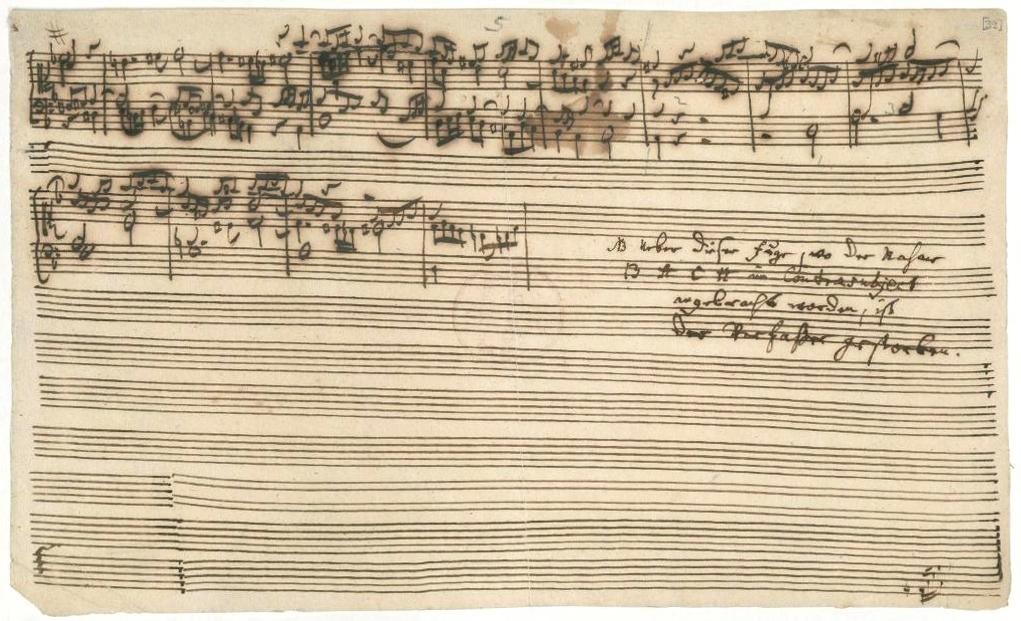
- NOTHING in the Obituary compiled by C.Ph. Emmanuel Bach and Joh. Fr. Agricola.
- Anonymous editor, verso of the titlepage Kunst der Fuge – 1751) : “…Man hat dahero die Freunde seiner Muse durch Mittheilung des am Ende beygefügten vierstimmig ausgearbeiteten Kirchenchorals, den der selige Mann in seiner Blindheit einem seiner Freunde aus dem Stegereif in die Feder dictiret hat, schadlos halten wollen.”
– Bach Dokumente II, no. 645; - Fr. W. Marpurg (tweede uitgave Kunst der Fuge – 1752) : “… Man hat indessen Ursache, sich zu schmeicheln, dass der zugefügte vierstimmig ausgearbeitete Kirchenchoral, den der selige Mann in seiner Blindheit einem seiner Freunde aus dem Stegereif in die Feder dictiret hat, diesen Mangel ersetzen, und die Freunde seiner Muse schadlos halten wird.”
– Bach Dokumente III, p. 15; - J.M. Schmidt (1754) in Musico-Theologica, oder Erbauliche Anwendung Musicalischer Wahrheiten (Bayreuth, Vierling, 1754): par. 88, p. 197: “Wie nöthig einem Musico die Seele sey” (contra de materialistisch-mechanische opvatting van de muziek, toentertijd populair vanwege de ingenieuze speeldozen, ‘.. aber ein denkendes, eind wollendes, ein componirendes Bild had noch keiner erfunden, nicht einmal etwas ähnliches) “Wer sich recht überzeugen will, der beliebe des vorhin belobten Bachs in Kupferstich herausgekommenen letztes Fugenwerk, welches aber durch seie darzwischen gekommen Blindheit unterbrochen worden ist, recht anzusehen, und die darinnen liegende Kunst, anzumerken; oder, welches ihm noch wunderbarer vorkommen muss, den in seiner Blindheit von ihm einem andern in die Feder dictirten Choral: Wenn wir in höchsten Nothen seyn. Ich bin gewiss, er wird gar halb seiner Seele nöthig haben, wenn er alle angebrachte Schönheiten einsehen, geschweige wenn er selbst spielen oder von dem Verfertiger urtheilen will.”
The Dutch translation of this tract 1756 by J.W. Lustig: