
Few composers have attracted as many legends as Johann Sebastian Bach. One of the most persistent tells how the blind composer, sensing that death was imminent, dictated a final chorale from his deathbed: Vor deinen Thron tret ich hiermit. What are the elements—the actual facts—on which this story is based?
The history of the story
The story does not begin with the obituary (written in 1751 and published in 1754), because it is not there. In it, the authors, Carl Ph. Emmanuel Bach and Bach’s student Agricola, refer to Bach’s eye problems, mention the operations he underwent, and even the temporary recovery of his sight ten days before his death, but nothing about a “dictation of a chorale” or any “last word”‘.
The story takes off with the publication of Die Kunst der Fuge (1751), issued by Bach’s heirs:
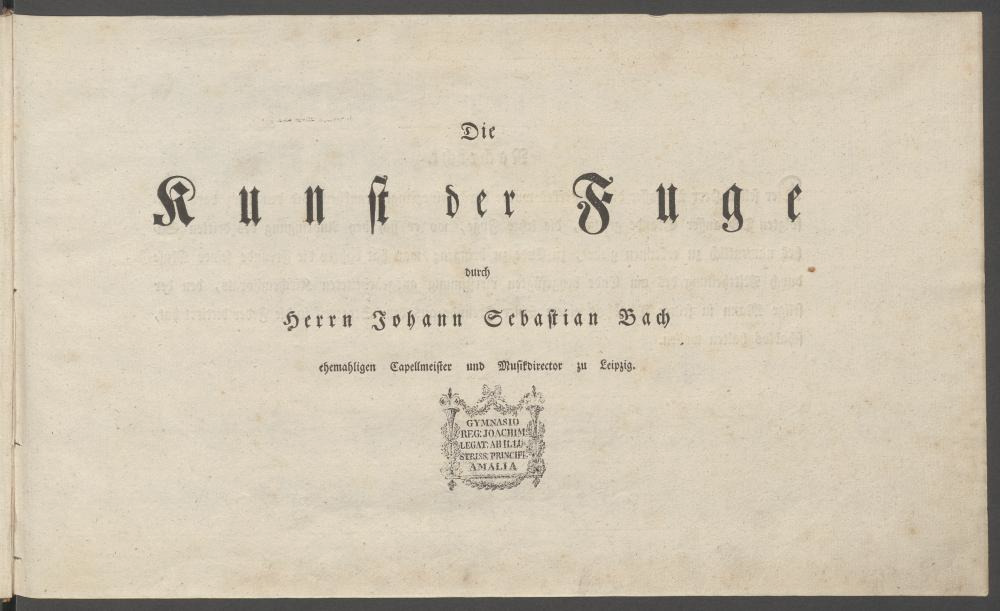
On the verso of the title page there is a small text (Nachricht/ Message)
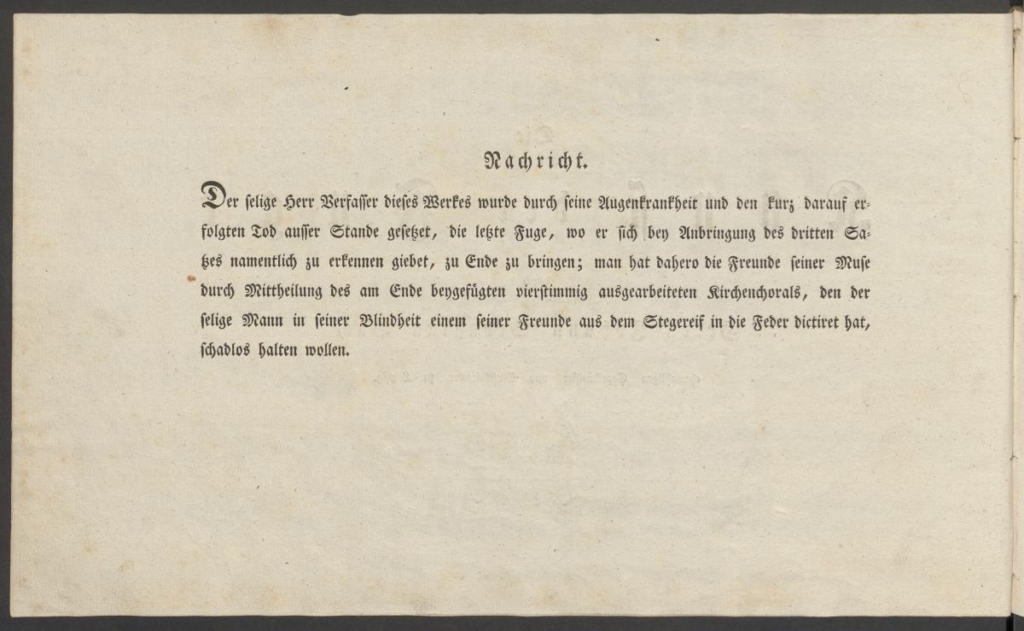
„Der selige Herr Verfasser dieses Werkes wurde durch seine Augenkrankheit und dem kurz darauf erfolgten Tod ausser Stande gesetzet, die letzte Fuge, wo er sich bey anbringung des dritten Satzes namentlich zu erkennen giebet, zu Ende zu bringen; man hat dahero die Freunde seiner Muse durch Mittheilung des am Ende beygefügten vierstimmig ausgearbeiteten Kirchenchorals, den der selige Mann in seiner Blindheit einem seiner Freunde aus dem Stegereif in die Feder dictiret hat, schadlos halten wollen.“ (The late author of this work was prevented from completing the final fugue—wherein he identifies himself by name upon the introduction of the third theme—due to his eye ailment and his death shortly thereafter. Therefore, the editors wished to compensate the friends of his art by providing the four-part church chorale appended at the end, which the late composer, in his blindness, had dictated off the cuff to one of his friends.)
1
The phrase in red explains the presence of a four-part church chorale after the fugue without an ending: It’s a ‘compensation’ for the incompleteness of that final fugue. NB: the title of the chorale at the end is not the one we expect (Vor deinem Thron) but : Wenn wir in höchsten Nöten sein, BTW, like the fugues presented on 4 separate bars.
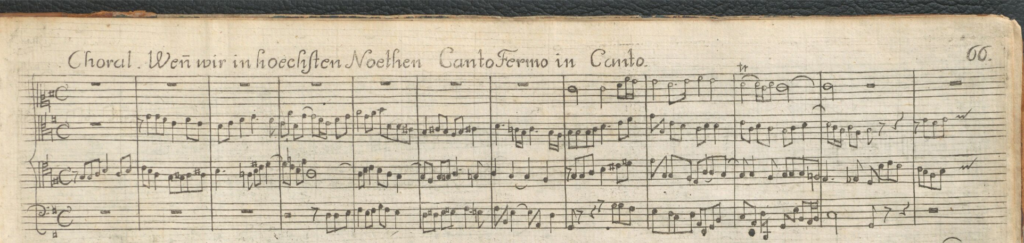
Summa: According to Bach’s heirs a 4vv chorale Wenn wir in höchsten Nöten sein
1. was dictated to a friend while Bach was already blind (i.e. somewhere between late 1749 and July 1750, when Bach suffered severe visual impairment.
2. It was added at the end of die Kunst der Fuge as a ‘compensation‘. This remains the story throughout the 18th century with one significant addition:
3. a very positive appreciation of the quality of the music was added by J.M.Schmidt (Musico-Theologia, 1754, a book which proofs the existence of God ‘ex musica’. Yes, really). Schmidt refers to Bach’s Kunst der Fuge and the Chorale as evidence that true music can only be made by human beings who have ‘a soul’ and writes: “Whoever wishes to be truly convinced should take a proper look at the copper-engraved, final fugal work of the previously praised Bach—which was, however, interrupted by the blindness that overtook him in the meantime—and note the artistry contained within it; or, what must seem even more wondrous to him, the chorale dictated by him to another’s pen during his blindness: Wenn wir in höchsten Nöthen seyn. I am certain he will have need of a good half of his soul if he wishes to perceive all the beauties applied, let alone if he wishes to play it himself or pass judgment on the creator.”2.
Nothing about a ‘deathbed-dictation’, or ‘last words’.
The legend starts (J.N Forkel, 1802)
J.N. Forkel (Music-historian) in a catalogue of Bach’s Works, writes about the Art of Fuge:
“To make up for what is wanting to the last fugue, there was added to the end of the work the four-part Chorale: Wenn wir in höchsten Nöthen seyn & Bach dictated it in his blindness, a few days before his death, to the pen of his son-in-law, Altnikol. Of the art displayed in this Chorale, I will say nothing; it was so familiar to the author that he could exercise it even in his illness. But the expression of pious resignation and devotion in it has always affected me whenever I have played it; so I can hardly say which I would rather miss— this Chorale, or the end of the last fugue.”
How Forkel knew that it was ‘a few days before his death’ and that the scribe was ‘Altnickol’ we don’t know. He had corresponded with C.Ph. Emmanuel, but his letters to Forkel with information about his father, don’t contain any information on this topic.
The legend gets its wings (Ph. Spitta, 1880)
In 1880, Ph. Spitta publishes a multi-volume biography of J.S. Bach, with lots of detail, writes:
“By his deathbed stood his wife and daughters, his youngest son Christian, his son-in-law, Altnikol, and his pupil Müthel. He had been working with Altnikol only a few days before his death. An organ chorale composed in a former time was floating in his soul, ready as he was to die, and he wanted to complete and perfect it. He dictated and Altnikol wrote. “Wenn wir in höchsten Nöten sein” was the name he had originally given it; he now adapted the sentiment to another hymn and wrote above it “Vor deinen Thron tret ich hiermit.”3
Spitta did not have any other factual historical source than we have for ‘his story’. It’s clear that the people present at Bach’s deathbed are those he imagined that would/could have been there. What he has noticed, however, is that the chorale published after Bach’s death was not a ‘new’ composition, but a ‘perfection’ of an already existing composition. And he saw and grasped the opportunity in changing the original title from Wenn wir in höchsten Noten sein into Vor deinem Thron tret ich hiermit (With this, I stand before your throne). That gives the story its captivating twist…
The rest is history…
The work in question published as ending of Die Kunst der Fuge is de facto a revised setting of the hymn Wenn wir in höchsten Nöten sein (BWV 668), belonging to the Leipzig Chorales (a manuscript collection, Bach had been working on between 1739-1742), which itself was a revision of a chorale from the Orgelbüchlein (Weimar), as he did with many others. During his final years Bach kept working on his oeuvre, finetuning, perfectioning. The resulting version of Wenn wir in höchsten Nöten sein is catalogued as BWV 668a. However, that version is not identical with the composition that the family placed at the end of The Art of Fugue. That seems to be a slightly older version. Confusion among the various versions seems to have begun almost immediately after Bach’s death. See scheme. Christoph Wolff, who analysed it into every detail (1991: Essays). He produces a stemma diagram at the end of his article (which I have expanded in with details from the article)
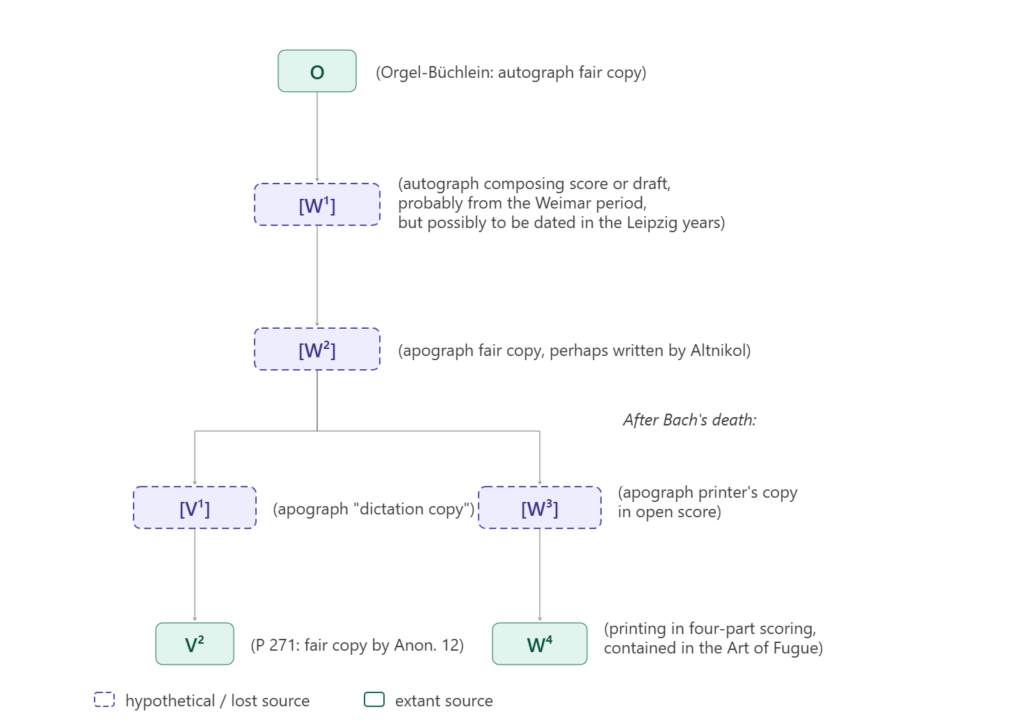
The Kunst der Fuge
Today we know that in his final years Bach was occupied with several projects, among them the B minor Mass and the Eighteen Leipzig Chorales (see above), perfecting existing material. The Art of Fugue belongs in this group as well. The first version (survived in autograph manuscript) dates back to the early 1740s, and presents itself as a study in ‘Contrapunctus’: 12 fugues and 2 canons. In the late 1740 Bach must have revisited his ‘Contrapunctus’ as well, revising, expanding it into what we now know as the ‘Kunst der Fuge’: 14 fugues, 4 canons. He must have had a publication in mind, because there are prints of ‘test plates’ with a correction (title) in the hand of Joh. Christoph Friedrich Bach, referring to the instruction of his father: “N.B. Der seel. Papa hat auf die Platte diesen Titul stechen lassen, Canon per Augment: in Contrapuncto all octava, er hat es aber wieder ausgestrichen auf der Probe Platte und gesetzet wie forn stehet.” 4
Was it unfinished ? In handwriting (C. Ph. Emmanuel Bach) on the last page is written: NB über dieser Fuge, wo der Nahme B A C H im Contrasubject angebracht worden, ist der Verfasser gestorben.“ 5. This is not to be taken as an ‘eye-witness’ report, but as a personal note, explaining why the fugue is not finished. Chr. Wolff suggests it was added much later by CPEmmanuel.6
Christoph Wolff interprets this last fugue as the ‘draft’ (“Entwurff”, mentioned by J.Fr. Agricola) in which Bach has written down the necessary parts (combination of the 4 subjects) and stops where the continuation of the fugue is self-evident. He also refers to the ‘sloppy’ music bars of this page, only fit for a draft, not for a full elaboration.
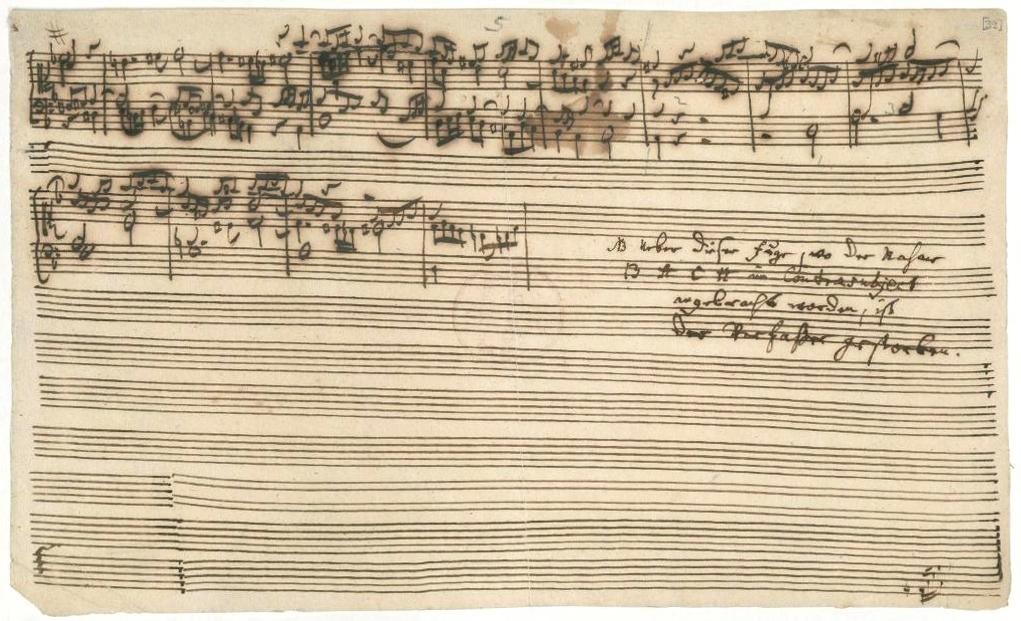
Whatever, Bach apparently was working on the Fugues in his last creative period, before he couldn’t write anymore. And he had the intention of getting them published/printed, as The Art of Fugue, or as Clavierübung V, or as a contribution to the Correspondierende Societät der musicalischen Wissenschaften (Mizler’s Society). In the 1751 publication the notes of the last bars are not printed, the fugue is left unfinished and followed by the ‘compensation-chorale’.
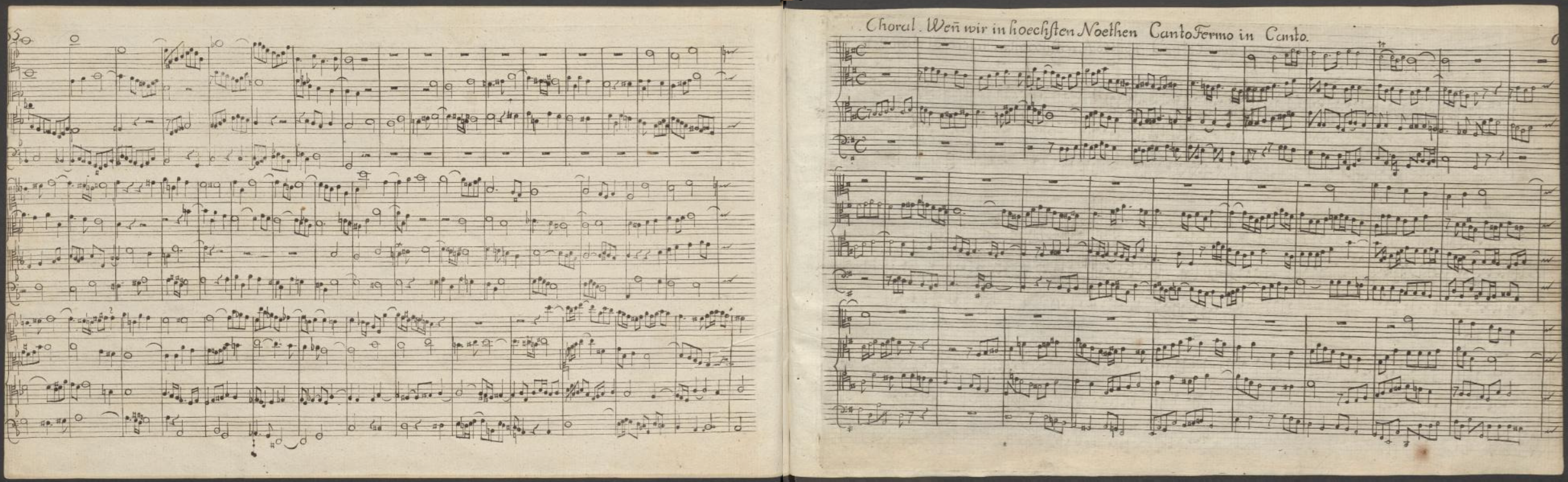
EXTRA: Musico-Theologica… Schmidt
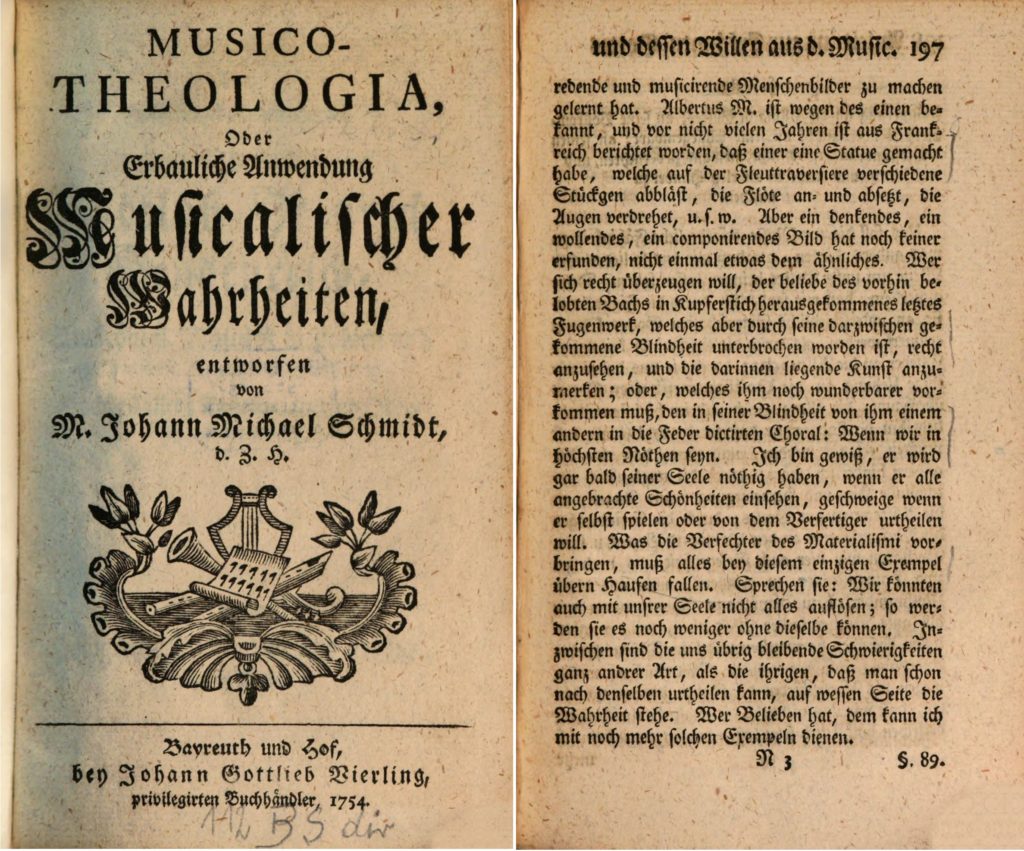
In mid-eighteenth-century music aesthetics, debates raged over whether music was merely a mechanical science or a product of the human soul. This friction is brilliantly illustrated in the contemporary reception of Johann Sebastian Bach, notably highlighted in a 1754 tract by J.M. Schmidt (Musico-Theologica, oder Erbauliche Anwendung Musicalischer Wahrheiten (Bayreuth, Vierling, 1754): par. 88, p. 197.
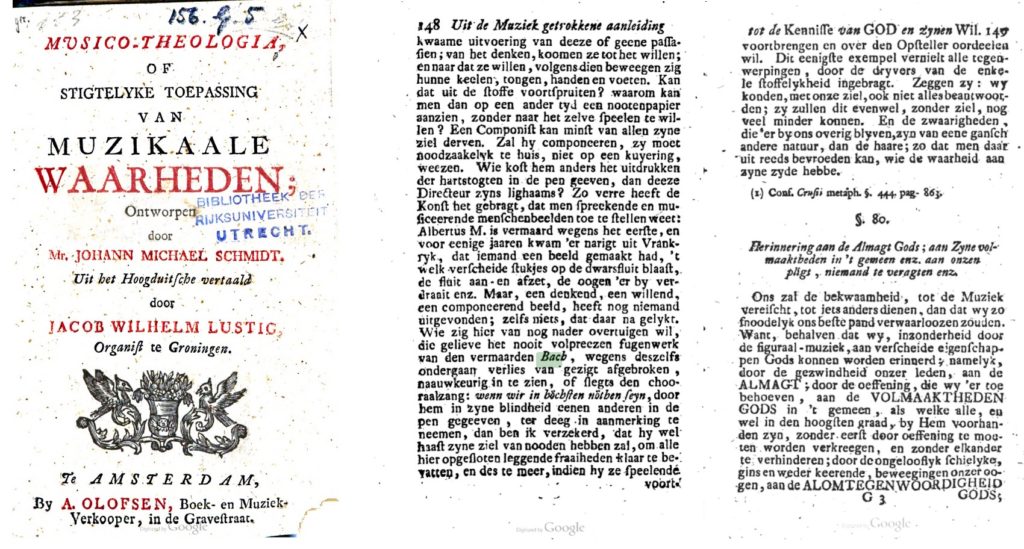
The author fiercely critiques the then-popular, materialistic-mechanical view of music—spurred by ingenious mechanical music boxes and lifelike automatons, such as a flute-playing statue that moved and even rolled its eyes—by asserting that “aber ein denkendes, eind wollendes, ein componirendes Bild hat noch keiner erfunden, nicht einmal etwas ähnliches” (“but a thinking, a willing, a composing image has not yet been invented by anyone, not even anything similar”). To prove “wie nöthig einem Musico die Seele sey” (“how necessary the soul is to a musician”), the writer points to the sublime signature of Bach’s final works. He challenges the critics to examine The Art of Fugue, interrupted by the composer’s blindness, or the chorale Wenn wir in höchsten Nöthen seyn, which a blind Bach dictated to an amanuensis. Of this profound testament, the author declares: “I am certain he will have need of at least half his own soul if he wishes to perceive all the beauties applied therein, let alone play it himself or judge the creator. Everything that the champions of materialism bring forward must fall to the ground before this single example”7
Below the original (1754) and a Dutch translation by J.W. Lustig (1756) of this tract (click to enlarge) :
Dick Wursten, juni 2026
- Similar remark by Fr. W. Marpurg (second edition Kunst der Fuge – 1752) : “… Man hat indessen Ursache, sich zu schmeicheln, dass der zugefügte vierstimmig ausgearbeitete Kirchenchoral, den der selige Mann in seiner Blindheit einem seiner Freunde aus dem Stegereif in die Feder dictiret hat, diesen Mangel ersetzen, und die Freunde seiner Muse schadlos halten wird.” Bach Dokumente III, p. 15
- for the German original and a contemporary Dutch translation, see below
- Um das Sterbebett standen neben der Gattin und den Töchtern der jüngste Sohn Christian, der Schwiegersohn Altnikol und der letzte Schüler Müthel. Mit Altnikol hatte Bach noch wenige Tage vor seinem Tode gearbeitet. Ein Orgelchoral aus alter Zeit schwebte vor seiner sterbensbereiten Seele, dem er die Vollendung geben wollte. Er dictirte und Altnikol schrieb. »Wenn wir in höchsten Nöthen sein« hatte er den Choral früher bezeichnet; jetzt schöpfte er die Stimmung aus einem andern Liede: er ließ ihn überschreiben »Vor deinen Thron tret ich hiemit«.
- “N.B. The late papa had written on the copper plate the following title, Canon per Augment: in Contrapuncto all octava, but had struck it out again on the proof sheet [test print] and restored the title as it was formerly.”
- “Working on this fugue, where the name BACH has been introduced into the countersubject, the composer died.“
- Chr. Wolff, Bach — Essays on his life and Music, 1991, p. 278, he suggests 1780, however in footnote 2 on p. 423: “… may have been written some years after 1750.”
- Ich bin gewiß, er wird gar halb seiner Seele nöthig haben, wenn er alle angebrachte Schönheiten einsehen, geschweige wenn er selbst spielen oder von dem Verfertiger urtheilen will. Was die Verfechter des Materialismi vorbringen, muß alles bey diesem einzigen Exempel Übern Hausen fallen”