
Complete German text with English translation
In the version found on bach-cantatas.com (translated by Francis Browne and William Hoffman), some stanzas are missing, and there are errors in sequence. That’s why.
I publish the text to illustrate what Christian communities sang during a Passion service when no choir or schola was present (16th-17th, early 18th century —in Leipzig until 1720, and even when Bach’s Passionmusic was performed in Leipzig, this kind of service took place in ‘the other church’). The only passion hymn to compete with this one is Jesu Leiden Pein und Tod
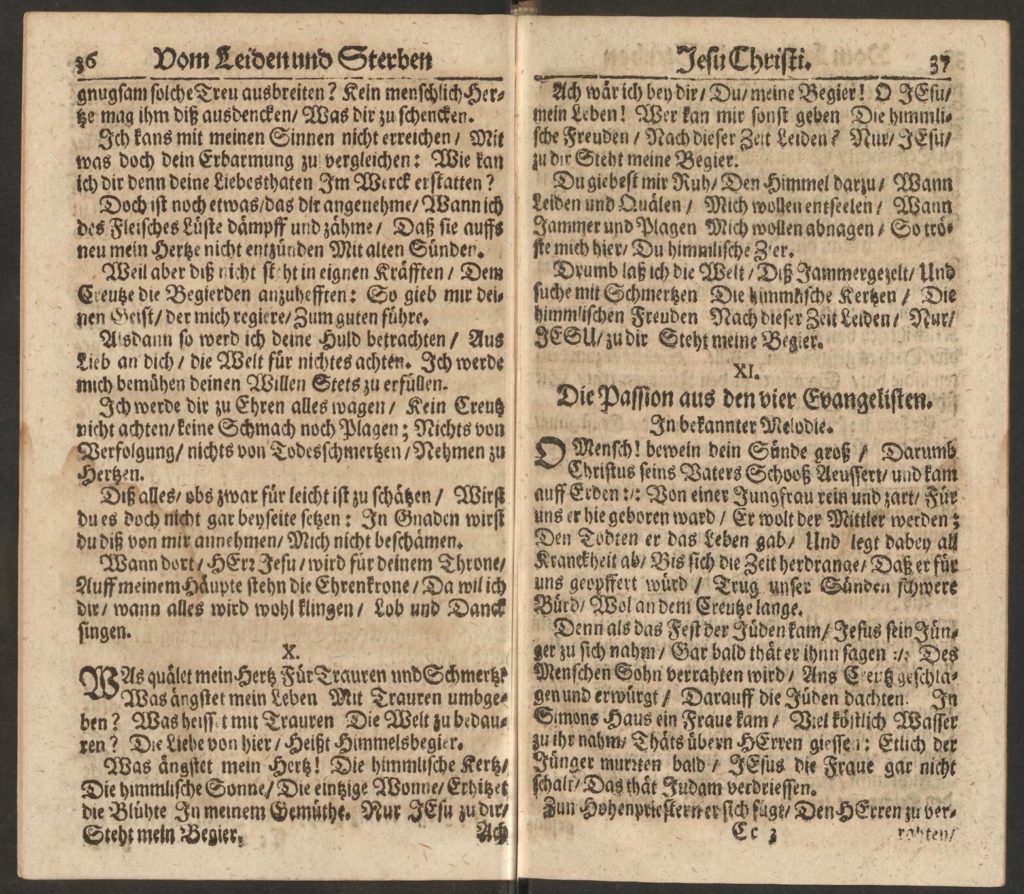
- The hymn was composed by Sebald Heyden in 1530 specifically for this occasion/use, and many hymnals include instructions for alternatim (alternating) singing. The tune already existed (Matthias Greiter, Strasbourg: Es sind doch selig alle die… Ps. 119).
- The two stanzas still sung today (1-23) are framing the 23-stanza Passion meditation in song form. In it, the story of the suffering of Jesus is recounted, in the style of a Gospel harmony based on the four Evangelists.
- The first stanza urges the reader to wholesome mourning over one’s own sins and the suffering Christ endured because of them. At the same time, the narrative begins with the mention of the incarnation and his salvific power. The final stanza summarizes the sensus moralis—the practical life consequences of Christ’s Passion for the faithful: gratitude, love, and fear of God.
- Each stanza consists twelve iambic lines with double rhyme scheme [aabccb], where a and c are masculine rhymes and b is feminine. This expansive form provides ample space for the narrative’s textual mass. Paul Gerhardt felt challenged to create a contrafactum to Heyden’s occasionally clumsy verses: his 29-stanza hymn in the same meter, O Mensch, beweine deine Sünd (“O man, bewail thy sin so great”). However: it’s the non-artificial aspect that gives the original its charm and liveliness (direct speech included).
- The German text below I reconstructed based on the above edition. No scholarly claims.
| German Text | English Translation |
| 1. O Mensch, bewein dein Sünde groß, Darum Christus seins Vaters Schoß Äußert und kam auf Erden; Von einer Jungfrau rein und zart Für uns er hie geboren ward, Er wollt der Mittler werden, Den Toten er das Leben gab Und legt dabei all Krankheit ab Bis sich die Zeit herdrange, Daß er für uns geopfert würd, Trüg unser Sünden schwere Bürd Wohl an dem Kreuze lange. | O man, bemoan your great sin (or sins) Because of which Christ left his Father’s bosom And came upon the earth; From a young woman pure and gentle He was born here for us. He wanted to become our mediator, To the dead he gave life And removed in this way all sickness Until the time came When he was sacrificed for us, Bore the heavy burden of our sins For a long time on the cross, |
| 2. Dann als das Fest der Juden kam Jesus sein Jünger zu sich nahm Gar bald thät er ihn’n sagen : Des Menschen Sohn verrathen wird Ans Kreutz geschlagen und ermördt Darauf die Juden tagen. In Simons Haus ein Frau kam Viel köstlich’s wasser zu ihr nahm Thäts übern Herren giessen Etlich der Jüngen murrten bald JEsus die fraue gar nicht schalt Das thät Judam verdriessen. | When it was time for the feast of the Jews Jesus gathered his disciples to himself and told them: The son of man will be betrayed, Nailed to the cross and put to death As the Jews plan. A woman entered Simon’s house, she brought precious perfume with her she poured it over the Lord. Several of disciples started to grumble Jesus did not reproach the woman this exasperated Judas |
| 3. Zum Hohenpriester er sich fügt, den Herren zu verraten lügt, nahm dreißig Pfennig behende. Bald Jesus mit den Jüngern kam und aß mit ihn’n das Osterlamm und tat dasselbe enden. Er setzt uns auf ein Testament, sein Tod zu bedenken bis ans End, und wusch den Jüngern Füße. Er bildet ihnen für die Liebe schon, und wie sie ihn würden verlassen, mit Trost tat er’s beschließen. | He betook himself to the high priest, and lied in order to betray the Lord, quickly took thirty pieces of silver. Soon Jesus came with the disciples and ate with them the Passover lamb and thus brought it to completion. He established for us a testament, that his death be remembered to the end, and washed the disciples’ feet. He set before them an image of love, and that they would abandon him, he concluded with words of comfort. |
| 4. Danach er an den Ölberg trat, mit Furcht und Zittern er da bat; Ach, betet und tut wachen:/: Einen Steinwurf er bald förder ging, zu seinem Vater auch anfing: O Vater, tu hier machen, daß dieser Kelch jetzt geh von mir, denn alle Ding sind möglich dir, doch es gescheh dein Wille. Solches er zum dritten Male bat, so oft er zu den Jüngern trat, sie schliefen all in Stille. | Afterwards he went to the Mount of Olives, with fear and trembling there he prayed; Ah, pray and keep watch: a stone’s throw farther he soon went, and to his Father thus began: O Father, grant here this, that this cup now pass from me, for all things are possible to you, yet let your will be done. This he prayed for the third time, as often as he came to the disciples, they all slept in silence. |
| 5. Er sprach : „Schlaft ihr in meinem Leid ? Wacht auf, die Stunde ist bereit, Ich werde nun gegeben In Hand der Sünder. Stehet auf, Der mich verrät, der wartet drauf, Dass mich mein’ Feinde fangen ! Als er noch red’t, sieh, Judas kam, Ein’ grosse Schar er mit sich nahm Mit Spiessen und mit Stangen. Ein Zeichen der Verräter gab : „Welchen ich küsse, merket ab: Der ist’s, den sollt ihr fangen ! | He said: “Do you sleep while I suffer? Awake, the hour is at hand; I shall now be delivered into the hands of sinners. Rise up— he who betrays me is waiting, that my enemies may seize me!” While he was still speaking, behold, Judas came, a great crowd he brought with him, with spears and with staves. A sign the traitor gave: “Whomever I shall kiss—take note— he is the one; him you shall seize!” |
| 6. Als Jesus nun wusst alle Ding, gar bald er ihnen entgegen ging, und sprach zu ihnen mit Güte: Wen suchet ihr mit solcher Gewalt? Jesus, sprachen sie, und fielen bald zurück in ihrem Wüten; Judas gab ihm den Kuss behend, der grausam Hauf auf Jesus rennt und fingen ihn mit Grimme. Petrus sein Schwert auszücket recht, hieb ab ein Ohr des Bischofs Knecht; Jesus bald antwort ihm: | Because Jesus knew all things, he soon went forth to meet them and spoke to them with gentleness: Whom do you seek with such force? Jesus, they said, and soon fell back in their raging fury; Judas quickly gave him the kiss, the cruel band rushed upon Jesus and seized him in wrath. Peter rightly drew his sword, struck off the ear of the high priest’s servant; Jesus immediately answered him: |
| 7. « Nicht mit dem Schwert, ach, Petrus, nein! Ich muss den Kelch austrinken rein, Den mir Gott hat gegeben ! » Die Schar führt Jesus zum Hannas, Dann bringt sie ihn zum Kaiphas, Gefangen und gefesselt. Petrus im Hof des Priesters stand : Von vielen Leut’ dreimal erkannt, Verleugnet er den Herren ! Kaiphas fragt Jesus : „ Wer bist du ? “ Sie riefen Zeugen noch dazu, Um ihn hart zu beschweren. | Not with the sword, ah, Peter, no! I must drink fully this chalice God has given to me! The crowd led Jesus to Annas, Then they took him to Kaiphas Captive and chained Peter stood in the courtyard of the high priest, When he was recog nised three times by many people, he denied the Lord! Caiphas asked Jesus : “Who are you?” They called witnesses also To bring serious charges against him |
| 8. Christus antwortet ihnen nicht. Der Hohepriester zu ihm spricht : „Was willst du dazu sagen ? Ich schwör’ dich bei dem Gotte mein, Sag, bist du Christus, der Sohn sein? “ Er antwort’t ohne Zagen : „Ich bin’s und sag : zu dieser Zeit, Werd’t ihr des Menschen Sohn von weit Auf Wolken sehen kommen, Und an der Rechten Gottes sein ! “ Kaiphas zerriss das Kleide sein Und sprach : „ Ihr habt’s vernommen !“ | Christ gave him no reply. The chief priest said: “What do you want to say about this? I abjure you by my God, Tell us, are you Christ, his son?” He replied without hesitation: “ I am and I say :at this time You will see from far the son of man Coming on the clouds And at the right hand of God!” Caiphas tore his clothes And said : “You have heard him! |
| C. I + II | |
| I 9. „Er hat gelästert Gott, den Herrn, Was solln wir weiter ihn aushörn? “ Sie sprachen : „ Er soll sterben ! “ Und spuckten ihm ins Angesicht, Auf ihn sie schlugen im Gericht Mit Schreien und Gelächter. Sie deckten ihm das Antlitz zu, Schlugen mit Fäusten, und dazu Fragten : „Wer hat geschlagen ? “ Am Morgen früh all das geschah, Der Sonnenaufgang war ganz nah : Das musste Christ schon tragen ! | He has blasphemed God the Lord! Why should we listen any more to him? “ They said:” He should die”, and spat in his face’ they struck him in the court with cries and laughter. They covered his face, hit him with their fists and then asked:”Who hit you ?” All this happened early on the next day It was nearly dawn. Christ had to bear this |
| 10. Dann zu Pilatus ging es hin. Als Judas sah, was ward aus ihm, Kam auf ihn schlimme Reue ! Das Geld er bald den Priestern gab : „Wie schwer ich doch gesündigt hab, Wie gross ist mein’ Untreue ! “ Er hing sich auf und brach entzwei. Die Priester fragten sich dabei : „Was tun mit diesem Gelde ? Des Töpfers Acker kaufen wir, Zum Friedhof für die Pilger hier. “ So hat’s die Schrift gemeldet. | Then they all went to Pilate. When Judas saw what became of him, He felt terrible remorse. He gave back the money to the priests: “ How seriously I have sinned, How great is my unfaithfulness!” The priests debated amongst themselves: “What should we do with this money? Let us buy the potter’s field As a cemetery for pilgrims.” This is reported in scripture. |
| 11. Als Jesus vor Pilatus stand, Schrien sie laut, ausser Verstand, Mit folgender Anklage : „Dem Kaiser will er widerstehn Und nennet sich ein Gottes Sohn, Verführt das Volk alltage.“ Pilatus ihm viel Fragen stellt, Aber der Herr kein Antwort meldt ; Darüber er sich wundert. Dann zu Herodes schickt er ihn. Herodes freut sich darauf hin : Er wollte sehn ein Wunder ! | When Jesus stood before Pilate shouted loudly and madly, with the following accusations: “he wants to oppose Caesar and calls himself the son of God, he leads the people astray constantly.” Pilate asked him many questions, but the Lord gave him no answer. He was amazed at this. Then he sent him on to Herod. Herod was pleased by this: he wanted to see a miracle! |
| 12. Da Jesus auch kein Antwort gab, Verachtet ihn Herodes grob, Schickt ihn Pilatus wieder. Der Römer zu den Priestern sprach : „Herodes auch den Menschen sah Und blieb doch unentschieden.“ Jedes Jahr üblich auf dem Fest, Einer das G’fängnis frei verlässt: Jesus will ich frei geben. Sie schrien all mit lauter Stimm : „ Schlag Jesus an des Kreuzes Stamm ! Barrabas wolln wir haben ! “ | When Jesus made no reply to him also, Herod felt great contempt for him, he sent him back to Pilate. The Roman said to the priests: “Herod also saw the man and remained still undecided. Each year customarily at the feast One man: is released from prison: I shall set Jesus free.” They all cried with loud voice: “Nail Jesus on the cross! We want to have Barabbas |
| I 13. So wurde Jesus ausgepeitscht Von den Soldaten allerseits Und mit Purpur gekleidet. Aus Dornen flochten sie die Kron, Ihm setzten auf mit Hass und Hohn, Mit G’walt und ohn’ Mitleiden. Sie grüssen ihn : „Dir König, heil !“ Und ziehen ihn am Narrenseil, Mit Schimpfwort und mit Schanden. Pilatus spricht : „Hier ist der Mann ! In ihm kein Bös’s ich strafen kann : Es ist ja kein’s vorhanden ! “ | So Jesus was whipped by the soldiers on all sides and clothed with purple. They wove a crown of thorns and put it on him with hate and scorn, violently and without pity. They greeted him: Hail to you! They made a fool of him with abuse and ignominy. Pilate said: “here is the man ! I can find no evil to punish in him: there is nothing ofthat sort! |
| II 14. Sie schrien auf mit lauter Stimm : “Ans Kreuz, ans Kreuz, mach Schluss mit ihm, Sonst bist du Caesars Feinde ! “ Als nun Pilatus hört’ dies Wort, Setzt’t er sich an des Richters Ort, Wusch öffentlich die Hände ; Erliess den Mörder Barrabas Und Jesus an das Kreuze gab, Nach ihrem falschen Willen. Sein’ Kleider sie auszogen ihm Und führten ihn mit grosser Stimm ; Das Kreuz trug er in Stille. | They kept shouting more loudly: crucify him crucify him make an end of him or your Caesar’s enemy, when Pilate heard this word, he sat down in the judge’s seat, publicly washed his hands. He let the murderer Barabbas go free and gave Jesus to be crucified, in accordance with their mistaken desire. He stripped his clothes from him And led him away with loud calls; He carried the cross calmly. |
| I + II 15. Als sie nun gingen mit ihm auf, Zwangen sie Simon, dass er lauf’ Und ihm das Kreuz nachtrage. Viel Volk und Frauen standen da, Doch Jesus, der sie weinen sah, Wandte sich um und sagte : „ Nein, weinet ja nicht über mich, Weint, Töchter Zion über euch Und über eure Kinder ! Ihr werdet sprechen : „ Selig, die Unfruchtbar ist und säugte nie, Wenn kommt der Tag des Endes.“ | As they went on their way with him, They enlisted Simon who was passing by and forced him to bear the cross as well. Many people and women were standing by but Jesus, when he saw them weeping, turned to them and said: “No, don’t weep for me, weep, daughters of Zion, for yourselves and for your children. You will say: “Happy is the woman who is barren and never suckled a child when the last day comes |
| 16. So kamen sie zu Golgatha. Zwei Übeltäter waren da, Die man auch schlug ans Holze Zur linken und zur rechten Hand, Wie es die Schrift lägst gab bekannt. Dann sprach der Herr am Kreuze: „ Vater, verzeih ihn’n diese Tat, Sie wissen nicht die Missetat ! “ Pilatus liess aufschreiben, Hebräisch, griechsich und latein: „ Jesus, der Mann aNazareth Und der König der Juden. | So they came to Golgotha. Two criminals were there, who had been fixed to wooden crosses on the right and left hand, as it is known from Scripture. Then: the Lord spoke on the cross: Father forgive them what they are doing, I do not know it is a crime!” Pilate had written up in Hebrew Greek and Latin: Jesus, the man from Nazareth and the king of the Jews. |
| I 17. Als Jesus so am Kreuze hing, Nahm man sein Kleider und gig hin, Sie durch das Los zu teilen. Die Mutter Jesu stand nicht weit, Johannes war an ihrer Seit ; Jesus sprach zu den beiden : „ Dies ist dein Sohn, Weib, nimm ihn an; Dies ist dein’ Mutter von nun an ! “ Johann sie zu sich nehmet. Die Hohen Priester trieben Spott, Schrien ihm laut mit schroffen Wort’ : : „ Bist du’s, der von Gott kommet ? “ | As Jesus was hanging on the cross, they took his clothes and gave them away, they shared them out by lots. Jesus mother stood not far away, John was at her side. Jesus said to both of them: “this is your son, woman, accept him; from now on this is your mother”, John accepted her. The high priests mocked him, they cried to him curtly: “are you the man who comes from God?” |
| 18. „ Bist du doch Gottes lieber Sohn, Dann steig vom Kreuz, hilf dir davon ! “ So sprachen auch die Schächer. Doch einer von den zweien rief : „ Dieser, der ist unschuldig hier ! Jesus, erbarm dich meiner, Wenn du bist in dem Reiche dein ! “ Er sprach: „ Heut wirst du bei mir sein Im Paradiese Gottes ! “ Finsternis kam zur sechsten Stund. Um neun Uhr, aus seins Herzensgrund, Schrie Jesus diese Worte : | If you are God’s dear son, then come down from the cross, help yourself. The thieves also spoke in this way. But one of the two called out: this man here is innocent! Jesus have pity on me when you are in your kingdom. He said: “today you will be with me in God’s paradise at the six-hour there was darkness and at the ninth hour,from the depths of his heart Jesus cried these words. |
| 19. „Mein Gott, mein Gott, wie läss’st du mich !“ Zur Antwort reichet man Essig Und gibt es ihm zu trinken. Als Jesus den versuchet hatt’, Sprach er : „Mein Gott, es ist vollbracht !“ Und liess sein Haupte sinken. “ O Vater, in den Händen dein Befehl ich dir den Geiste mein,“ Schrie er mit starker Stimme. Die Felsen sprangen ganz furchtbar, Im Tempel, der Vorhang sogar Entzwei riss bis nach unten ! | “My God, my God, why do you forsake me!” In reply they fetched vinegar and gave it him to drink. When Jesus had tried it, he said: “My God, it is accomplished!” And he bowed his head. “O father, in your hands I entrust my spirit to you, he cried out with a loud voice. Rocks split terrifyingly, in the temple the curtain was torn from top to bottom |
| 20. Die Erde fing zu beben an, Viel Gräber wurden aufgetan. Der Hauptmann und sein’ Leute Sprachen: „ Fürwahr, ein frommer war’s, Ein Gottes Sohn, dies zeiget das“ ! Und schlugen sich die Bruste. Als man den Schächern brach die Bein, War Jesus tot, ihm brach man keins: Sie stachen ihm die Seite ; Daraus rann Wasser mit dem Blut : Der es bezeugt, der sah es gut. Die Schrift erzählt es heute. | The earth began to shake, many graves were opened. This ensuring and his men said, truly this was a righteous man, shows was the son of God and they struck him on the chest. When they broke the legs of the thieves, Jesus was dead and so they do not break his legs: they speared him in the side. Water with blood run out. An eyewitness testifies this, Scripture relates it today. |
| I 21. Nach dem, als dann der Abend kam, Der fromme Joseph Jesus nahm Vom Kreuz, ihn zu begraben. Auch Nikodemus dazu kam, Viel Aloes und Myrrhe nahm, Um Jesus einzusalben. Nicht weit von Golgatha entfernt, Da war ein Grab, gehau’n im Berg, In steiler Felsenmauer. Sie legten Jesu leib darein, Darüber rollten sie den Stein , Und gingen weg mit Trauer. | Afterwards when it was evening, The pious Joseph took Jesus down from the cross to bury him Nicodemus came also brought much myrrhand spices with him to embalm Jesus. Not far from Golgotha there was a tomb carved in rock with a high stone wall . They placed Jesus’s body inside, rolled the stone into place and went their way in sorrow. |
| II 22. Am Sanstag ruht er in dem Grab. Frühmorgens dann, am dritten Tag, Steht Jesus auf gewaltig ! Er öffnet uns sein Himmelreich, Und spricht uns, treu und gnadenreich, Von Sünden frei und ledig. Darum wir sollen fröhlich sein, Dass unser Retter, er allein, Christus, hat überwunden Für uns die Sünd und ihre Not, Dazu die Hölle und den Tod : Der Teufel liegt gebunden ! | On Saturday he rests in the grave. Then early in the morning, on the third day, Jesus rises up in power! He opens for us his heavenly kingdom and says to us, faithfully and mercifully that we are free and delivered from our sins. For this reason we should be joyful that our saviour, only he, Christ, has overcome for us sins and their distress, with them hell and death: the devil lies bound. |
| I + II 23. Christus für uns litt grosse Pein, Drum lasset uns ihm dankbar sein, Nach seinem Willen leben. Weil uns sein Wort so helle scheint, Lasset uns sein der Sünde feind Und täglich danach streben ; Die Lieb’ erzeigen jedermann; Wie Christus an uns hat getan Mit seinem Leiden, Sterben. O Menschenkind, betracht das recht, Wie Gottes Zorn die Sünde schlägt : Tu dich davor bewahren ! | Christ suffered great pain for us, therefore let us be thankful, and live according to his will. Because his word shines so clearly for us, let us be enemies of sins each day strive in this way to show love for everybody as Christ has done for us with his suffering and death. O human race, consider what is right, since God’s anger strikes sins protect yourself from it! |