
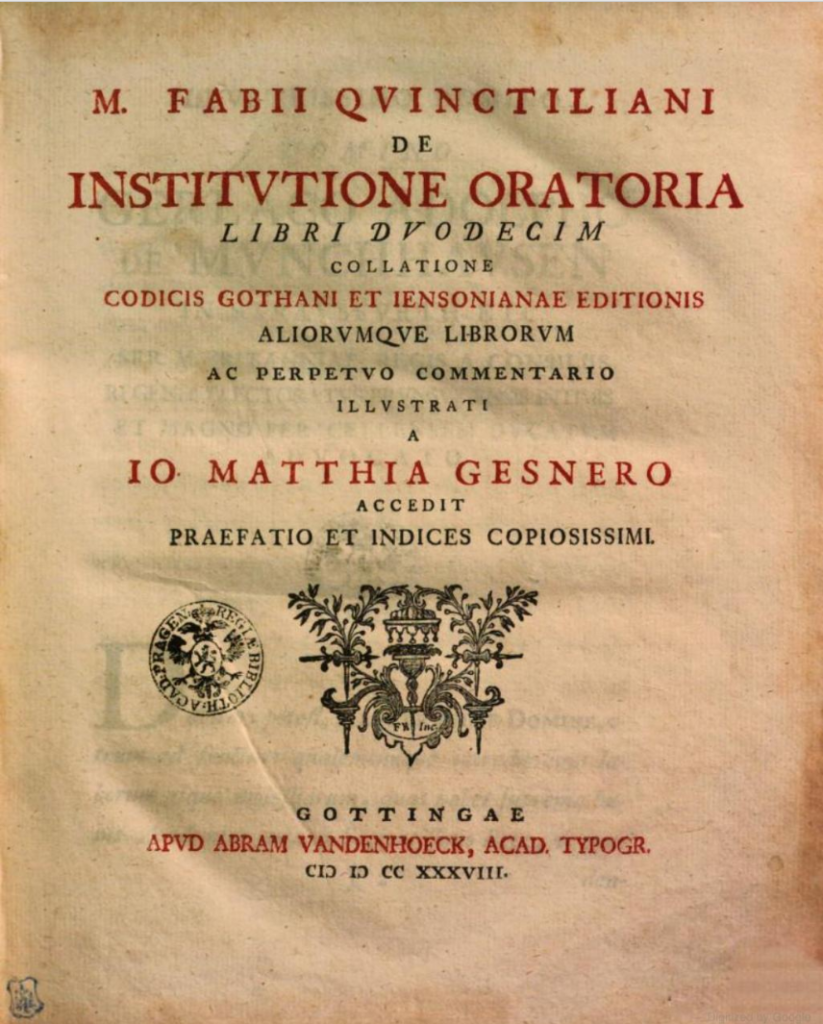
Marcus Fabius Quintilianus, De Institutione Oratoria, ed. Johann Matthias Gesner (Gottingen: Abram Vandenhoeck, 1738).
Gesner says to his Roman master Quintilian: “You think a lyre player is impressive? You haven’t seen my colleague, Bach.”
In his scholarly edition of the retorical handbook of Quintilianus (ed. 1738), J.A. Gesner adds an extensive footnote in Book 1, Chapter 12, referring to J.S. Bach. Quintilian has said that a good orator needs to be good in many things (polyvalent) at the same time (simtaneously ) and process his quite diverse knowledge all at once (multitasking). Chapter 12 continues with the question: is this realistic? Some people doubt it. Quintilian then argues that the human mind is naturally capable of multitasking, using a musician as his primary proof: the lyra-player/singer, the proof that man is capable of multitasking: memorising the music, plucking the strings with one hand, moving along with the other, and inventing/singing a tune, all at the same time… In the footnote Gesner takes Quintillian aside and tells him he even knows a better example… Bach…
Quitilian on the multitasking musician(lyra)
| De Institutione Oratoria I, 12 (Quintilianus, ed. Gesner) | |
| … 2 Sed non satis perspiciunt, quantum natura humani ingenii valeat: quae ita est agilis et velox, sic in omnem partem, ut ita dixerim, spectat, ut ne possit quidem aliquid agere tantum unum,in plura vero non eodem modo die, sed eodem temporis momento vim suam impendat. | … But they do not sufficiently perceive how great the power of the human mind is: which is so agile and swift, and looks (if I may say so) in every direction at once, that it cannot even do just one thing alone, but rather bestows its force upon many things, not merely in the same day, but at the same moment of time. |
| „3 … An vero citharoedi non simul & memoriae, & sono vocis & pluribus flexibus serviunt, cum interim alios nervos dextra percutiunt, alios laeva trahunt, continent, probant, ne pes quidem otiosus, certam legem temporum servat, & haec pariter omnia? 4 Quid? nos agendi subita necessitate deprehensi, nonne alia dicimus, alia providemus, cum pariter inventio rerum, electio verborum, compositio, gestus, pronuntiatio, vultus, motusque desiderentur?” | Or do lyre-players not simultaneously use their memory, the sound of their voice, and numerous vocal inflections, while in the meantime they strike some strings with the right hand and pull, hold, or damp others with the left? Not even the foot is idle, keeping a steady law of time; and all these things happen at the at once. [4] And what of us? When we are seized by a sudden necessity of pleading, do we not say one thing while providing for another, even as at the same moment the invention of matters, the choice of words, the arrangement, the gesture, the delivery, the facial expression, and the bodily motion are required? |
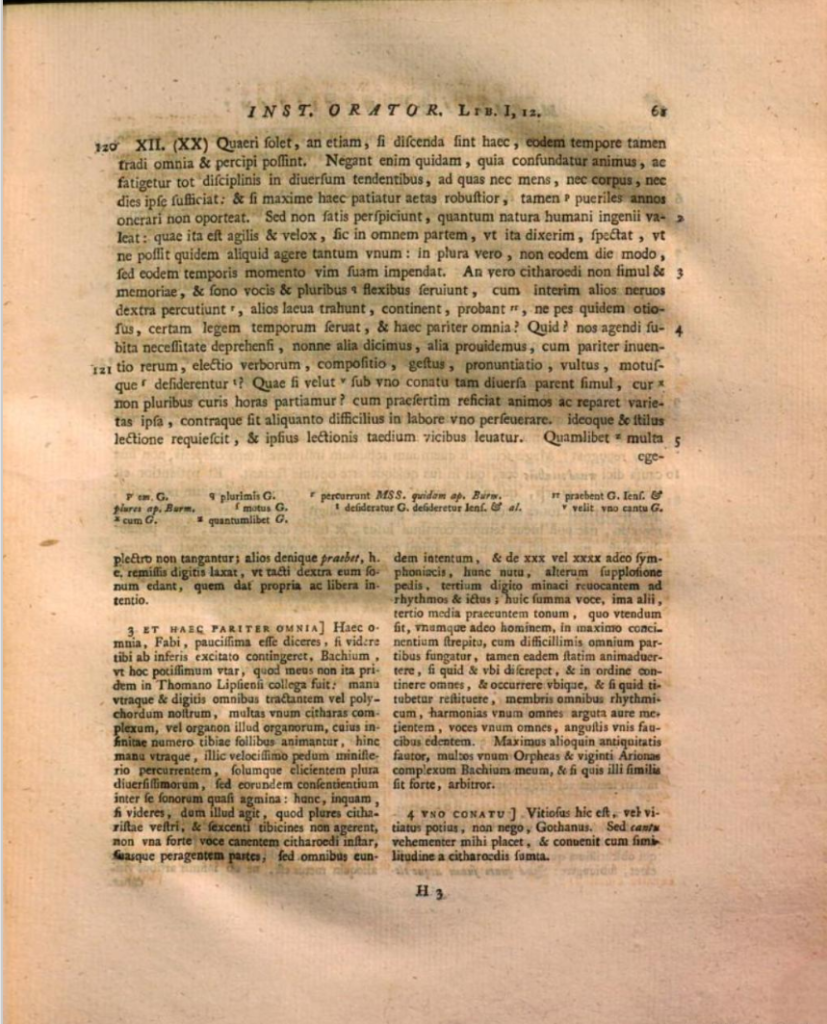
Gesner’s footnote: Bach is a better proof
The footnote is extraordinary, because in it the editor doesn’t give a scholarly comment (as in the other footnotes), but addresses the original author (Fabius Quintillianus) by name. It’s an apostrophe. … Gesner had collaborated with Bach in his time in Leipzig (as rector of the Thomasschule 1530-1533).
Quite moving to see this euloge on Bach appear in a scholarly edition of Quintilian, fanmail in disguise…
But it might also be more than that: A timely defense against Johann Adolph Scheibe, a composer and music critic who had recently attacked Bach’s music as being overly complex, and contra natura (1737). In 1738 Rhetoric Professor at Leipzig University, J.A. Birnbaum had already taken up Bach’s defense, and now his colleague from Göttingen, prof. dr. J.A. Gesner. The footnote is inserted at the end of section 3
J.A. Gesner: J.S. Bach as the ultimate multitasking musician
3 ET HAEC PARITER OMNIA] Haec omnia, Fabi, paucissima esse diceres, si videre tibi ab inferis excitato contingeret, Bachium, ut hoc potissimum utar, quod meus non ita pridem in Thomano Lipsiensi collega fuit: manu utraque & digitis omnibus tractantem vel polychordum nostrum, multas unum citharas complexum, vel organon illud organorum, cuius infinitae numero tibiae follibus animantur, hinc manu utraque, illic velocissimo pedum ministerio percurrentem, solumque elicientem plura diversissimorum, sed eorundem consentientium inter se sonorum quasi agmina: hunc, inquam, si videres, dum illud agit, quod plures citharistae vestri, & sexcenti tibicines non agerent, non una forte voce canentem citharoedi instar, suasque peragentem partes, sed omnibus eundem intentum, & de xxx vel xxxx adeo symphoniacis, hunc nutu, alterum supplosione pedis, tertium digito minaci revocantem ad rhythmos & ictus; huic summa voce, ima alii, tertio media praeeuntem tonum, quo utendum sit, unumque adeo hominem, in maximo concinentium strepitu, cum difficillimis omnium partibus fungatur, tamen eadem statim animadvertere, si quid & ubi discrepet, & in ordine continere omnes, & occurrere ubique, & si quid titubetur restituere, membris omnibus rhythmicum, harmonias unum omnes arguta aure metientem, voces unum omnes, angustis unis faucibus edentem. Maximus alioquin antiquitatis fautor, multos unum Orpheas & viginti Arionas complexum Bachium meum, & si quis illi similis sit forte, arbitror.
“All these things, Fabius, you would say were very trivial, if it should happen to you to see—having been summoned from the underworld—Bach (to mention him specifically, because he was not long ago my colleague at the Leipzig Thomasschule): how he, with both hands and all his fingers, plays either our polychord (which comprises many cithers in one) or that instrument of instruments (Lat. organum), whose infinite number of pipes are brought to life by bellows; how he runs to and fro, here with both hands and there with the swiftest service of his feet, eliciting alone many diverse—yet harmoniously agreeing—ranks of sounds, as it were. If you could see him, I say, while he is doing that which many of your cithara-players and six hundred of your flute-players could not do; not singing with perhaps a single voice in the manner of a lyre-player performing his own part, but a single man intent upon everyone at once: recalling this one to the rhythm and beat with a nod, another with a stamp of the foot, and a third with a threatening finger.
[You would see him] giving the tone—high to this one, low to another, and middle to a third—at the very moment it must be used; and how this one man, amidst the greatest roar of the performers, though he is executing the most difficult parts of all, can nevertheless instantly notice if anything is amiss and where it disagrees, keeping everyone in order, intervening everywhere, and restoring anything that falters. You would see him as the master of rhythm in every limb, a single man measuring all the harmonies with his keen ear, and producing all the voices through the narrow limits of a single throat. Otherwise a great admirer of antiquity, I nonetheless believe that my Bach (and anyone who might be like him) comprises within himself many Orpheuses and twenty Arions.”
Scheibe’s passion-oratorio 1739: A coincidence?
In March 1739 Bach was forbidden (by the City Council) to perform the standard liturgical Music on Good-Friday, no reason given. Bach is flabbergasted, angry and complains with the Superintendent, Salomon Deyling. Apparently to no effect. On Good-Friday 1739, a passion-oratorium is performed in the Neue Kirche (composed by J.A. Scheibe). Birnbaum’s lengthy defense of J. S. Bach (contra the attack of Scheibe) had appeared just a few weeks earlier. Coincidence? Or did Scheibe have influence on the Leipzig authorities?
Summary and Notes
The ‘Fabius’ addressed here is Marcus Fabius Quintilianus (known in English as Quintilian), the most famous teacher of rhetoric in ancient Rome. His Institutio Oratoria (The Education of an Orator) is considered the “gold standard” for Latin education in the modern era. Gesner (former rector of the Thomasschule (1730-1733) and friend of Bach published a commentary on this book, he takes the liberty of addressing Quintillian while editing the secion in which Quintilian discusses how a person can handle several things at once (multitasking). Quintilian used the example of a lyre player who can sing while playing. Gesner basically says to the ancient Roman master: “You think a lyre player is impressive? You haven’t seen my colleague, Bach.”
Polychordum: Gesner retrojection of the harpsichord
Organon illud organorum: clear reference to the organ.
Symphoniacis: Referencing the 30 or 40 musicians (singers and instrumentalists) Bach would lead simultaneously.
Orpheus and Arion: Legendary musicians of Greek myth.