
“Christoph Birkmann (mathematician and librettist of cantatas 1726-1727)”
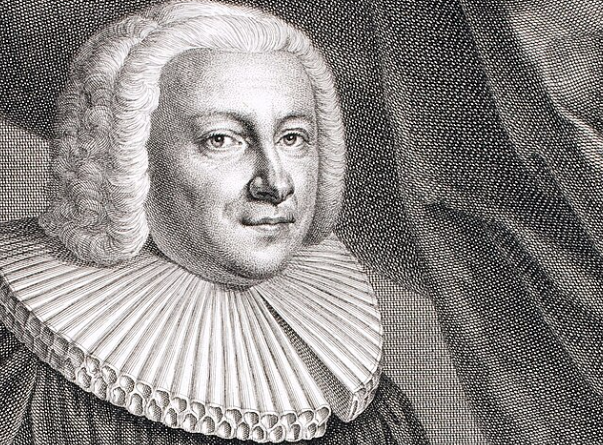
In 2015, Dr. Christine Blanken of the Bach-Archiv Leipzig discovered a hitherto unknonw 1728 publication by Christoph Birkmann (1703-1771) containing 71 cantata librettos (entiry liturgical year). It was already known that this Pastor (from and active in Nuremberg) had studied In Leipzig (1724-1727) and performed music with Bach . Blanken decided to investigate further and discovered that the cycle of cantata texts contained many known cantatas by Bach, of which the author until then was Anonymus , amongst them some of the most famous: Ich habe genug (BWV 82) and the Kreuzstab-cantata (BWV 56) , Was Birkmann the author? But first, a quote from his autobiographical note “Ehren-denkmal” (1738, p. 22f) (translated – the original on the Dutch page):
‘Because I stayed in the house of M[agister] Birnbaum for some time, I took advantage of the fine opportunity offered weekly in speech exercises and the defense of mixed propositions, where it often fell to me to perorate ex tempore. From then on, I pursued theology in earnest, hearing Pfeiffer, Carpzov, Bernd, Sibern, and other famous teachers from both chairs; I also attempted to preach a few times, but postponed further practice until a more convenient time, finding pleasure in Hoffman’s and Teller’s guidance in Exegesi sacra et dispositione textuum sacrorum, as I could enjoy both as desired. At the same time, I did not entirely neglect music, but diligently attended to the great master, Mr. Director Bach and his choir, also visiting the Collegia musica in winter, thereby gaining the opportunity to assist several students with the help of the Italian language.‘
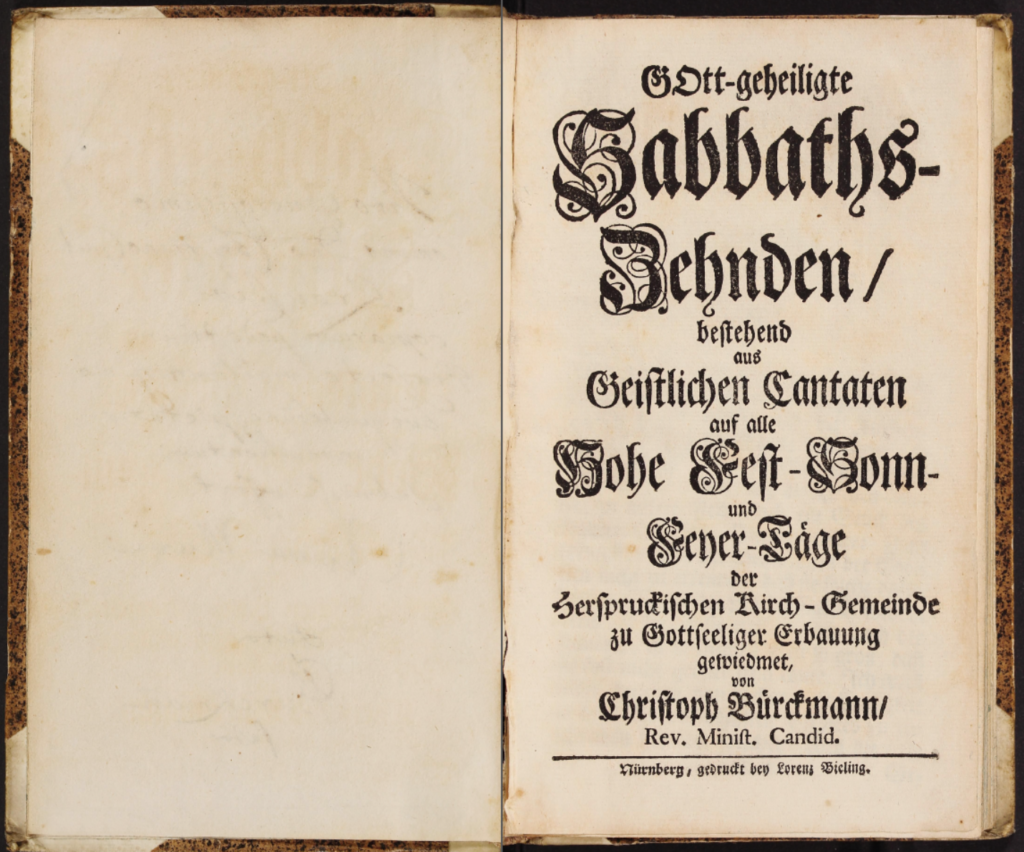
Christoph Birkmann thus sang or played along in the cantatas (In this context, the word “Choir” refers, as it does elsewhere, to a “group of singers and instrumentalists performing together”). While this connection was previously known, the booklet she found in the Nuremberg library, titled “GOtt-geheiligte Sabbaths-Zehnden” (1728), contained a complete annual cycle of cantata texts… including a large number of Bach cantata texts for which the author had previously been ‘unknown’ (many solo and dialogue cantatas, including the famous Ich habe genug and Ich will den Kreuzstab gerne tragen…). Below is the list of the Birkmann sub-cycle, which runs from late October 1726 to early February 1727:
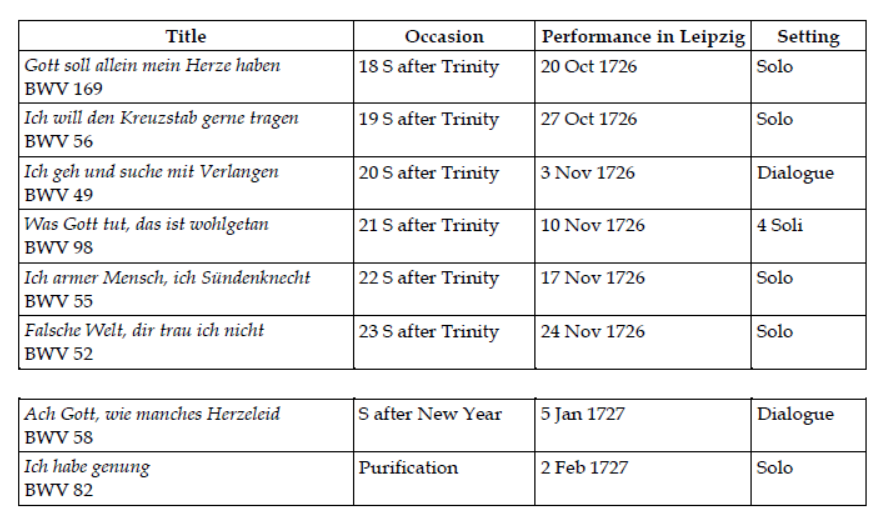
Between January 5 and February 2, Birkmann’s collection includes four additional solo/dialogue cantatas for which no music has survived. Interestingly, there are no other surviving cantatas by Bach for those specific Sundays either. This suggests that these might be four lost cantatas composed and performed by Bach, for which we unfortunately no longer have the scores.
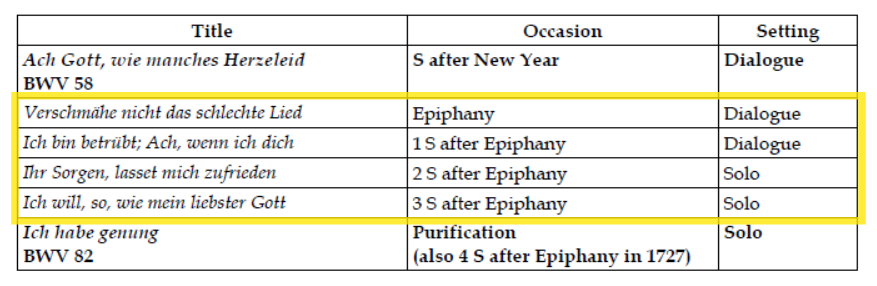
Another surprise, however, was that the full libretto of the second version of the St John Passion from 1725 is also included in this volume. In the preface, Birkmann states that he is not only the compiler and editor but also the author of the texts. This suggests he may have been the source for the three new arias in this version of the Passion:
– Himmel reiße, Welt erbebe
– Zerschmettert mich, ihr Felsen, Bogen
– Ach windet euch niet so, geplagte Seelen
In short: he and his book are well worth getting to know better.
(Continue reading below the image of the title page and the beginning of the ‘St John Passion’, which is referred to here as an oratorio).
Christoph Birkmann (1703-1771) came from a simple working-class family in Nuremberg, but thanks to a strong educational system (first the Armen school (Diakonieschule), then the Latin school), his talent for languages, mathematics, and music was quickly noticed. As a side note: musical boys from the Latin school formed the church choir. Lacking financial means, he became a “working student” from his teens, tutoring others to fund his education. Receiving support and the prospect of a scholarship, he enrolled at the University of Altdorf in 1723 (a small town with a highly regarded university where Leibniz earned his degree). As a multi-talent, he struggled to choose between music (as a singer and soon a composer), languages (mastering classical languages plus English, French, and Italian), and mathematics. When the promised scholarship proved meager, he took the leap to the big city in late 1724: Leipzig and its university. He arrived in early December 1724, penniless, just in time for the start of Advent to catch Nun komm der Heiden Heiland, BWV 61, at the Thomaskirche. He remained in Leipzig until September 1727. Enrolling just before Christmas 1724, he became a student of Physics and Mathematics under Prof. Christian August Hausen (an astronomer and later an authority on electricity who had traveled to England to meet Newton). Hausen wanted to keep Birkmann and introduced him to observatories in Dresden and Berlin, but by then, rhetoric and theology had captured his interest. This shift was likely influenced by his friendship with Johann Abraham Birnbaum, a near contemporary and already an enthusiastic young rhetoric teacher and promoter of German as a literary language. The destitute student soon moved in with him. Birkmann immersed himself in the musical scene (joining several collegia musica) and earned money by teaching Italian to fellow students. Alongside his official science studies, he attended various public and private lectures in rhetoric and theology, with the latter eventually becoming his primary focus.
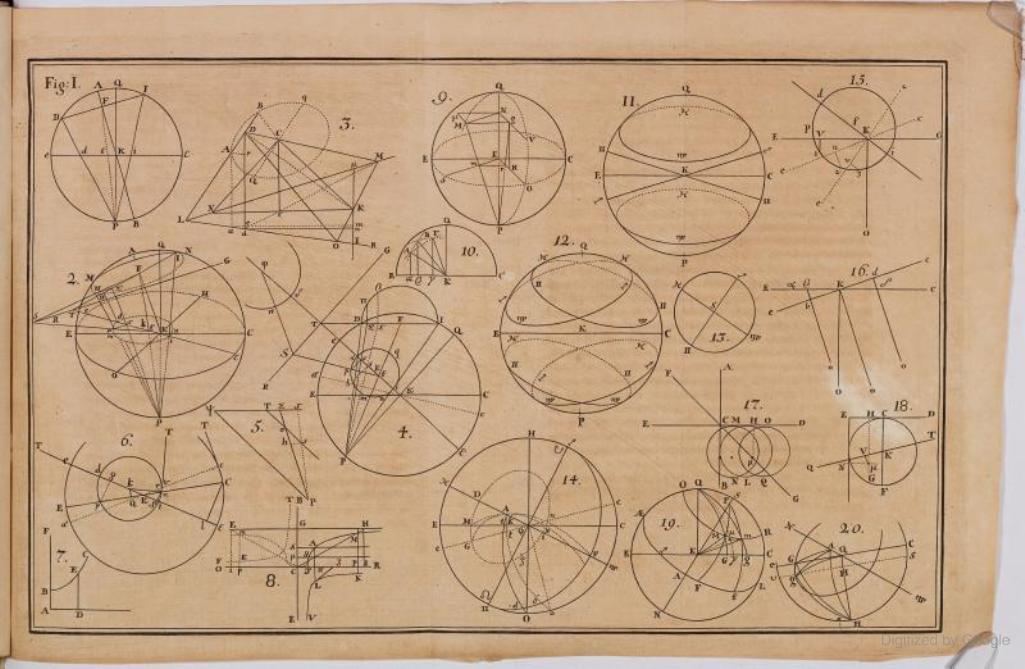
Nevertheless, Hausen (praeses) and Birkmann (respondens) published a dissertation in 1726 titled “Theoria solis motus circa axem propriam” (Theory of the sun’s motion around its own axis). It explored how telescopic observations of sunspots could be used to calculate the sun’s rotation speed and the tilt of its axis (Hausen’s result was 7.25°). Birkmann publicly defended the work, which included geometric drawings and mathematical calculations. See image.
Birnbaum (1702–1748) was only a year older than Birkmann but was already establishing himself. In 1724, he acquired his ius docendi and began as a private lecturer (Collegia Privata). In 1734, he became a professor of rhetoric at the university and emerged as a passionate advocate for Bach and his music (defending him against the attacks of J.A. Scheibe, who considered Bach’s music unnecessarily complex). One wonders if there was contact between Bach and Birnbaum even earlier. In any case, Christoph Birkmann knew Bach personally; he performed in Bach’s “choir” (i.e., the cantatas) and must have been broadly gifted musically, as he was also a member of various collegia musica in Leipzig (semi-professional music groups, often centered around the University; Bach took over the leadership of one such society in 1730, performing at Café Zimmermann). Under Birnbaum’s influence, Birkmann left his scientific career behind to focus on biblical exegesis and the art of preaching, which likely offered more financial security. He sought to become a pastor. In early 1727, he moved to Hersbruck (near Nuremberg) to work as a private tutor. In 1731, he became an assistant pastor and later the Senior Pastor in Nuremberg, where he remained until his death in 1771. As he aged, his Pietist nature became more pronounced, whereas it had been more of an ‘accent’ during his time in Leipzig.
To the point: After his departure and before his ordination, he published the libretti of an annual cycle of cantatas in 1728: “GOtt-geheiligte Sabbaths-Zehnden” (Sabbath Tithes Dedicated to God, consisting of spiritual cantatas for all high feasts and Sundays, dedicated to the congregation at Hersbruck for a godly exercise in piety… by Christoph Birckmann, candidate for the ministry, printed in Nuremberg by Lorenz Bieling). The preface and his autobiography provide a rare insight into how these cantatas were created, performed, and edited. They also highlight the importance of Leipzig students in the performance of Bach’s church music. Birkmann worked with Bach on revising older libretti (likely from Weimar, though early Picander versions are also found in this collection). He also wrote an entire series of cantata texts himself (often in the ‘first person’ and/or dialogue cantatas, which Bach began composing in 1726). The text of the St John Passion – 1725 version – is also included in this collection. While it is not always clear which parts are edits and which are original texts, given his evident literary talent and theological knowledge, it is plausible to attribute the new texts in the 1725 St John Passion to him: three highly expressive arias. His focus was clearly on deeply felt religious emotions expressed through the text. His poetic talent and mastery of style are unmistakable: imagery-rich, fluid, and structurally sound (link to the full libretto and translation of the 1725 St John Passion).
Dick Wursten