The St Matthew Passion
This page takes up a simple question: what kind of piece is this, actually? How should we picture its liturgical setting? How was it performed under Bach?
Dutch translation of the libretto: bach.wursten.be/cantatas/bwv244.htm.
Concert or church music
We know the St Matthew Passion only as a concert piece. And it makes no difference whether it takes place in a concert hall or in a church: it remains a ‘performance’. A church is more atmospheric, certainly, but even there it is a concert. Yet the work has a clear liturgical context: it is the principal music for the afternoon service (the Vespers) of Good Friday, beginning at 1.45 p.m. To us that seems not fit – the music is far too long – but for people of the eighteenth century it was of an ordinary ecclesiastical length. This music replaces the gospel reading for Good Friday, that is, the whole Passion narrative. It was preceded by a hymn and followed by a motet and a prayer. And, not to be forgotten: between the two parts came a sermon, lasting about an hour. Here is the order of service. For the rest it is very basic – and, I think, extremely effective.
The liturgy
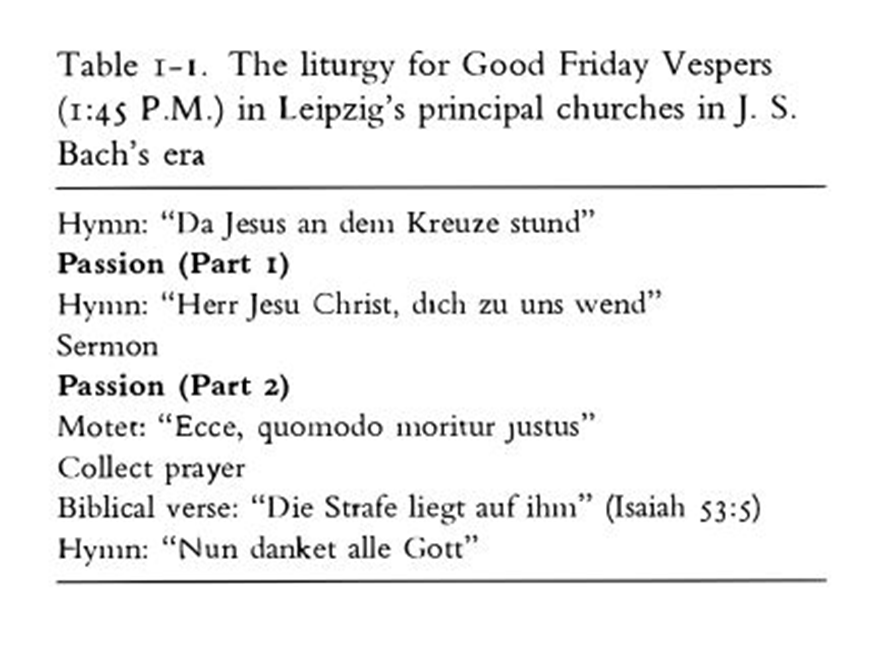
In the first hymn the congregation is called to ponder the seven words from the cross in their hearts, to make them their own. That is what the celebration is for: appropriation. Then the gospel reading (the Passion) begins. After Part One the traditional prayer at the opening of the Word is sung (Herr Jesu Christ, dich zu uns wend…), and a long sermon follows, which likewise seeks to bring about the appropriation of what the Passion recounts. After the sermon the reading continues: Passion Part Two. When that has ended, with the burial, comes the four-part motet Ecce quomodo moritur justus in the setting by Jacob Handl (Gallus), also sung from the organ gallery. Then a short collect. The minister declaims Isaiah 53:5 (‘the chastisement of our peace was upon him’), whereupon the congregation says its Deo gratias – that is, sings it: Nun danket alle Gott.
A fuller account of the first performance of the St John Passion (1724) in the Nikolaikirche in Leipzig, with a sketch of the atmosphere, is here.
Performance: crucial differences
1. Disposition
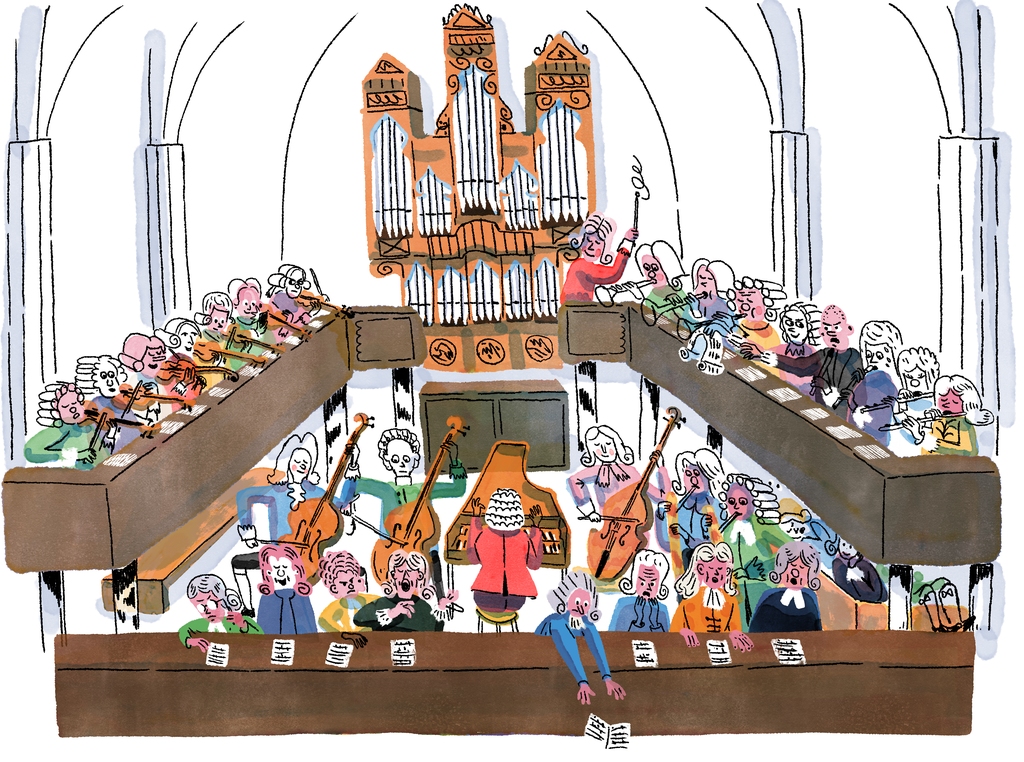
A striking difference from performances today is that in Bach’s time all the musicians remained out of sight. They were up by the organ, on the gallery – instrumentalists and singers alike. And there were no soloists: the best singers from each of the two choirs took all the arias. For the revival of 1736 (the apotheosis?) Bach also separated the two choirs spatially, placing each ‘choir’ (singers and instruments) apart on the gallery, so that a genuine stereo effect arose – of obvious interest for the dialogues. Konrad Küster goes further still, and imagines Chor II (instruments and singers) on the small eastern gallery, between the nave and the liturgical choir (see the photograph on the right – that gallery, but without its organ, demolished in 1740). Stereo then becomes surround sound, since the congregation sat literally in between. The standard view has it that only the organ on that gallery – the ‘swallow’s nest’ organ – was used, for the cantus firmus in the opening chorus and in O Mensch, bewein at the end of Part One.
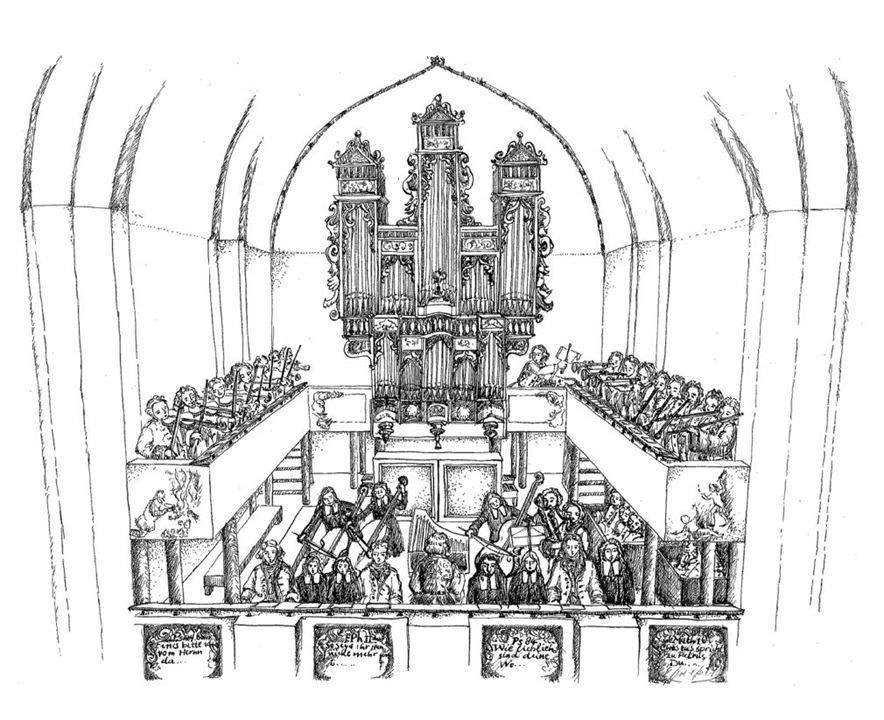
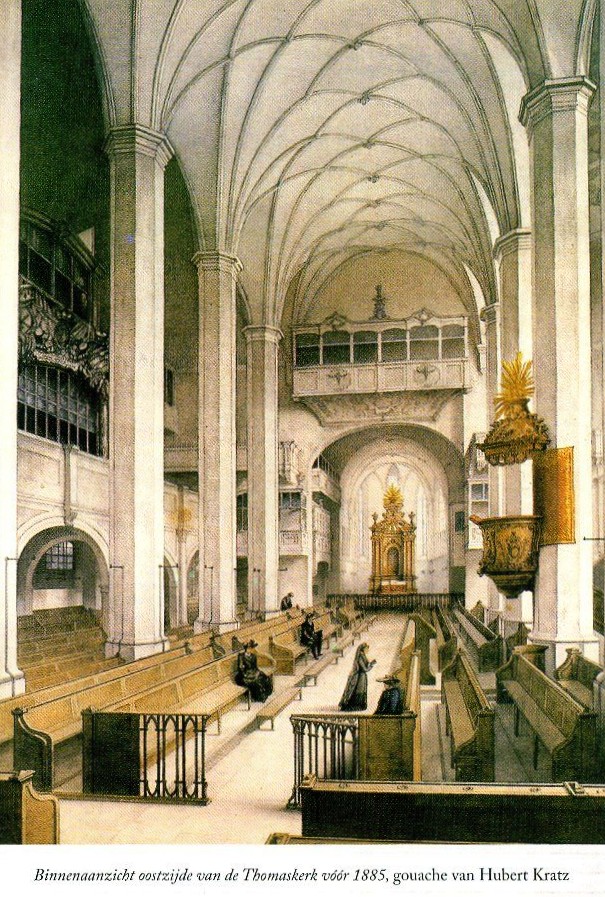
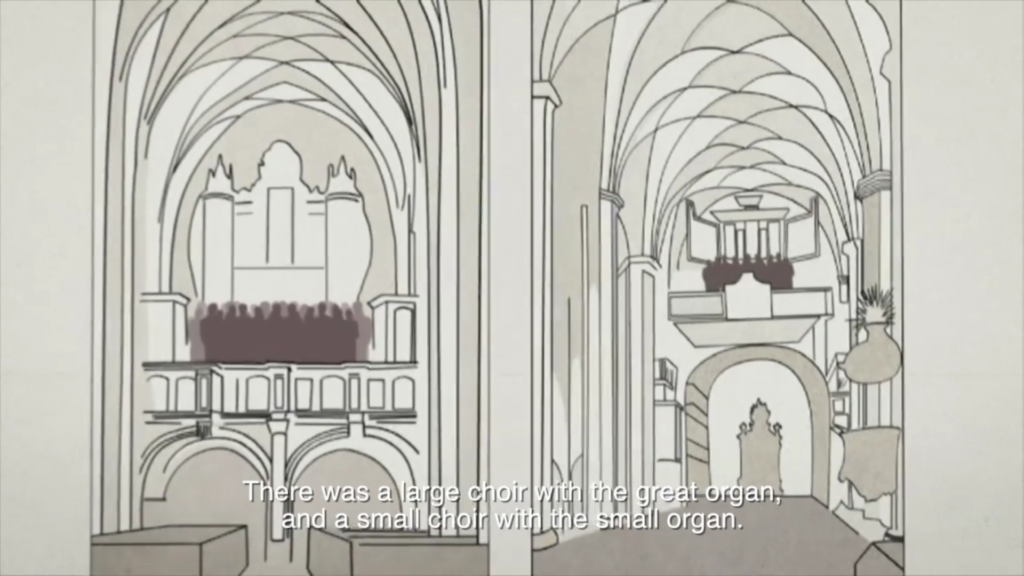
LEFT: the layout on the great organ gallery (west end). Drawing: Rens Bijma, 2017. All the singers – both ‘choirs’ – stand in the front row: 2 × 4 = 8 boys and men. The instrumentalists are to left and right. The organist plays continuo. This could be the performance of 1727 or 1729, though much here remains uncertain. RIGHT: the ‘swallow’s nest’, the gallery against the wall. Beneath it you look into the choir. This gallery is some thirty metres from the main gallery. If Choir 2 really did make music there, it must have been quite a challenge.
The drawing of the gallery in the Thomaskirche comes from Rens Bijma’s doctoral thesis (2017). It is based on the actual dimensions and the available sources: letters, memoranda, complaints, the parts (handwritten performing material) and contemporary descriptions. It visualises the end result. Bach sits at the harpsichord. Someone else plays the organ as a continuo instrument, with pedal. The 2 × 4 singers stand at the balustrade.
In the performance of 1736 Bach explicitly distinguishes two choirs – that is, two groups of musicians (voices + instruments + basso continuo), for that is what ‘choir’ meant in Bach’s day and before. This is confirmed by a note from the sexton of the Thomaskirche, who records that ‘both organs’ were used. That means Bach must have made use of the ‘swallow’s nest’, the small organ gallery, since the second organ stood there. Whether the whole of the second choir stood there is a matter of debate.
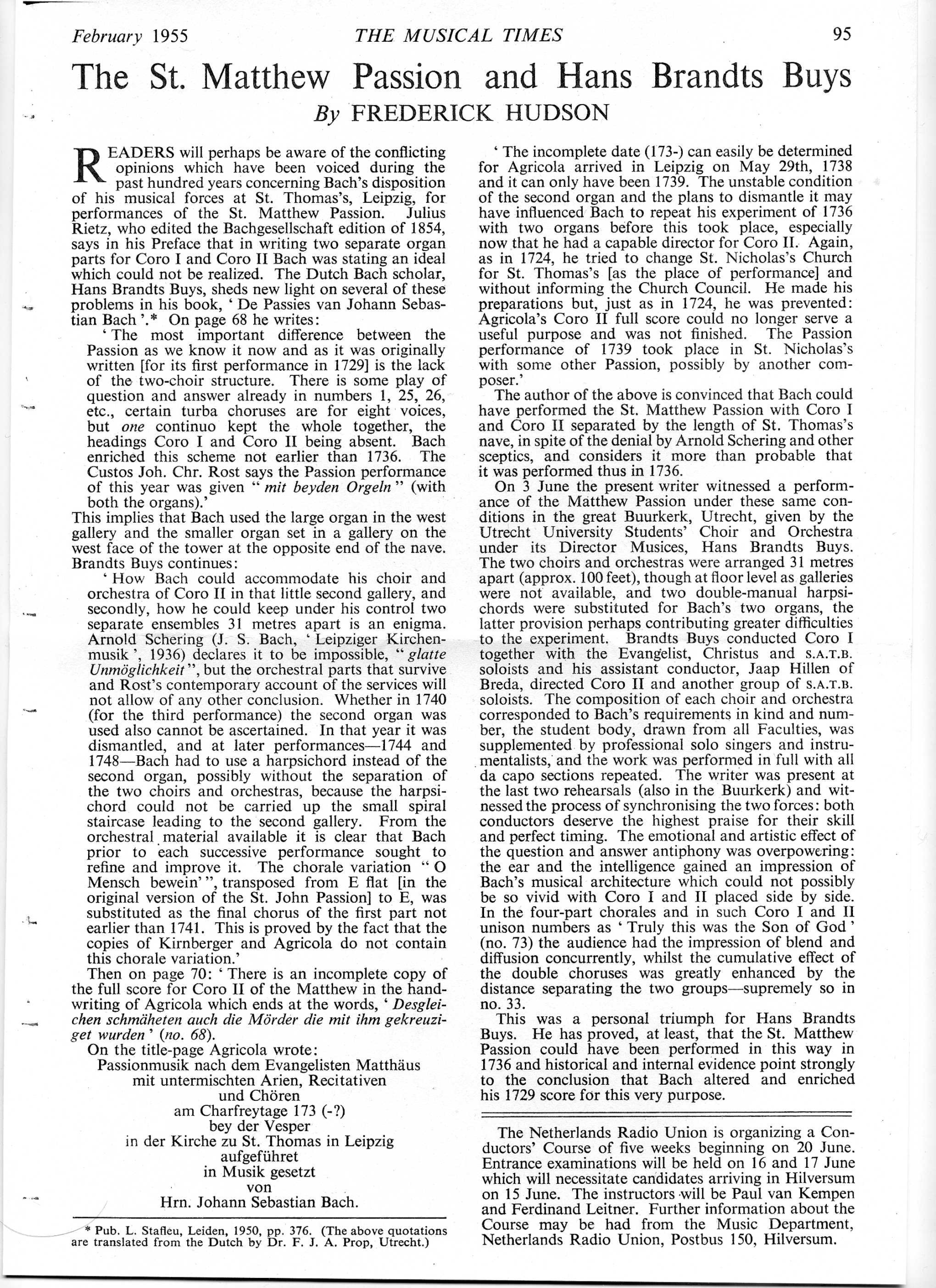
Hans Brandt Buys did it – already in 1955
With thanks to Eduard van Hengel, who sang under Hans Brandt Buys himself. The Passion took place in the Buurkerk in Utrecht, and even reached The Musical Times. The objection raised at the time – you will never cram those musicians into that small gallery by the swallow’s nest organ – still holds, even if one singer per part was enough for Bach. So the whole musical group of ‘Chor II’ that had to fit into that small space consisted of 4 singers, 3 violinists, 2 flautists, 2 oboists, 1 cello and 1 bass instrument: thirteen, plus the organist.
Today Konrad Küster (of the Bach-Handbuch) is the chief advocate of this way of performing the work. Resistance to it remains strong, particularly in Germany, where the choral tradition is so entrenched that even the researchers of the Bach-Archiv cannot get smaller-scale, more dynamic performances accepted.
2. Number of musicians
A related and crucial difference from later performing practice is that there was probably no more than one singer per part in each choir, though in Choir 1 some of the vocal parts may have been doubled (ripienists). The soprano ripienist of Choir I is indicated in the score to sing O Lamm Gottes in the opening chorus (and later O Mensch, bewein). So the singers SATB of Choir 1 and SATB of Choir 2 also sang all the arias. The Evangelist belongs to Choir 1, and therefore also sang the tenor line in the choruses of Choir 1, and the arias – as his own part-book shows.
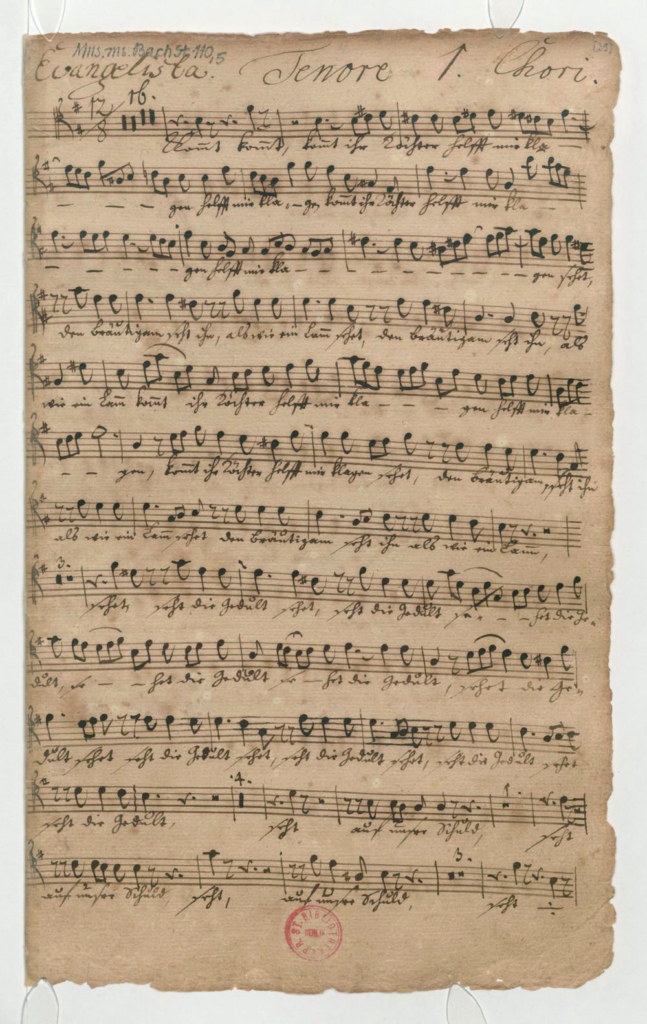
The bass of Choir 1 sings the bass lines of Choir I, the arias of Choir I, and the role of Jesus. As said: simply take the original part-book (bassus chori I) and you will see exactly those notes, with the role scribbled in between. He does get a rest when the bass of Choir 2 has his turn, for Gerne will ich mich bequemen.
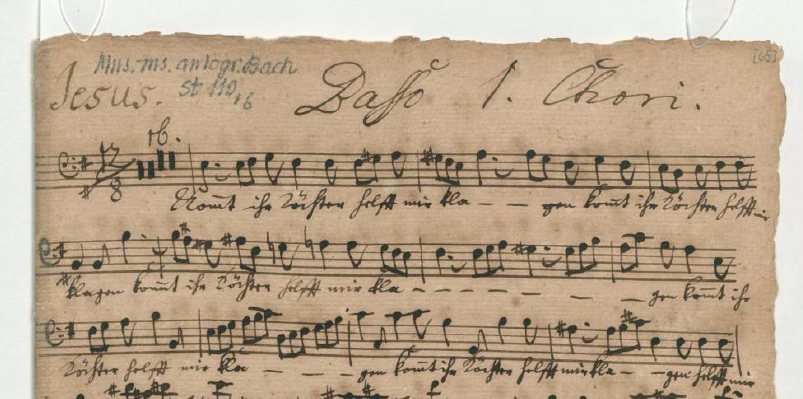
Choir 2 has a clear role in the dialogue movements: it functions as the answering party. Its tenor and alto also take the parts of the two false witnesses. That must have sounded striking in 1736 – two figures from the gospel narrative suddenly cutting in from the other side.
As mentioned, besides the ordinary parts there is a soprano in ripieno, who sings only the opening chorus and the closing chorus of Part One, O Mensch, bewein dein Sünde gross. (Note that the first version has no closing chorus in Part One, only a four-part chorale.) This soprano (boy) had a single sheet of music paper with the notes on it. That sheet has survived as well.
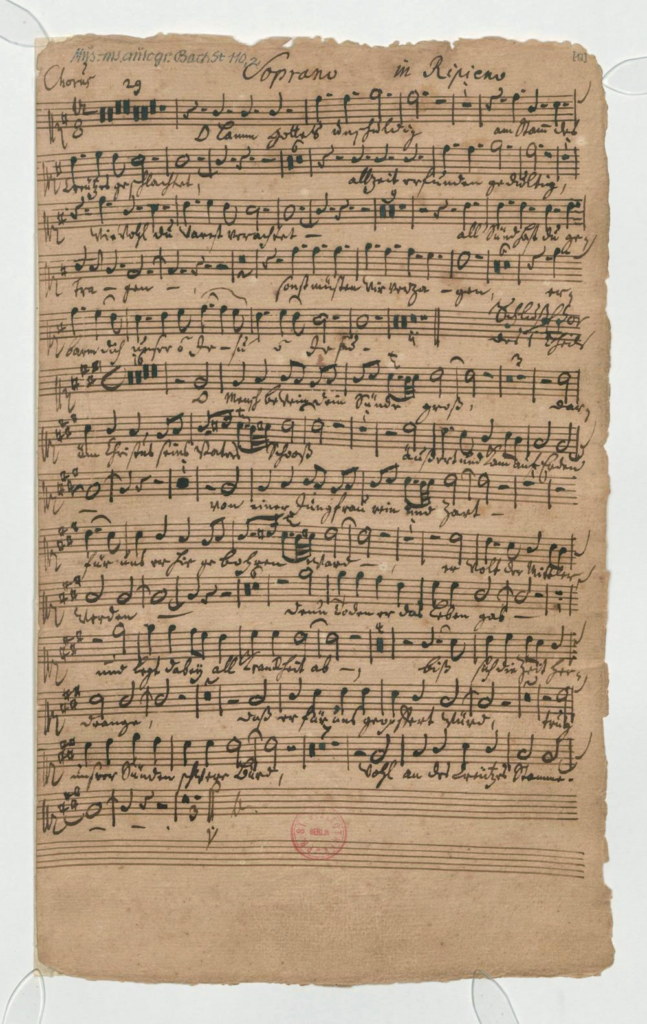
In this manner of performance the tenor in particular has a great deal to sing – an argument for not singing the recitatives too heavily, or he will never reach the end. Only the tenor recitative and aria “Geduld, Geduld!” are sung by another tenor, from Choir II (in the swallow’s nest?). The other male roles for bass (the high priest and priests, Judas, Pilate, Peter) are on a separate sheet and appear to have been assigned to two different basses. It would not surprise me if these contributions were supplied by instrumentalists; they are truly minimal. (Picture it: “I still need a bass, for Peter, and a soprano for Pilate’s wife…”) And perhaps there were also guests, acquaintances or town musicians who joined in. It does not much matter. What matters is this:
- There is no large choir of the kind we know. That is an anachronism.
- There is no ‘theatre’ or ‘opera’ aspect to the casting.
- All the written parts, vocal and instrumental, are in principle of equal standing.
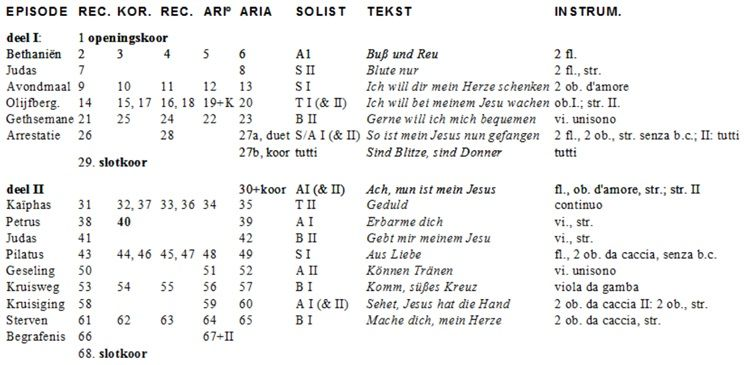
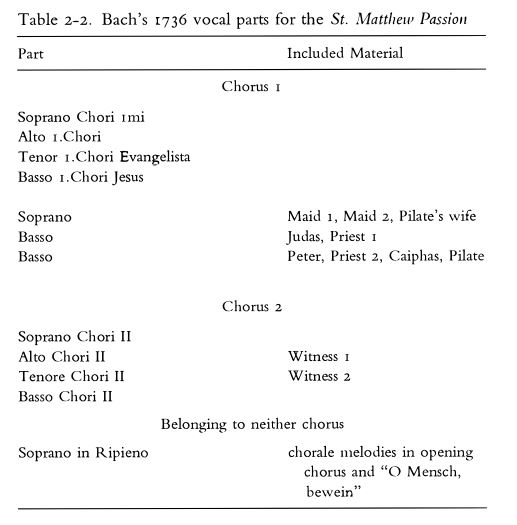
Below is a schematic overview of how the parts (and roles) are distributed according to the surviving part-books. What stands out is that only the canon of the false witnesses falls to the second choir (alto and tenor). Adding it all up gives twelve vocal parts and eighteen instrumental ones: thirty people. That is the minimum with which the whole can be performed, and it puts you close to the original forces. Sigiswald Kuijken uses eleven singers (the ripienist also takes the short solos) and twenty-three instrumentalists: thirty-four people. And it sounds marvellously clear and transparent, and full at the same time.
Parts in the St Matthew Passion
3. Not an oratorio
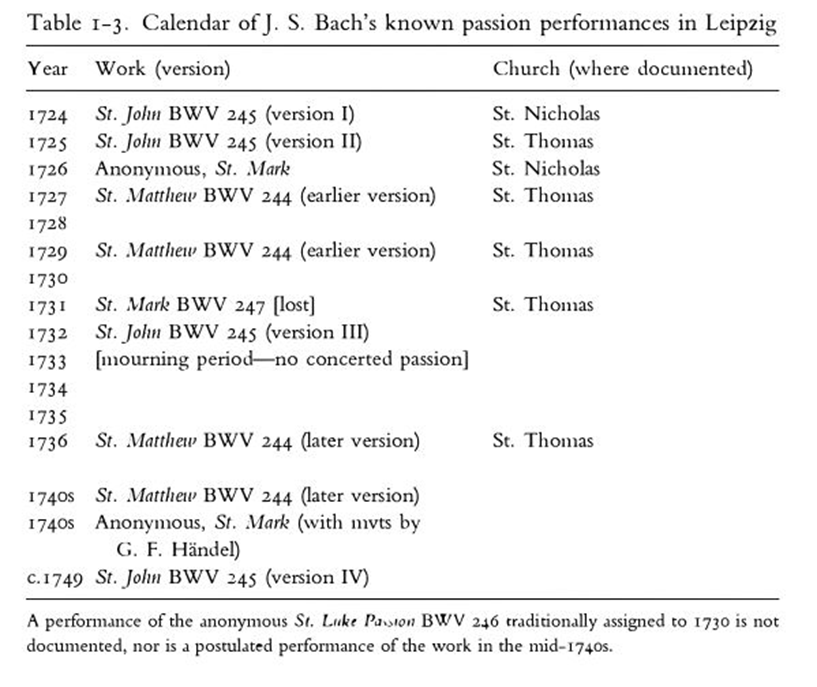
Bach’s Passions were not conceived as religious opera (dramma in musica). Such works existed, but for those you had to be in Hamburg, where the Brockes Passion was regularly performed from the beginning of the eighteenth century, in settings by Keiser, Handel and Telemann. That, however, happened quite explicitly outside the liturgy of the church. These were public ‘performances’, like Buxtehude’s Abendmusiken, organised by the Hamburg opera house. Concerts, in other words. Anyone leafing through that libretto sees the differences from the church Passions at once. In the Brockes Passion the roles are genuine roles: persons, characters. The narrative text is a paraphrase of the gospel in which the poet has allowed himself considerable liberties to heighten the effect. The libretto of the St John Passion shows some similarities with this Passion oratorio, and even borrows from it. To my mind that also explains the unevenness of the St John Passion: the baroque free movements throw the whole out of balance – Fremdkörper, I find. Bach kept tinkering with it throughout his life, up to a year before his death. He was evidently never as satisfied with it as with his second, great Passion: the St Matthew. To us that work seems very baroque, but it was in fact sober. Only some of the dialogues, Sind Blitze among them, betray the influence of the Hamburg oratorio tradition – particularly the figure of Zion, who converses with the Daughter of Jerusalem, and who in the Brockes Passion is a fully developed theatrical lead. Bach must have been content with the result of his setting of the Passion according to Matthew. In 1736 he wrote out the complete score fair, in two colours, and he cherished that copy – he repaired it, too. Here is what we know about the various performances.
Dates and places of performance
Further reading
Analyses and musical examples for individual passages from the St Matthew Passion:
- Erbarme dich – the women around Jesus
- The opening chorus – who is the daughter of Zion?
- Am Abend da es kühle war – the stillness after the deposition
- Sehet, Jesus hat die Hand – the raising of the cross as a blessing embrace
- O Haupt voll Blut und Wunden – the chorale of the Passion (in Dutch)
- On the bleeding heart and the flowing tears – from a sermon by Heinrich Müller
Finally, a livelier version of the same drawing, from De Volkskrant, accompanying an interview with the author of the book mentioned above, Rens Bijma. What you have to supply in your imagination is the invisible organist at the main organ, who played the basso continuo far more robustly than today’s chamber organs do – probably even with a sixteen-foot stop. He is in contact with Bach’s assistant, the time-beater, who really ought to stand a little further back, half behind the Rückpositiv of the organ. See the drawing above, the source of this free sketch.