Good Friday, Leipzig 1724
The first performance of the St John Passion – a reconstruction of that afternoon.
Friday 7 April 1724, a quarter to two
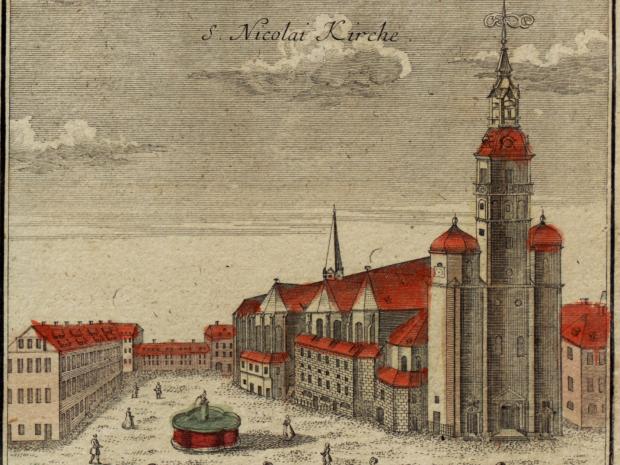
The bells of the town churches begin to ring – softly at first, then in full, until they can be heard across the market square and through the whole city. Yes, I know: that is too early, since Easter has not come yet. But Leipzig still had a bone to pick with Rome and no wish to wait for Rome’s bells. They simply rang when the time was ripe – to call people to Vespers on Karfreitag, Good Friday. That year the principal service was held for the first time in the Nikolaikirche; before that it had always been at the Thomaskirche. From then on the musically elaborate celebration alternated between the two churches.1
How the Passion used to be sung
Until 1720 the Passion narrative was sung on Good Friday by the boys of the Thomasschule, but far more simply. At the Thomaskirche it was a through-composed setting from Luther’s day, by Johann Walter: a reciting tone for the Evangelist and the other dramatis personae, and simple polyphony for the turbae, the crowd and the disciples. At the Nikolaikirche the people themselves sang the Passion narrative in the form of a Passion hymn, a song in which all the events and dialogues of the story are worked out stanza by stanza. Often it was sung in alternation – understandably, given the length. Two examples: the well-known O Mensch, bewein dein Sünde gross (Sebald Heyden, 1525), which runs to 23 stanzas; and Jesu Leiden, Pein und Tod (Paul Stockmann, 1623), which has 34.
In 1721, however, the progressive faction in the Leipzig council – which decided such matters – got its way, and ‘modern Passions’ were allowed in the town churches from then on. The complete gospel text still had to be retained, but it could now be supplemented with free texts: recitatives, arias, choruses and chorales. Johann Kuhnau, then cantor, had probably been waiting for this, since the New Church (the university church) had been doing it for years and the congregation had begun to vote with its feet. So in 1721 his St Mark Passion was heard at the Thomaskirche. Kuhnau died the following year, and in June 1723 J. S. Bach was appointed his successor. Good Friday 1724 was thus the first time Bach would present a fully composed Passion, after the music-free weeks of Lent. It became the St John Passion – the first version; Bach went on tinkering with it until the year before his death in 1749.
ASIDE: nobody had told Bach that the venue had changed to the Nikolaikirche. He had prepared for a performance at the Thomaskirche and had already had the libretto printed. When the council was alerted to this they asked him to change the venue at once. But it was already 3 April. Bach protested: too late – four days’ notice – and there were practical problems. The harpsichord at the Nikolai was broken, and there was too little room on the choir gallery. Together with the sextons and the churchwarden the difficulties were resolved, and an announcement in the local paper made the correct venue known. So the performance at the Nikolai could go ahead on 7 April after all. (the original documents are here)
For Bach the composition had been something of a search, not least because the texts for the recitatives, arias and choruses were not simply there for the taking. He probably assembled the libretto himself – cobbled it together, one might say: a stanza from a poem by Christian Weise (Ach, mein Sinn), another by Christian Heinrich Postel (Es ist vollbracht), some arias from the Brockes Passion,2 and a few more texts here and there by poets unknown to us. And, above all, a great many chorale texts.
The service begins
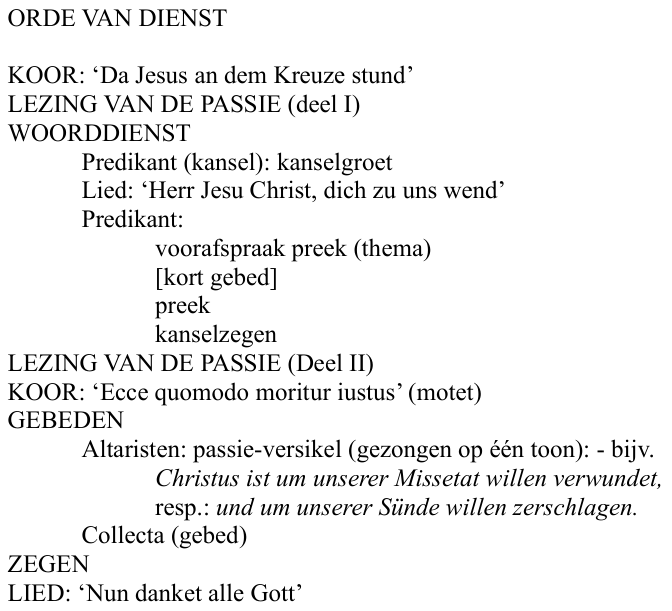
When the bells have finished, towards two o’clock, and the church has filled, the organ begins to play. Those present already know which hymn it will be; it has been the same for years: Da Jesus an dem Kreuze stund. In it the poet treats the seven words from the cross, after an introductory stanza, and ends by urging the hearer to ponder these words of Christ attentively. After an intonation, or a chorale prelude, the singers of the Thomas choir sing all nine stanzas.
After the last stanza the organ plays on for a while, and meanwhile those present can hear the strings being tuned at the back of the church, on the special Schülerchor – the gallery where all the singers and instrumentalists had to stand. A dark spot, but the vaulted ceiling gave excellent projection. Beside the organ, on the left of the picture, there was hardly any room at all.
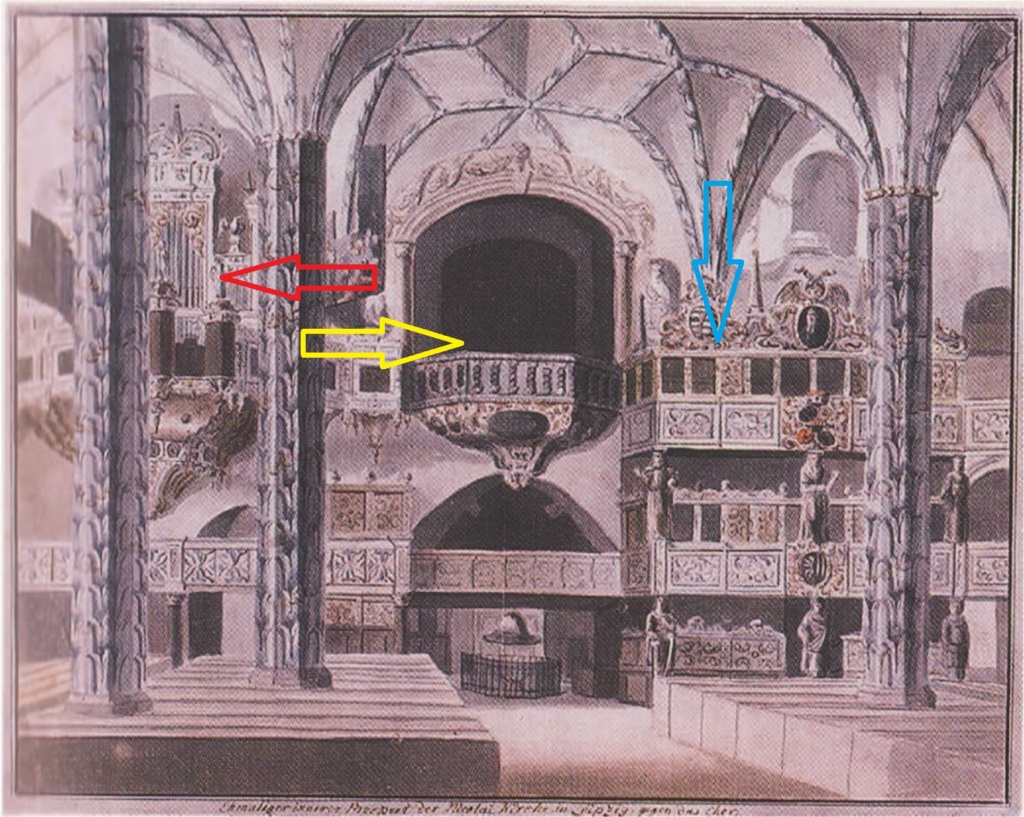
When the organ falls silent the strings begin to stir, the oboes sound, and it rings through the church: Herr… – Herr, unser Herrscher. Psalm 8, fused with elements of the classical collect for Good Friday. The Passion has begun. And when Part One is over there is no interval; it is the preacher’s turn. As he makes his way to the pulpit, half way down the nave, the organ preludes on the pulpit hymn Herr Jesu Christ, dich zu uns wend – a prayer voicing the expectation that God himself will speak through the words of a man: the living Word.
The best-loved hymns are the ones that say nothing new (‘νέος’) but give the old a fresh validity (‘καινός’). The language is biblical throughout.
Herr Jesu Christ, dich zu uns wend,
dein’ Heilgen Geist du zu uns send;
mit Hilf und Gnad er uns regier
und uns den Weg zur Wahrheit führ.
Tu auf den Mund zum Lobe dein,
bereit das Herz zur Andacht fein,
den Glauben mehr, stärk den Verstand,
dass uns dein Nam werd wohlbekannt,
bis wir singen mit Gottes Heer:
„Heilig, heilig ist Gott der Herr!“
und schauen dich von Angesicht
in ewger Freud und selgem Licht.
‘Turn your face towards us…’ (Psalm 25)
‘When the Spirit of truth comes, he will guide you into all the truth.’ (John 16)
‘Open my lips to your praise…’ (Psalm 51)
Luke 8:15 (seed on good ground)
Luke 17:5 (faith like a mustard seed)
Revelation 4:8 takes up Isaiah 6 (the Sanctus)
in adoration of the Lamb of God.
Revelation 22:4 (the new Jerusalem)
Isaiah 35:10
The sermon
After this hymn it goes quiet. From the pulpit the minister of the day – in this case Archdeacon Friedrich Wilhelm Schütz – pronounces the pulpit greeting. He then sets out briefly which elements of the Passion narrative he will be treating in his homily, and closes with a short prayer. For the next hour he will go through the announced points one by one, explaining and deepening them. He will look for meaning, for connections running through the whole of Scripture. He will offer familiar perspectives and, he hopes, some new ones. And above all he will draw the gospel – the good news – out of the Passion narrative and lay it on his hearers’ hearts; press it upon them, even. For this story has the power to change a life. When he has discharged his office and finished the sermon, he descends from the pulpit and returns to his place in the chancel.
Part Two, and the burial
Part Two of the Passion begins: the high point, even though in human terms it is the lowest – the crucifixion, the death of the Anointed. Es ist vollbracht rhymes with Der Held aus Juda siegt mit Macht, which is characteristic of the way the evangelist John describes the crucifixion, that is, interprets it: not as a downfall but as the reaching of a destination. Then comes the burial. The body, worn out with struggle, is laid to rest in an earthly grave – but the soul of the believer may now hope for an undreamt-of flight upward:
Ah Lord, let your dear angel
at my last hour carry my soul
to Abraham’s bosom;
let my body, in its little sleeping-chamber,
rest wholly at peace, without pain or torment,
until the last day.
Then wake me from death,
that my eyes may see you
in all joy, o Son of God,
my Saviour and my throne of grace!
Lord Jesus Christ, hear me:
I will praise you eternally.
As the last chord dies away it grows silent. Rarely can the faith of those present in the truth of what has been sung have been stronger than at that moment.
After the Passion
But it is not over yet. Suddenly a polyphonic motet in four parts descends upon the hearers: Ecce quomodo moritur iustus… See how the righteous man dies, and leaves us his peace: et in pace erit memoria eius.
When the last sounds have died away the minister rises again and goes to the altar. Two altarists – assistants – sing the Passion versicles on a single note. The text is taken from Isaiah 53, for instance:
The chastisement of our peace was upon him,
and with his stripes we are healed.
The priest then says the classical oratio collecta, a prayer that sums up the soul of the celebration and helps the congregation to begin taking in what it has witnessed. He invites everyone to stand, and the blessing of Aaron rings through the building. The congregation answers, as at every Vespers, with a gratias agimus tibi in the form of a hymn: Nun danket alle Gott.
By now evening has come; Good Friday is over. The people go home. On Saturday evening they will return to church, to greet the light of Christ.
Holy Week 2025, Dick Wursten
SOURCE: this reconstruction is based on the notes of the sexton of the Thomaskirche, Johann Christoph Rost. The original text, with an English translation and commentary, is here.
Postscript: the gallery
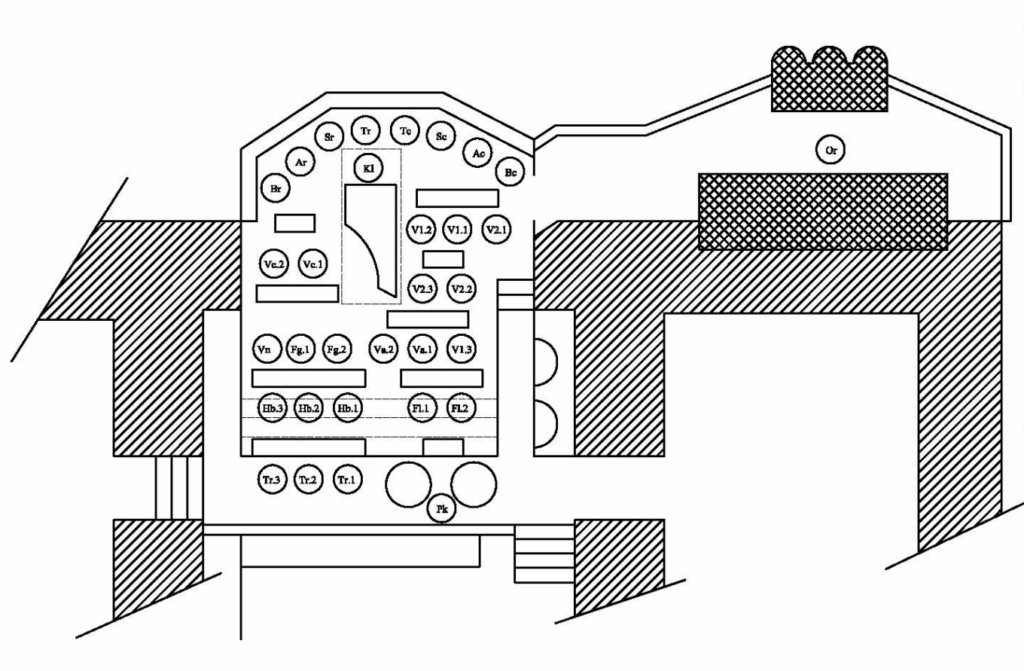
Rens Bijma has written a doctoral thesis investigating the placing of the musicians and the acoustic properties of the Thomaskirche and the Nikolaikirche as they then were. He also measured the available space. This is his reconstruction for the Nikolaikirche – and it shows at once why Bach complained of a shortage of room. You are looking into the church, so the organ is on the right. Bijma places all the musicians on the Schülerchor.
Postscript: and in 1727, the St Matthew
The St Matthew Passion first appears in church in 1727. By that time Bach had explored practically every musical form in his cycles of cantatas, and he had also come across Christian Henrici – Picander – who as a cantata poet had done excellent work, to measure and to order. In 1727 the two of them probably went through the gospel of Matthew together and set up the ‘scenario’. Working backwards from the result, one can see that Bach wanted not only recitatives and arias at every hinge in the narrative, but dialogue texts as well. That allowed him to draw the ‘daughters of Zion’ into the story – figures from the Song of Songs, the companions of the bride. The idea had been carried much further in Hamburg, in the Brockes Passion, which Telemann also set. The difference from Bach: in the Brockes Passion the gospel text itself is dramatically reworked. In Leipzig in the 1720s that was thought a bridge too far – and I suspect Bach thought so too. Music for two choirs. You know the result: a magnificent overture in which the first choir calls on the second, the daughters of Zion, to help raise the great lament for the Son of Man, who must go his way to the end so that the children of men may have a future.
I have done the same exercise in English with the St Matthew Passion in view: A vesper with Bach’s Passion: how to imagine it? Well, let’s try…
- To be precise: there was a Vespers in the other church too, but there the Passion was sung choraliter, without a Hauptmusik.↩
- The Passion oratorio Der für die Sünde der Welt gemarterte und sterbende Jesus by the Hamburg councillor Barthold Heinrich Brockes (1712), set by Handel, Telemann and Reinhard Keiser among others. It consists entirely of free texts; even the gospel narrative is retold in rhyme, with dramatic effects, and it has no fewer than thirty arias. Thoroughly baroque: large emotions.↩