A vesper with Bach’s Passion: how to imagine it?
Well, let’s try. The premieres: the St John Passion in 1724, the St Matthew Passion in 1727.
A reconstruction of the Good Friday Vespers in Leipzig as Bach’s congregation would have experienced it. A companion piece to Good Friday 1724, which follows the same afternoon in more detail, with the St John Passion in the Nikolaikirche.
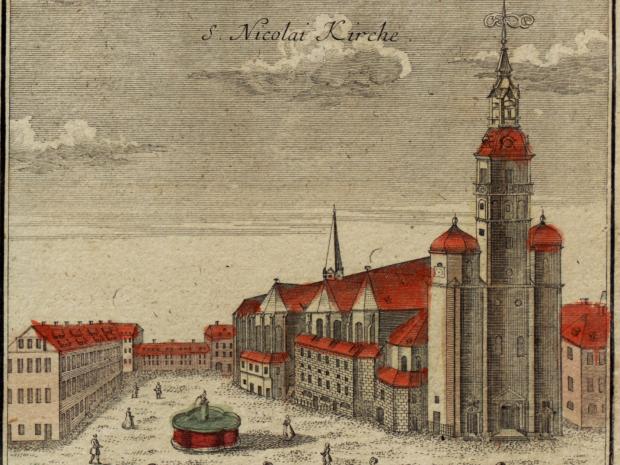
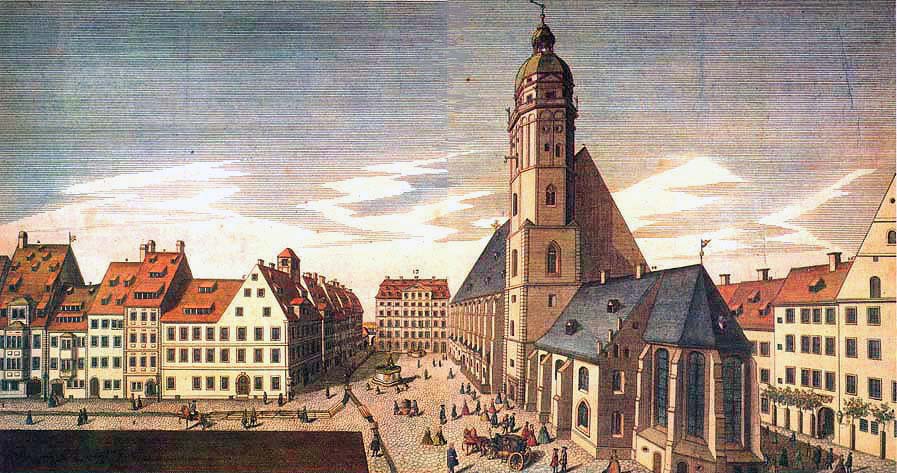
Leipzig, Good Friday
At a quarter to two the bells of the town churches begin to toll: the citizens of Leipzig are called to gather for Vespers. Around two o’clock the organ takes over and intones the chorale Da Jesus an dem Kreuze stund (‘when Jesus stood upon the cross’).
All the stanzas are sung, the first and the last inviting the congregation to muse upon the wounds and the words of the Man of Sorrows. That is exactly what they are about to do – assisted by the power of music.
As they close their hymnals, the Hauptmusik begins. All the musicians and singers are placed at the rear, the west end of the church: on the organ loft at St Thomas, and in the schoolboys’ loft at St Nicholas – the yellow arrow below; the red one points to the organ.
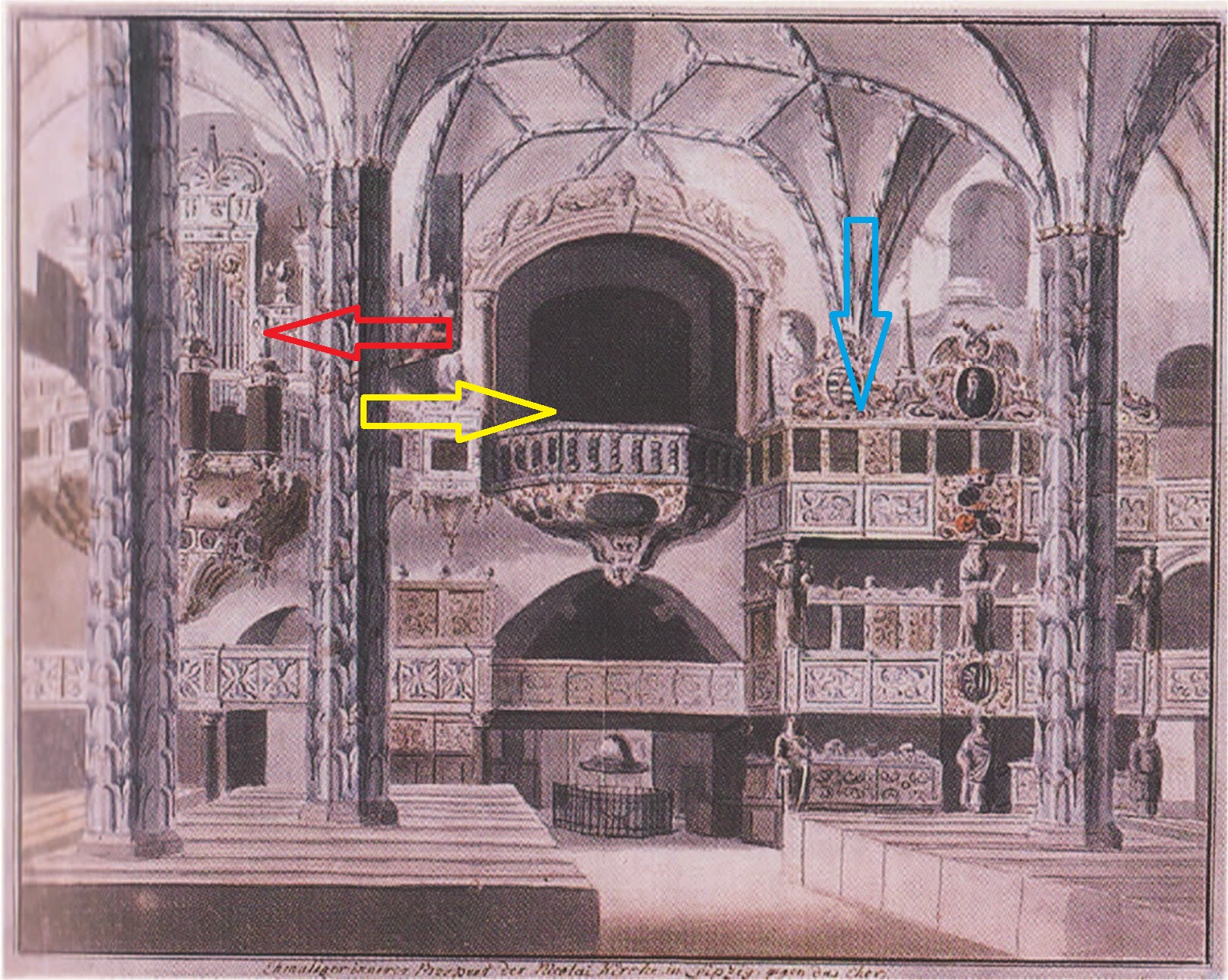
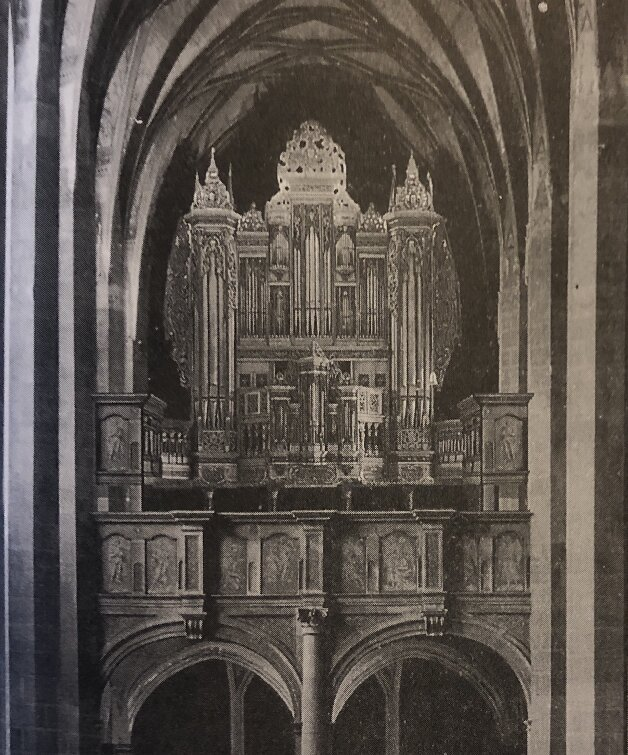
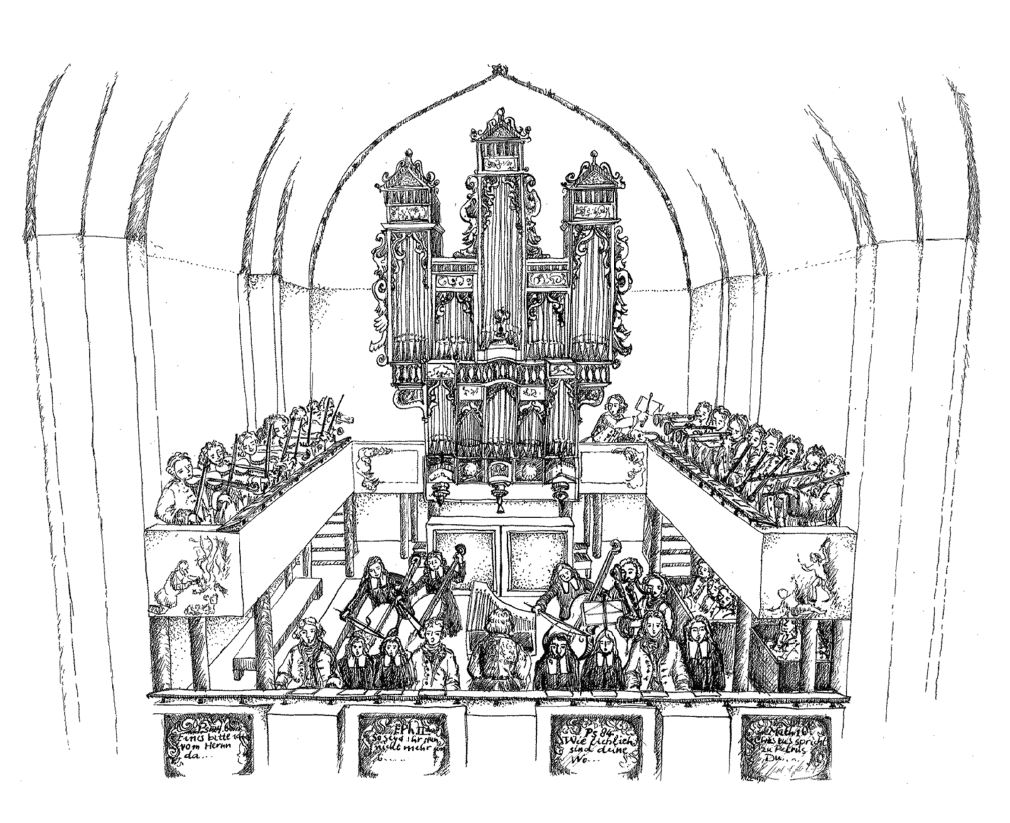
It must have taken them by surprise, in 1724, with Bach’s first offering – the St John Passion: Herr, unser Herrscher. And in 1727, entirely different in atmosphere but equally breathtaking, the instrumental lamento (feel the heartbeat) that opens the St Matthew Passion: Kommt, ihr Töchter, helft mir klagen (‘come, ye daughters, help me mourn’), followed by the dramatic dialogue – Sehet! ‘Wen?’ ‘Den Bräutigam…’ – and then, rising from primeval depths, far above the musical flood, a soprano in ripieno (no boys’ choir) begins to sing the familiar hymn O Lamm Gottes, unschuldig.1
That opening chorus lasts nearly ten minutes. It heralds the gospel narrative, in which recitatives alternate with crowd choruses, chorales and arias. The first part concludes with the elaborated chorale O Mensch, bewein dein Sünde gross – inserted only in the 1736 version, having been plucked from the St John Passion. In the earlier versions a simple four-part chorale closed the first half: Jesum lass ich nicht von mir (‘I shall not let Jesus go from me’), just as the St John Passion has Petrus, der nicht denkt zurück (‘Peter, who does not think back’).
And then: silence.
The sermon, and the second part
After a brief pause the great organ begins once more, playing the pulpit hymn Herr Jesu Christ, dich zu uns wend. The assembly then sings the first stanza.
Herr Jesu Christ, dich zu uns wend,
dein’ Heilgen Geist du zu uns send;
mit Hilf und Gnad er uns regier
und uns den Weg zur Wahrheit führ.
Lord Jesus Christ, be present now,
our hearts in true devotion bow,
your Spirit send with grace divine,
and let your truth within us shine.
tr. Catherine Winkworth
Meanwhile the minister walks to the pulpit and ascends it. For many of those present this is the heart of the service: the sermon, often lasting an hour. Here the Passion narrative is turned into meditation – reflections on one’s own life, on suffering, and on the redemptive power of Christ’s.
After the sermon the music resumes. Recitatives, arias, choruses and chorales follow one another once more, until the story reaches the garden of Joseph of Arimathea, where the tomb is sealed. The St Matthew Passion ends with the final chorus Wir setzen uns mit Tränen nieder (‘we sit down in tears’), closing with the words sanfte Ruh – gentle rest. In the St John Passion angelic voices carry the soul to paradise: Ach Herr, lass dein lieb Engelein. Those who have listened, attuned in breath and spirit, will have undergone catharsis.
After the Passion
But Vespers are not yet over.
The finest singers rise again to perform the motet Ecce quomodo moritur justus – probably by Jacob Handl (Gallus), though the source does not say so explicitly. This ancient part of the Vespers liturgy, a responsory set in rich polyphony, deepens the emotional resonance stirred by the baroque music. It evokes the image of how the just man – the tsaddiq – dies: on earth no one takes notice, but in heaven he is received in peace.
Good Friday 2025, Dick Wursten
The source: Rost’s description
All the information about the order of the Good Friday Vespers rests on a single source: the description by a sexton (custos) of the Thomaskirche, Johann Christoph Rost. For completeness, the original text (no. 180 in Bach-Dokumente II). It refers to 1721, the first performance of Kuhnau’s Passion, but the sexton says explicitly that the same order was repeated in the following years – he writes Item. The reference to the chorale O Lamm Gottes unschuldig at the end of the first half of the Passion does not, in my reading, necessarily mean a hymn sung by the congregation; it may equally refer to the closing chorale of Part One of Kuhnau’s Passion, whose text and score are lost. More on Rost’s notes here.
Aö. 1721. ward am CharFreytag in der vesper, die Passion zum 1sten mahl Musiciret, np. I. Viertel auf 2. wurde gelautet mit dem gantzen gelaute, als ausgelautet, wurd auf dem Chor, das Lied gesungen Da Jesus an den Creütze stund etc, dann ging gleich die Musicirte Passion an, und ward vor der Predigt halb gesungen, diese Helffte schloße sich mit dem verß, ô Lamb Gottes unschuldig, damit ging der Prister auf die Cantzel. auf der Cantzel ward a[uch] Herr Jesu Christ dich zu uns wend gesungen. Nach der Predigt dann ging die andere Helffte der Music an, als solche aus, ward die Motete Ecce quomodo moritur justus etc gesungen, alsdenn der Passions verß intoniret u. Colle[c]te gesprochen. alsdenn Nun dancket alle Gott gesungen.
A popular misconception
In 2002 – reprinted in 2023, and now open access – Denis Laborde attempted a similar exercise, but his sketch is wanting, because it is not grounded in sound historical scholarship. Since it is widely read and reproduces popular misconceptions, a few remarks.
- Contrary to what he suggests, no orchestra or singers were placed near the altar. All of them were on the organ loft. (He is writing about the St Matthew Passion.)
- The congregation did not join in singing the chorales during a cantata, oratorio or Passion. When there was no musicierte Passion, the congregation sang hymns.
- His much-quoted sentence – “In the clamor of the two orchestras playing at both ends of the nave, in the chaos of the two choirs responding to each other in waves of dissonances, while in the center the congregation struck up their Lutheran chorales…” – is ludicrous.
- The motet Ecce quomodo moritur (Gallus) was sung after the Passion, but by the choir, not by the congregation.
- His inventio – which is also his conclusio, so caveat – that this performance provoked a clash with Bach’s superiors over the ‘operatic’ character of church music is widespread but not founded in fact. Verify your references.
Denis Laborde, ‘The unbearable sound: the strange career of musicoclashes’, in Iconoclash. Beyond the image wars (Cambridge, Mass.: MIT Press, 2002), pp. 253-280.
Gerber, 1732: ‘as if one were at an opera’
The source behind that story is a book on liturgical practice in Saxony by Christian Gerber. Here is the original passage.
Als in einer vornehmen Stadt diese Paßions-Music mit 12 Violinen, vielen Hautbois [Oboen], Fagots und anderen Instrumenten mehr, zum erstenmal gemacht ward, erstaunten viele Leute darüber und wußten nicht, was sie daraus machen sollten. Auf einer Adelichen Kirch-Stube [Empore] waren viele Hohe Ministri und Adeliche Damen beysammen, die das erste Passions-Lied aus ihren Büchern mit großer Devotion sungen: Als nun diese theatralische Music angieng, so geriethen alle diese Personen in die größte Verwunderung, sahen einander an und sagten: Was soll daraus werden? Eine alte Adeliche Wittwe sagte: „Behüte Gott, ihr Kinder! Ist es doch, als ob man in einer Opera-Komödie wäre.“ – Aber alle hatten ein Mißfallen daran und führten gerechte Klage darüber.
Christian Gerber, Historie der Kirchen-Ceremonien in Sachsen (1732).
Gerber is a Pietist and indeed a critic of concerted music in church. But the passage does not explicitly refer to Bach in Leipzig – or not to Bach alone; the tenor is a general criticism. A further caveat: Gerber refers to the first time a concerted Passion was performed. In Leipzig that was in 1717 (Telemann’s Brockes Passion, at the New Church) and in 1721 at the Thomaskirche (Kuhnau’s St Mark Passion). Bach’s first is not until 1724, with the St John Passion. That said, the description itself fits the opening of the St John Passion well: violins and oboes suddenly filling the church from the organ loft, in place of the sober recitation of the gospel by the dean near the altar or from the pulpit that the congregation would have expected, or the alternating singing of a Passion hymn.
- In 1736 Bach placed the entire second choir on the small mid-church gallery with its organ. This can be inferred from a note by the sexton: in 1736, ‘mit beyden orgeln’ – embedding the listeners in the story, surround sound. Note that this implies that a number of arias were sung from there as well, and that the dialogues must have been breathtaking.↩