Bach on Exodus and Leviticus (Calov) – marked texts
In the book of Exodus there are several interesting markings. The most prominent are the famous annotation on Exodus 15:20 (Miriam’s musical response to Moses’ song, which Bach marks with a reflection on “bi-choral music”) and his keen interest in the twelve gemstones of the High Priest’s breastplate. Also notable is Bach’s careful calculation of the sum of the people’s offerings for the construction of the sanctuary. But there is more to discover. Enjoy!
Exodus – 2 Mose
We’re still in Calov volume I, book 1
Some corrections
Column
428 [should be 426] (fac. 37).
Ex. 5: 20 v. 33 [actually v. 23-Editor] For
since I came to Pharaoh [Bach
inserts “mit ihm zu reden in Deinem Nahmen” (to speak with him
in Your name)] he has tormented the people more
severely and You have not delivered Your people. (There
has not appeared even the slightest sign of a beginning of
deliverance.)
Column
427 (fac. 38).
Ex. 6: 3 (… The Patriarchs certainly recognized God, but such a
sermon of fered openly for the community had at that time not yet
been introduced by God, as [Bach inserts
“worden” to change the following verb to perfect tense]
has occurred through Moses and Christ.)
Column
436 (fac. 39).
Ex. 7: 23 v. 23 And Pharoah turned away
(from Moses and Aaron) and went into his house and
did [Bach inserts
“nicht” (not)] take it to heart…
Annotation on music: ‘Erstes Vorspiel…’
Columns 482-483 (fac. 40).
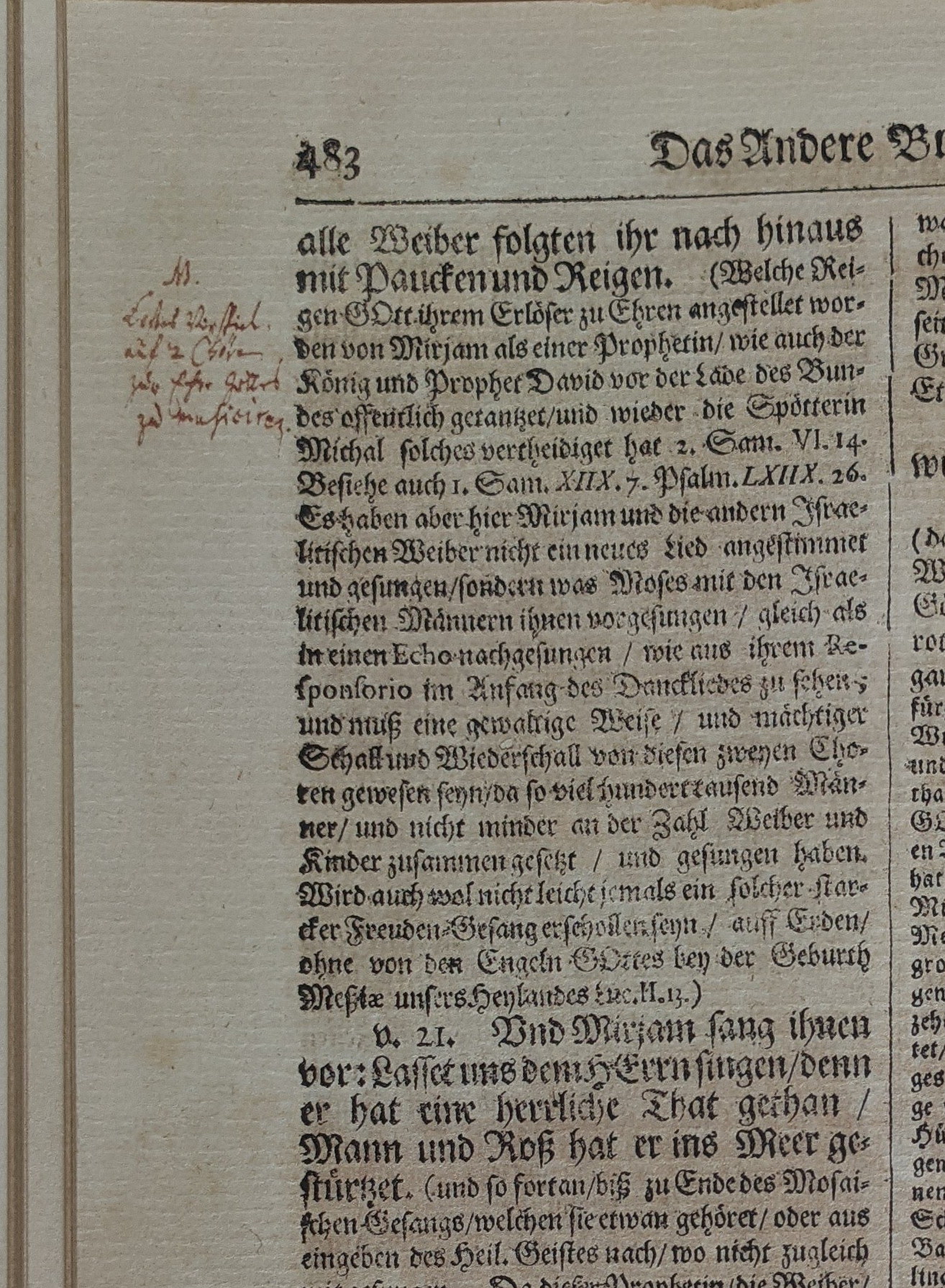
Ex. 15:20
v. 20 Und Mirjam die Prophetin
(sie wird eine Prophetin genennet / weil sie auch mit dem
Heil. Geist erfüllet worden / wie dieser Gesang auszweiset )
Aarons Schwester (…) nam eine Paucken in ihre
Hand / und alle Weiber folgten ihr nach hinaus miet Paucken un
Reigen. (Welche Reigen Gott ihrem Erlöser zu Ehren
angestellet worden von Mirjam als einer Prophetin / wie auch der
König und Prophet David vor der Lade des Bundes offentlich getantzet
/ und wieder die Spötterin Michal solches vertheidigtet hat. [….] Es
haben aber hier Mirjam und die andern Israelitischen Weiber nicht
ein neues Lied angestimmet und gesungen / sondern was Moses mit den
Israelitischen Männern ihnen vorgesungen / gleich als in einen Echo
nachgesungen I wie aus ihrem Responsorio im Anfang
des Danckliedes zu sehen; und muß eine gewaltige Weise I und
mächtiger Schall und Wiederschall von diesen zweyen Choren gewesen
seyn I da so viel hunderttausend Männer I und nicht minder an der
Zahl /Weiber und Kinder zusammengesetzt I und gesungen haben. Wird
auch wol nicht leicht jemals ein solcher starcker Freuden-Gesang
erschollen seyn I auff Erden I ohne von den Engeln Gottes bey der
Geburth Meßiae unsers Heylandes Luc. II. I3.)
v. 21 Und Mirjam sang ihnen vor: Lasset uns dem Herrn
singen / denn er hat eine herrliche That getahn / Mann und Ross
hat er ins Meer gestürzet (Und so fortan / biss zu
Ende des Mosaischen Gesangs / welchen sie etwan gehöret / oder aus
eingebed des Heil. Geistes nach / wo nicht zugleich mit gesungen. Da
dieser Prophetin / die Weiber / wie Mose ihrem Bruder dem Manne
Gottes und Herzogen des Volckes die Männer nach gesungen haben.)
v. 20 and Miriam the prophetess (she is called a prophetess because she was also filled with the Holy Spirit, as this hymn shows) Aaron’s sister (She is not called Moses’s sister but rather Aaron’s sister because Aaron was the older brother) took a timbrel in her hand and all the women went out after her with timbrels and dancing.* (These dances which God brought about through Miriam the prophetess in honor of their savior, just as David the king and prophet danced publicly before the ark of the covenant and, against the woman of mockery, Michal, defended such practices. […] But here Miriam and the other Israelite women did not start singing a new song, but rather sang along to what Moses and the Israelite men had sung, as if in an echo. This can be seen from their responsory at the beginning of the hymn of praise. ; and it must have been a mighty melody and mighty sound and echoing response from these two choirs, I with so many hundreds of thousands of men I and no fewer in number / women and children together I and singing. It is unlikely that such a powerful song of joy has ever been heard on earth, not counting the angels of God at the birth of the Messiah of our salvation.)
*Bach writes in the margin with red ink “NB. Erstes Vorspiel auf 2 Chören zur Ehre Gottes zu musiciren” (NB. First prelude (or first example of a piece of music) to be performed with two choirs to the honor of God).
Erstes
Vorspiel can be interpreted in different ways:
First
example (Vorspiel/Vorbild/Fürbild – as one of the terms
that designate the ‘typos’ within Calov’s typological
hermeneutics. Cf. the three other annotations
on music in I/II Chronicles;
First
prelude‘ or ‘first antiphone’. This interpretation is
enhanced if one continues reading the Calov/Luther commentary:
‘Echo’, ‘responsorium’. Exegetical difficulty: Miriam’s short
verse is in no way a Prae-ludium, vor-spiel, because
Moses has already sung the hymn. It’s a post-ludium, or
‘answer’ All options have been suggested since 1969 (first
publication by Trautmann). Linking it to the motet ‘Singet den
Herrn‘ has also been proposed, suggesting this is the
‘inventio’. Quite unlikely. H-J. Schulze dates the entry ‘after
1740’. Bach bought the Calov Bible in 1733. The motet is ca. 1727.
First performance is also a
possibility: the word ‘Vor-spiel’ has a resonance in v. 21: ‘Und
Miriam sang ihnen vor. Vor-spielen (cf. Dutch; Iemand
iets voor-spelen) = first performance
of
a multichoral work. Also interesting – but not for Bach, but
perhaps for Calov: discussion about the verb “atan” used here,
meaning not singing but ‘answering’. Luther: ‘sang ihnen vor’,
Hieronymus: ‘praecinebat’; KJV: And Miriam answered (cf. StV:
antwoordde). This also suggests the word ‘responsorium’.
Column 486 (fac.
41).
Ex 15 v. 17 And they came to Elim (that
was the sixth station Numbers XXXIII. 9), where there were
twelve springs of water and seventy palm trees (like the
12 heads of the tribes of Israel and 70 counselors in the Sanhedrin
and the great counsel who were later chosen, and also like the 12
apostles and 70 disciples chosen and sent out by Christ in the New
Testament. Matthew X. Luke X) and they encamped there by
the water.
(I
wonder: Are the numbers triggering Bach to mark
this spot?)
…
Column 491 (fac. 42). Ex. 16 v. 32 [Bach inserts before beginning of passage: “Und Mose sprach” (And Moses spoke)] This is what the Lord has commanded: fill an omer with it to keep for your descendants so that one may see the bread that I fed you with in the wilderness when I led you out of Egypt.
Hypocrisy , falseness
Columns 498-499 (fac.
43).
Ex. 18 v. 21 Look around you among the peoples …
for able … people … who fear God … truly (without
falseness, wicked tricks, hypocrisy, and evil affectations. That
results from the fear of God where one has God before one’s eyes and
relies defiantly on the One above. (original
Deutsch: “pochet und trotzet auff den droben”)Then one
will also become upright and will do with heartfelt desire and
love what is just and will carry it out faithfully. Otherwise
there is the appearance of all sorts of malice and hypocrisy in
the world that one leads people around by the nose, thus twisting
a wax nose onto the just, and before one looks around, good has
been turned into evil and things that are unjust have been made to
be just.)
Column 510 (fac.
44).
Ex. 20: 12 (… But parents must also care for their children, not
just in matters of the body but, most of all, in matters of the
soul, because they [parents] are in God’s position to which they
must do honor. Know also how they [children] should honor their
parents well: therefore a
father shall punish his child like a judge, teach him like a
doctor, preach to him like a pastor or bishop. If a father
does these things he can stand before God; if he does not do them he
will get his just payment from God in due time… .) Inhoudelijke
trigger, of gewoon mooi gezegd? Well said, nicely put)
Column 541 (fac. 45). Ex 25: 10 Of the Ark of the Covenant. v. 10 Make an ark of acacia wood (v. 5 in that respect) two cubits and a half shall be its length, a cubit and a half its breadth, and a cubit and a half its [Bach strikes through “Länge” (length) and writes in “Höhe” (height). ]
Twelve numbered gemstones
Columns 557-558 (fac.
46). Ex. 28: 17-20
[Bach
numbers the 12 gemstones set in the breastplate of the
High priest’s garment (4 rows of 3). He also underlines
their names in the commentary. The entire passage is emphasized
with marginal markings. Modern exegetes confess they don’t always
know with certainty which Hebrew name represents which gemstone.
Calov offers the name, a full description, and the meaning (always
related to Christ’s salvific work). Everything in God’s Word makes
sense – is his deepest conviction; and preaches the one true
gospel. This section is a fine example of how his hermeneutics
works. Bach’s entry and marking (complete section!) is in color
red.]
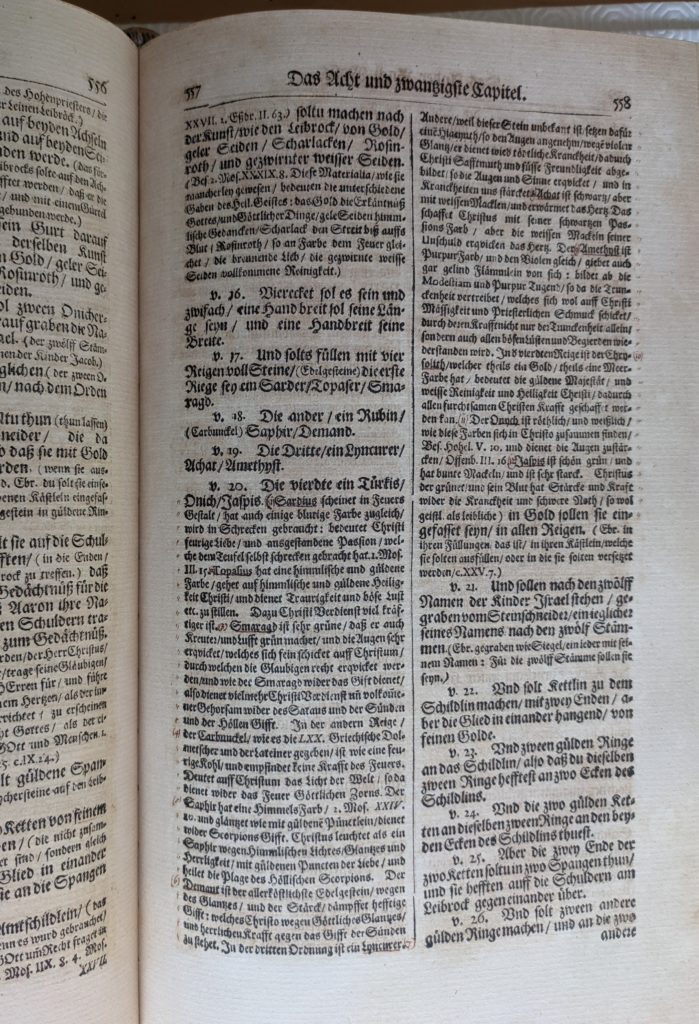
.v.
20 The fourth row a beryl, an onyx, and a jasper
marking
                and underlining in red
([Bach: #1] the
sardius appears in the form of fire with a simultaneous
blood color and is used in [instruments] of fright: it signifies
Christ’s ardent love and His triumphant passion which brought
fright to the devil himself. Genesis Ill. 15. [Bach: #2] Topaz
has a heavenly and golden color, referring to the heavenly and
golden holiness of Christ and serves to mollify sadness and ill
humor, etc. In that Christ’s service is far stronger, [Bach: #3] the
emerald is quite green to make herbs and air green and to
quicken the eyes, which applies nicely to Christ through whom the
faithful are quickened; and just as emerald serves to counteract
poison, so Christ’s service and perfect obedience works to
counteract the poison of Satan, sin, and hell. In the second row
[Bach: #4] the carbuncle, as the Septuagint Greek and the
Latin translators named it, is like a burning coal and is
invulnerable to the power of fire. This signifies Christ, the
light of the world which withstands the fire of God’s wrath.
[Bach: #5] the sapphire has a heavenly color, Exodus XXIV.
10. and glistens with small golden markings and is used against
the scorpion’s poison. Christ shines like a sapphire thanks to
heavenly light, brilliance, and majesty, with golden markings of
love, and He heals the torment of the hellish scorpion. [Bach: #6]
The diamond is the most precious jewel of all because of
its brilliance and power and because it subdues vehement poison:
which to Christ applies through divine brilliance and glorious
power against the poison of sin. In the third row is [Bach: #7] a
jacinth. [German: lyncurer] Others, because this stone is
unknown, set a hyacinth [underlined with dots], pleasing
to the eyes because of its violet brilliance and serving against
deathly illness, by which Christ’s gentleness and sweet
friendliness are represented, quickening the eyes and senses and
strengthening us in illness. [Bach: #8] Agate is black,
but with white markings, and warms the heart. That Christ
accomplishes with the black color of His passion, but the white
markings of His innocence quicken the heart. [Bach: #9) Amethyst
is of purple color, similar to violet, and gives off also a mild
glow of flame: it represents modesty and purple virtue which
overcomes drunkenness and applies to Christ’s moderation and
priestly adornment, through whose power not only drunkenness but
also all evil pleasures and desires are resisted. In the fourth
row is [Bach: #10) the chrysalith which has partially a
color of gold and partially of sea green and which signifies the
golden majesty and white purity and holiness of Christ, by which
Christ’s power can be turned towards all terrified Christians.
[Bach: #11] The onyx is reddish and white, as these colors
combine in Christ, especially Song of Solomon V. 10. and serves to
strengthen the eyes, Revelation III. 16. [Bach: #12] Jasper
is beautifully green with bright markings and is very strong.
Christ makes things green and His blood has strength and power
against sickness and dire peril, both spiritual and physical)
they shall be set in gold in all the rows (Hebrew
in their filling, that is in their appointed settings which they
shall occupy or into which they shall be set. Chapter XXV. 7.)
Column 559 (fac.
47) marking
in red – Bach triggered
by ‘Urim Thummim’… what’s that?
Ex 28: v. 30 And shall mount on the breastplate of the
office light and justice (what that was,
one no longer knows. In Hebrew it is called Urim and Thummim
Leviticus VIII. 24. Numbers XXIV. 11. [These
references passages are incorrect; perhaps Calov intended Lev.
VIII. 8. and I Samuel XIV. 41. -Editor] by which the
light of truth and recognition and the justice of lawfulness is
modeled; the true illumination and perfect justice of our High
Priest Jesus Christ who was given to us in wisdom and justice. I
Corinthians I. 30.) and they shall be upon Aaron’s
heart, when he goes in before the Lord; thus Aaron shall bear the
office of the children of Israel upon his heart continually before
the Lord.
Column 560 (fac.
47). marking
in red Curious Bach
Ex 28: v. 36 And you shall make a forehead-plate of fine
gold and engrave on it as a signet is carved out “the Holiness of
the Lord” (these two words are coined upon golden
plates and indicate that the Lord had sanctified the high priest
through His Holiness and the gifts and offerings that he brings
are pleasing and holy in the eyes of God. On the example of Christ
in whom all is pleasing Ephesians I. 6.)
Columns 565-566 (fac.
48). marking
in red Still curious
Bach
Ex. 29: 18 v. 24 And you shall lay everything in the hands
of Aaron and his sons and wave it before the Lord.
(the Hebrew word indicates a kind of
movement forward and backwards Exodus XXV. 20. [inaccurate;
perhaps Calov intended Leviticus XXIII. 20 or Numbers VI.
20-Editor]or more correctly, back and forth as the
power of Christ’s sacrifice extends itself forwards and backwards
through all mankind, people who have lived and those who will yet
come; thus the offerings are first lifted upward and then are
drawn down and following this up and down motion [Bach
corrects the misprinted “Mittergang” (mid-motion) to “Niedergang”
(down motion)] it is moved left and right to form the
cross of Jesus. As Lyra observes.)
Column 567 (fac.
49). marking
in red
Ex. 29: v. 37 Seven days you shall make atonement
for the altar and [Bach inserts
the missing word “weihen” (consecrate)] it
(in the consecration of the altar which occurred then for the
first time so that in its use no sin would be committed and so that
the gift of the altar itself would be consecrated Matthew XXIII. 29.
[19-Editor]. Also in memory: God did not want offerings brought to
Him in any other place but that which was consecrated II Kings XVI.
11. 12. Ezekiel XVI. 24. and as a model of the true altar in Christ
which alone is pleasing to God. Hebrews XIII. 10. For the
consecration of the altar one bull is to be sacrificed daily for all
seven days – and not only two rams daily, as is suggested in v. 36)
and the altar shall be most holy; whoever touches the altar
shall become holy.
and spices
[As with the gemstones in ch. 28, here the spices are underlined]
Column 572 (fac.
50). marking
in red
Ex. 30: 24 And of cassia (through
cinnamon is
represented the expulsion of poison from hell’s serpents and the
illumination of our dark vision; through kalmus
which eliminates excessive moisture is indicated the love
of our Savior, through whom the multitude of sins are controlled and
covered: cassia
works against adder bites, as Christ’s death counteracts the bites
of hellish serpents. Genesis III. 15.) five hundred
(schekels) according to the schekel – of the sanctuary
and of oil from the olive tree (by that is
indicated that all spiritual gifts flow from the olive tree of the
Holy Spirit) one hin. See chapter XXIX.
40.)
Columns 573-574 (fac.
51). marking
in red
Ex. 30 v. 34 And the Lord said to Moses: Take
spices, balsam, stacte, galbanum, and pure incense, of each there
shall be an equal part (Balsam is a heart
strengthener and gives off a sweet aroma, like the prayer of a
believer. Stacte heats and dries: through prayer the heart
can be warmed and the impure are dried and healed. Syrach XXXVIII
James V. Onycha is omitted in the German and Latin
Scripture [i.e.:
this spice is mentioned in the Hebrew original, and added by
Calov], a spice whose white color represents pure
prayer, without hypocrisy, the loveliness and power to heal the
wound of the heart, and the prayer of the believer in the power of
Christ’s merit. Galbanum, when ignited, kills
serpents; prayer, when powerful, kills the hellish serpent. Incense
drives out stench and purifies the air; prayer drives out putrid
sins and purifies the spirit. The crushing of the spices
represents the pounding or crushing of the spirit and the prayer
of penance. Psalm LI. 19. Isaiah LVII. 16. The placement before
the throne of grace indicates that prayer must occur at the true
throne of mercy, in Christ.)[in German: ‘Die
Stellung vor den Gnaden-Stuel deutet / das Gebet
müsse durch Christum den rechten Gnaden-Stuel geschehen’ (=
Gnaden-thron, Gnadenstuhl)]
Column 598 (fac. 52)
marking
in red still
interested to understand
Ex. 25 v. 22 So they came, both men and women,
all who were willing, and brought pins, earrings, (also
other kinds of) rings, and bracelets and all sorts of gold
objects, everyone brought gold in offering to the Lord
*(these two words “heben”
and “weben”
(lifting and waving) we must further define and differentiate: for
a sacrifice or gift in worship to God is called a “Hebe”, a lift
offering, held straight
upwards to the Lord. A “Webe” means however that one waves the object in the four
directions, east, west, south, and north.)*
Column 599 (fac. 53). Ex 25 v. 30 And Moses spoke to the children of Israel: Behold, the Lord has called by name Bezalel, the son of [Bach strikes through “Levi” and inserts “Uriel], son of Hur, of the tribe of Judah.
Column 606 (fac.
54). marking
in red
Ex. 37 v. 24 From a hundred-weight of pure gold
(that makes 18,000 Reichsthaler) he made it
[the lampstand] and all its utensils (chapter
XXV. 39.)
Money, money, money… (the offering)
Column
609-610 (fac. 55). marking in red
Ex 38 v. 24-25
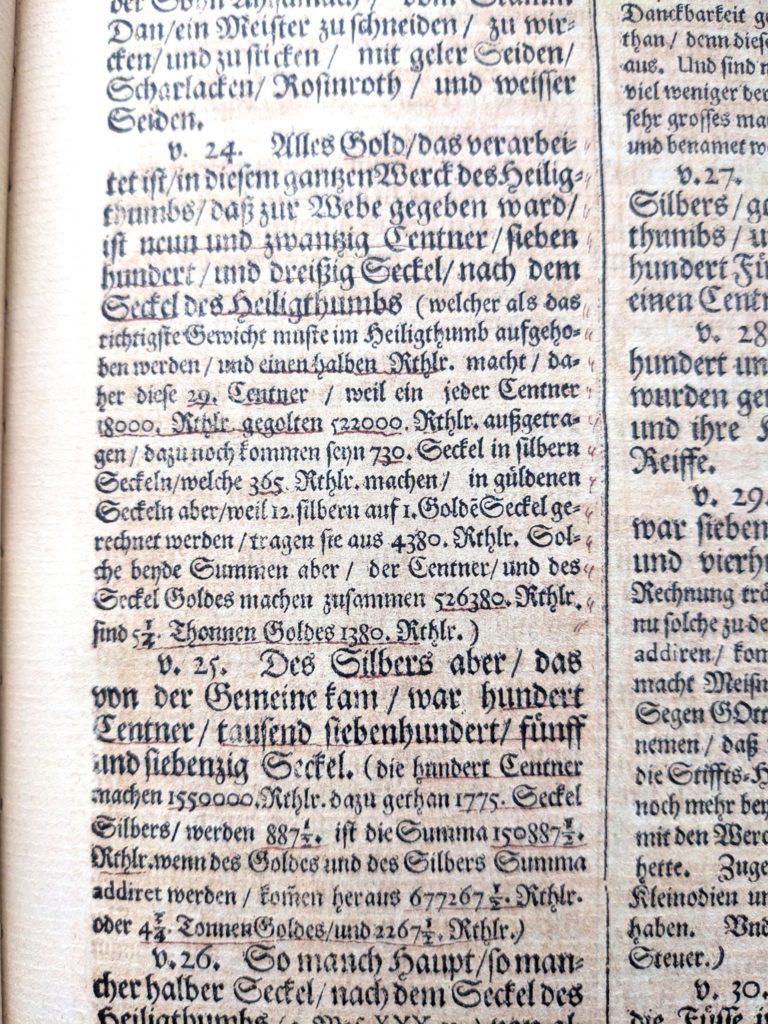
Column 609 Ex.
38:24
All the gold that was used in all the construction of
the sanctuary, gold given in offering, is twenty-nine
talents, seven hundred thirty shekels by the shekel of the
sanctuary (which must be the most
accurate measurement of offering in the sanctuary and equals half
a Reichsthaler; by which these 29 talents, each
talent being 18,000 Reichsthaler, had a value of 520,000
Reichsthaler, and in addition there were 730 shekels
in silver shekels, making 365 Reichsthaler. But in gold
shekels, because 12 silver shekels equal one gold shekel, this
equals 4,380 Reichsthaler. These two sums together; the talents
and the shekels of gold, add up to 526,380 Reichsthaler,
or 5¼ tons of gold and 1,380 Reichsthaler.) 25 Of
silver which came from the congregation there were a hundred
talents and a thousand seven hundred seventy-five shekels (the
hundred talents have a value of 1,550.000
Reichsthaler, and added to this 1,775
shekels of silver equaling 887½
, there is a total of 150,887½ Reichsthaler.
When the sums of gold and silver are added together we get 677,267½ Reichsthaler
or 4¾ tons of gold and 2267½
Reichsthaler.)
[A talent in English = Zentner in German.]
Column 610 Ex 38:29The offering
of bronze [german: Ertzes]
was seventy talents, two thousand four hundred shekels
(according to Agricola’s* calculation this equals 4,072
Reichsthaler; when we then add this to the sums of gold and silver
weget 681,339
Reichsthaler; which makes 778,673
Meissen Guldens out of which to take the blessing of God
and the wealth of the people that they were able to contribute
nearly eight tons of gold
into the Tent of Meeting, and would have given still more if
Moses, following the foreman’s counsel, had not deemed it
unnecessary. Not to mention the treasure that the jewels and other
materials would have amounted to. And the collection, or payment of
the contribution.)
[Bach
writes in the margin (at *) “Die Sum[m]a der
freijwilligen Opfer beträgt fast in die acht Ton[n]en Goldes” (The
sum of the free-will offerings amounts to almost eight tons of
gold.) Makes
the impression of re-calculation by Bach based on the
numbers/weights/valuta mentioned (and underlined) in the
commentary]
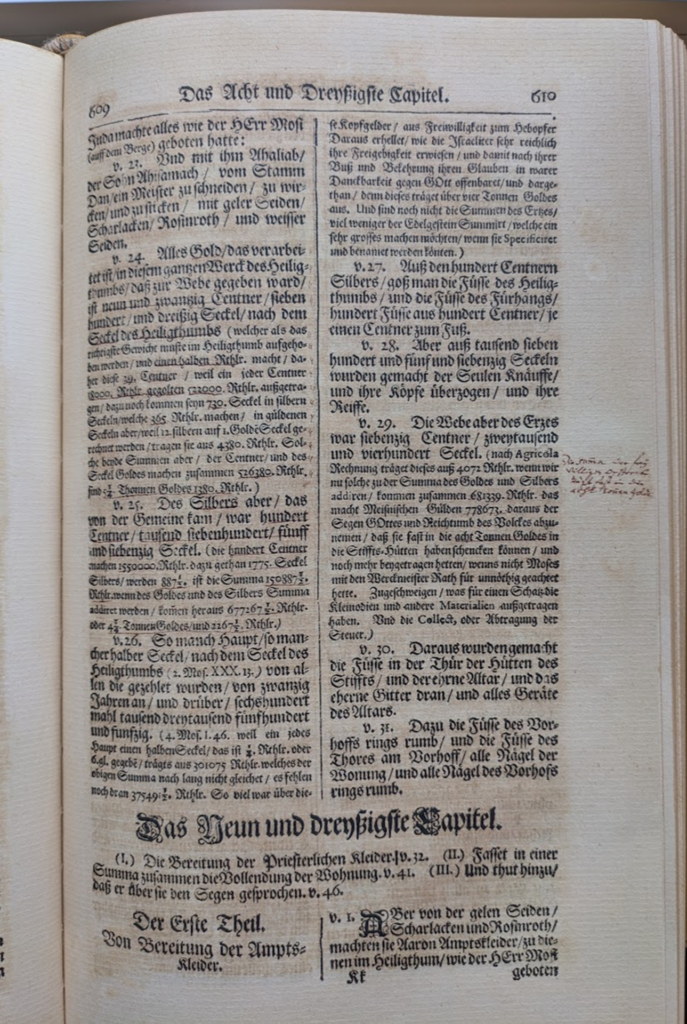
photo: Van Wijnen facsimile 2017
Column 612 (fac.
56). marking
in red
Ex 39 v. 21 And the breastplate was bound by its
rings to the rings of the body cloak ephod with a yellow lace, so
that it would lie firmly upon the ephod and not become loose, as
the Lord had commanded Moses.
(in this long description there is no mention of Urim and
Thummim, from which we might conclude that these other jewels were
not included, only the interpretation of those on Aaron’s official
shield, especially Exodus XXVIII. 30.)
Maria boodschap
Column 617
(fac. 57) in red (but
the ink was bijna op..)
Ex 40:17 Thus the tabernacle was erected in the second
year (after the journey out of Egypt) on
the first day of the first moon (the
construction was in the month of Nisan as a foreshadowing
[german:
zum Fürbild der gnadenreichen Empfängnis Chirsti] of
the merciful conception of Christ, which happened on the
25th of March, corresponding to the month of Nisan,
according to which the festival of the conception of Christ is
celebrated on the same day in proper Christendom. [German:
in der werthen Christenheit]Then on the same day the
true tent of the holiest temple of the body of Christ was
completed by the glory of the eternal son of God in which the
fullness of God physically dwells, Colossians II. 9. which
is also compared to the temple [german: der Hütten]
John I. 14.)
Column 619 (fac. 58) in red Ex 40:34 Then a cloud(which arose from Moses’s tent Exodus XXXIII. 7.) covered the tent of meeting [german: die Hütte des Stiftes] (Here is enacted what God promised Exodus XXV. 8. compare II Chronicles V. 14. Ezekiel ill. 4. 5.) and the glory of the Lord(which is separate from the cloud as a special exceptional revelation of divine glory and was a glorious and uncommon brilliance of light not like the shine of the luminous cloud) filled the tabernacle [german: Wohnung] (Numbers IX. 25. [15-Editor] as also happened when the temple of Solomon was erected. II Kings VIII. 18.)
NB: This section has to be read together with 1-2 Chronicles, where Bach gives his opinion on what this means for the Church, its Musik, and ‘God’s presence’ (Gnadengegenwart). There is more reflection (cohaerenz, concordantie, Schrift met schrift uitleggen, cf. the titlepages) than often considered. The word ‘Fürbild’ – foreshadowing : type/anti-type: Bach is familiar with the typological hermeneutiecs of Calov/Luther.
Leviticus – 3 Mose
Column 666
(fac. 59) marginal
markings with red ink
chapter:
not-kosher creatures.
Lev. 11 v. 20 Everything
that moves after the manner of birds and goes upon all fours
(that both fly and have four feet) that shall be an
abomination to you.
v. 21 However you may eat those winged creatures that walk on
all fours and do not hop on the ground with two legs.
v. 22 Of them you may eat: the Arbe according to its
kind, the Selaam according to its kind, the Hargol
according to its kind, and the Hagab) according to its
kind (these four creatures are not found in our area
although the ‘Arbe’ and the ‘Hagab’ are often thought to be the
same as common grasshoppers which are also four-legged creatures,
but it is more accurate to use the Hebrew names the way we do with
‘Hallelujah’ and other foreign words.)
Column 694
(fac. 60)
Lev. 16 v. 23 And Aaron shall go into the tent of
meeting and take off the linen garments that he had put on when he
went into the holy place(garbed himself to enter v. 4) and
leave them there(at the holy place). 24 And
he shall bathe his body with water(from the brass
handbowl) (wash away; not that he had [Bach inserts “nicht”
(not)] become pure in the holy place but rather to show
that all impurity of sins, both his and those of the people, had
been removed, just as they had removed the bodily impurity from
their hands and feet.)
The life of the flesh (soul) is in the blood
Column 698
(fac. 61). Marginal
markings in red
Prohibition
on the eating of ‘blood’ and why
Lev. 17 v. 10 If any
man of the house of Israel or of the strangers that sojourn among
them eats blood, against that person I will set my face
(to look upon him with a face of wrath as an enemy) and
will cut him off from among his people (so that
he would have no place among the people ‘of God. Leviticus III. 17.
chapter VII. 16. Deuteronomy XII. 23.)
v. 11 For the life of the flesh is in the blood
(the life not only of humans but also of animals has its essence
and home in the blood so that it appears that anyone who eats
the blood of animals wants to devour them wholly, which is
tyrannical. However, such Levitical commandment does not bind
Christians, even though in the earliest churches, so that the
Jews would not be angered, for a period of time it was forbidden
to eat the blood, Acts XV. 29.) and I have
given it for you upon the altar so that your souls are atoned by
this (by the blood of animals], for the blood(and
the life of animals which lies in their blood) is the
atonement for life.
Lev18:16 – NB: Your brother’s wife & the law on the levirate
Column 702 (fac. 62).
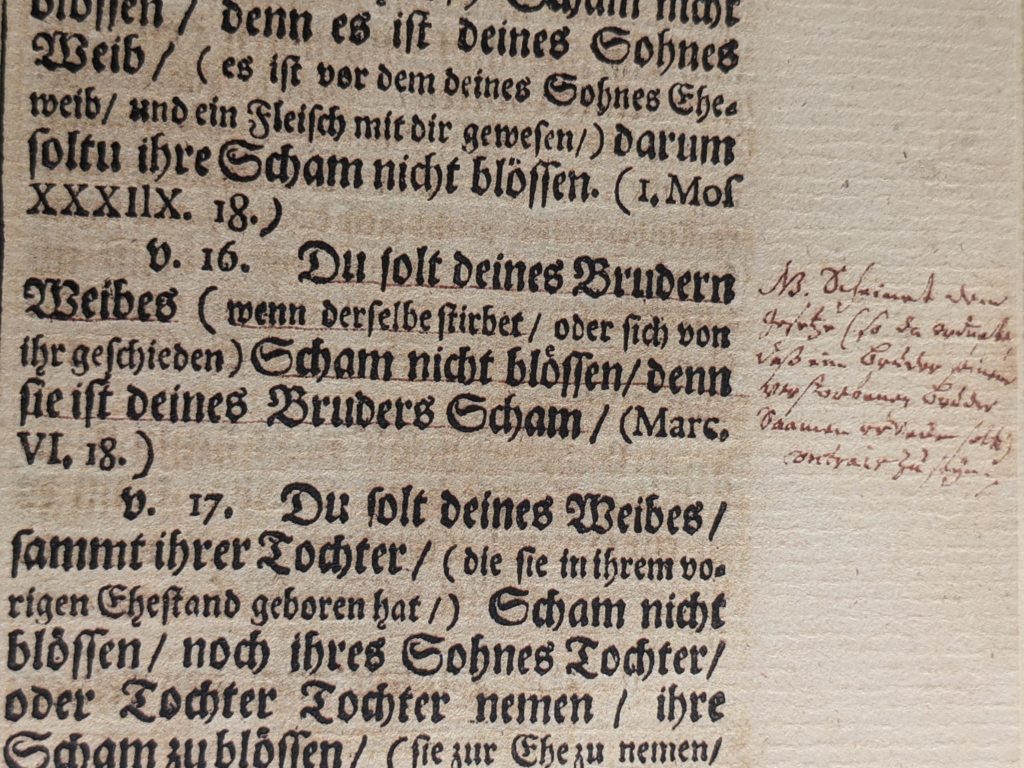
Du solt deines Brudern Weibes (wenn derstelbe stirbet / oder sich von ihr geschieden ) Scham nicht blössen / denn sie ist deines Bruders Scham / Marc. VI.18
You shall not uncover the nakedness of your brother’s wife(if he should die or be separated from her) for she is your brother’s nakedness Mark 6:18.)
[Bach writes in the margin, “NB Scheinet dem Gesetze (so da ordnete dass ein Bruder seinem verstorbenen Bruder Saamen erwecken sollt) contrair zu seyn. usw” (Appears to be contrary to the law which prescribes that a brother should raise up seed for his dead brother, etc.). Explanation: The law on the ‘levirate’ says you should ‘marry’ your brother’s wife (after your brother has died) and have sex with her to provide a child for your brother’s lineage. Bach reacts more to Calov’s addition (‘if he should die’ wenn derselbe stirbet), than to the biblical text itself. Also noteworthy. Bach does NOT underline the second option: separation, for not relevant concerning the levirate. He reads with akribia)
Labor on Easter?
Column 726
(fac. 63). Marginal
markings in red
about the sabbath, and the feasts, (Pesach)
Lev. 23 v. 8 And you shall bring offerings to the
Lord seven days (in thanksgiving as remembrance for the
deliverance from captivity in Egypt and for the dedication of the
faithful coming salvation of Christ from the spiritual captivity.
Hebrews II. 14.); the seventh day shall be called holy.
When you come together you shall also perform no laborious work.(as
on the first day. The days between the first and the last
days of Easter you can perform labor.)
Column
727 (fac. 64).Marginal
markings in red
Lev. 23:11 (that such first fruit is pleasing unto God and that He
will bless you henceforth with your grain crops, which He allots to
us as a generous [Bach
inserts “Meister (master)] of food provisions, so that all
bodily creatures now living will be abundantly fed.)
Column 749
(fac. 65).
Lev. 26 v. 38 And you shall not(for fear
and trembling) be able to stand up against your enemies.
And you shall perish among the nations and the land of your
enemies shall eat you up. (You must die in
exilio and in suffering, as has happened to a good part of the
Israelites in the seventy-year Babylonian captivity: such things the
surviving jews even un til this day must experience following their
destruction and dispersion for 1600 [Below this
number, Bach writes “1700”] years.)
Fruit of conversion
Column 750
(fac. 65).
about
the ‘Frucht der Bekehrung zu Gott’
Lev. 26: 41 Darumb will ich auch ihnen entgegen wandeln …
und will sie in ihrer Feinde Land wegtreiben / da wird sich ja ihr
unbeschnittenes Herz demüthigen … und denn werden sie ihnen die
Straffe ihrere Missethat gefallen lassen. (That is, just
as they took pleasure in their sin and were repulsed by my laws thus
will they also find pleasure and delight in the punishment, and say:
O what justice has been done to us, our cursed sin may be
thanked; that is what we get for it. O justice, dear God, o
justice! And those are words and thoughts of a sincere penance and
regret which are formed from the depth of the heart and they learn
to spit at themselves “phooey upon you; what have I done?” That
pleases God that He again becomes merciful. Therefore we have
translated the word “misdeed” as punishment of misdeed in order to
give such understanding. Otherwise, it would mean that they would
take pleasure in the misdeed. It is to be understood just so: The
land enjoys its holiday, that is, it speaks: God was right with
his punishment that the land must lie barren so that the
people’s desire would long for it. Such words are also found is
Isaiah XL. 2. dismissa est iniquitas, id est, placita et
accepta poena pro iniquitate ejus, id est, per Christum est
satisfactum pro ea. For that is the purpose of the
punishment of God, not that men are ruined, rather that they be
converted and live again. Ezekiel XVIII 23. 32. XXXIII. 10. 11.)
Columns
752-753 (fac. 66).
Lev 27, v. 7 And if the person is sixty years old
and upward, then you shall place a value of [Bach
overwrites “fünfzig” (fifty) to form “fünfzehen” (fifteen)] shekels(about
7 1/2 Reichsthaler) if it is male: a female, however, a
value of ten shekels.(That is about 5 Reichsthaler; for
in old age they can perform only smaller services.)
back to Genesis
continue with Numeri and Deuteronomium