Does God take pleasure in humankind?
The Greek text of the angels’ song in Luke 2:14. What does it say? How can it be translated? What about the traditional translation:‘men of good will’? And why is there so much debate about it?
This page belongs with the one on the Latin Gloria in excelsis Deo that Bach set in 1742 to accompany the Christmas oratio of the Leipzig university: BWV 191.
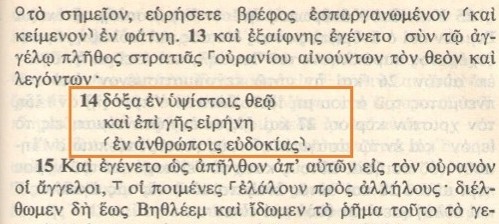
The song of the angels in Luke 2:14 is famous, and it has caused confusion for centuries. What exactly follows ‘Glory to God in the highest…’?
Peace on earth,
and towards men a good pleasureor
Peace on earth among men of his good pleasure
— or of ‘good will’
Put differently:
Does God give peace on earth (full stop) and does he, moreover, take pleasure in humankind?
or
Is the peace God gives on earth meant only for those in whom he takes pleasure (or who are of good will)?
You can already sense from this rephrasing that the debate will not be settled by linguistic or textual arguments alone. Theology plays its part in the background. And yet the text underlying the two translations differs by a single letter: a genitive s.
In this essay I am not going to tell you which reading or translation is the right one. Others do enough of that. Nor am I allowed to: you must read and interpret the text yourself. What I offer here, as well as I can, are the linguistic facts; then you must choose what you think it says, and how you understand what you read. Either you are a Protestant or you are not.
What does the Greek actually say?
That is clear, but for one letter: the final s, which turns the last word into a genitive. Here it stands in square brackets.
δόξα ἐν ὑψίστοις θεῷ καὶ ἐπὶ γῆς εἰρήνη ἐν ἀνθρώποις εὐδοκία[ς].
Glory to God in the highest (sc. heavens), and on earth peace among men [of the] good pleasure
About the first two clauses there is no dispute — glory to God in heaven, peace on earth — but a great deal has been written about the last, concerning men and good pleasure. With reason, for the three little words en antropois eudokia[s] harbour two problems, each of which governs the translation and hence the range of possible meanings:
- A question of textual criticism about eudokia(s): two variants are in circulation, with and without the genitive s. Each has a whole string of textual witnesses.
- A question of translation: what does that little word eudokia actually mean? Or rather: what can it and can it not mean? Words have fields of meaning rather than single fixed senses.
These are best treated separately, or the confusion only grows.
1. The textual question: nominative or genitive?
First of all: the manuscripts have no punctuation, apart from a full stop at the end. So you may — and must — supply the commas yourself. The difference lies in the presence or absence of the genitive s at the end of the word eudokia.
- eudokia — nominative
- The peace on earth then stands apart from the pleasure God takes in humankind. Those last three words become a nominal clause in their own right, alongside the two other nominal clauses.
- eudokias — genitive
- The peace on earth is meant for ‘men of good pleasure’. The last three words must then be joined to what precedes.
Translators today — as you will have guessed — almost all prefer the genitive construction. Modern versions drop the genitive in translation by rendering it as a relative clause. That reads better and is, technically, a good solution — idiomatic in the target language and faithful to the source: peace on earth among those whom God loves. However it is translated, accepting this construction makes the angels’ song twofold:
Glory to God in the highest
And on earth peace among men of his good pleasure
In other words: the second statement, ‘peace on earth’, is not meant generally but is qualified by saying for whom that peace is intended, namely for the ‘men of good pleasure’.
An aside: for other ways of translating and interpreting this genitive — men of good will — see part 2. But this much already: Protestants used to be rather dismissive of Jerome’s translation, calling it plainly wrong. That judgement was above all doctrinally motivated, for as far as grammar and syntax go, modern linguistics is on Jerome’s side.
If one prefers the nominative, the angels’ song becomes threefold:
Glory to God in the highest
And on earth peace
And towards men good pleasure
Here the birth of the Christ child effects three things: glory for God, peace on earth, and pleasure taken in humankind.
As said, both versions are supported by important early witnesses. Scholars try to weigh them: the age of the manuscript, its overall quality, and possible explanations of how the differences arose — copying errors, the lectio difficilior. This is done as objectively and verifiably as possible, but it remains open to dispute. Who is without prejudice here? Be that as it may: the scholarly editions have opted for eudokias for well over a century. What follows is a summary of the witnesses for each reading.
A. en antropois eudokias
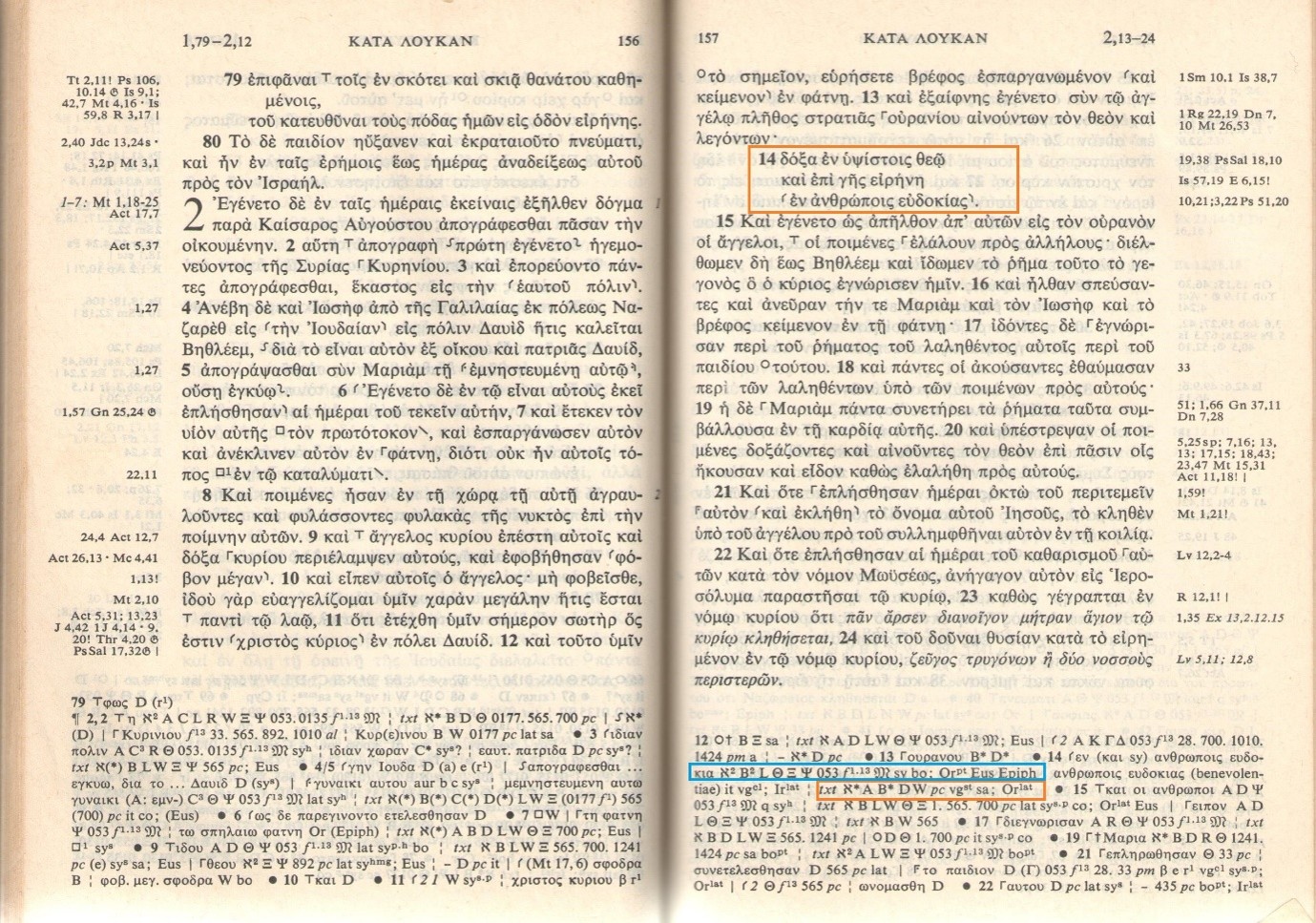
This reading is found in the oldest manuscripts of the Alexandrian tradition — in orange in the image of the critical apparatus below. The Alexandrian text is itself the oldest. It occurs in the Codex Alexandrinus and in a series of papyrus fragments.
Striking here: in the Codex Sinaiticus (א) and the Vaticanus (B) the final s was present, but has been scraped away. You can still see it. Interesting — why, and when, would that have been done? Awkward questions.
The genitive construction is also found in the church fathers and in Latin bibles: Jerome’s Vulgate presupposes it. Interesting too is Origen, who in the first decade of the third century — very early indeed — read and wrote Greek. An exposition of this passage by him survives, unfortunately only in a Latin translation, in which he presupposes the genitive s.
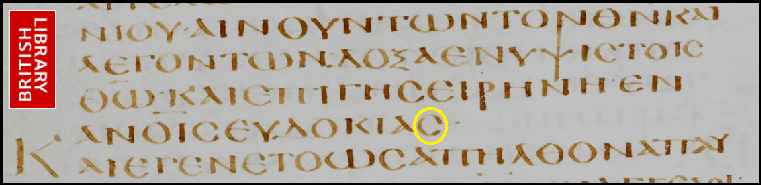
An aside: a few witnesses transmit the phrase without the preposition en (in, among). Strictly speaking that preposition is not needed — antropois is a dative.
B. en antropois eudokia
This reading stands in the Byzantine tradition and in the later versions of the Alexandrian — and also in the Vaticanus and the Sinaiticus, but there only through the removal of the s, so those do not really count. Once again, though: why would anyone delete a final s?
The reading is presupposed by church fathers and in some versions of the Latin bible. It is also present in the Syriac version of the New Testament, and in the Textus receptus: a sixteenth-century Greek text compiled from the originals then available, but ‘uncritical’ — that is, not by present-day scholarly standards. That is no reproach: the discipline did not yet exist, it was only then coming into being. They were pioneers.
On the Vulgata: before the Council of Trent the word is a collective term for the most widely used Latin bible text. That text could vary from region to region; there was no fixed normative version. That comes only with Trent, at the end of the sixteenth century — and then, in the various editions, this very passage is altered once more.
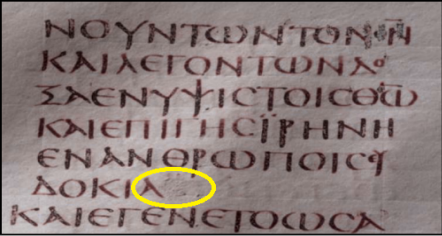
Note that Jerome (Vulgata) turns out to have read a genitive as well. He too has a twofold division; only his rendering of the Greek word eudokias differs. So the Vulgate and the modern Dutch versions all presuppose the same Greek text with the genitive, and hence the twofold strophe (A). Only their translation choices differ. See part 2.
That text underlies the bible translations of the sixteenth and seventeenth centuries. Here, then, the threefold verse is present in the Greek. Hence Luther’s version, the Bible de Genève and the King James all offer a threefold verse, as does the Dutch Statenvertaling:
- Luther
- Ehre sei Gott in der Höhe und Frieden auf Erden und den Menschen ein Wohlgefallen
- Bible de Genève
- Gloire soit à Dieu és cieux très-hauts, et en terre paix, envers les hommes bonne volonté
- King James
- Glory to God in the highest, and on earth peace, good will toward men
They all used the same Greek base text — Erasmus, Estienne, Beza — which the churches then accepted as the correct one. In that edition the word is eudokia. Only with the rise of text-critical biblical scholarship is attention drawn to the witnesses reading eudokias, and sympathy soon shifts to that variant. Whether that new preference is compelling, I do not know. But read on.
2. How do you translate eudokia?
…and what happens when it stands in a genitive construction with ‘men’?
This debate hardly arises in the Greek church, for there one understands at once what one reads — or thinks one does, just as you suppose you understand what I write if English is your language. The problem begins with the Latin translation of the Greek phrase men of good pleasure. In the Vulgate, Jerome’s version from the end of the fourth century, they are homines bonae voluntatis — men of good will.
The construction then becomes that there will be peace on earth among people who are of good will, or even: who will the good. A fine message for Christmas, certainly, but a somewhat surprising — even provocative — choice on Jerome’s part. Does it hold up?
The Greek word eudokia comes from the verb eudokeoo, which has several senses:
- to agree with
- to take pleasure in
- to choose
- to be willing, to want
- to decide
An aside: in Epicurean philosophy, attaining a eudokoumenè zoè — a life one is content with — is the highest thing one can achieve.
Jerome’s rendering — bonae voluntatis, in line with sense 4 — therefore seems to me possible in itself. Were I a teacher of Greek at a Latin school, I would not strike it through in red. At most I would myself prefer homines benevolentiae. But.
A Jewish text from the Hellenistic period
One important element must still be added to the translator’s task. We are not translating Homer or Epicurus, but a Jewish text from the Hellenistic period. For a bible translator that context matters. It concerns the language itself: Hellenistic Greek, koine Greek — the English of its day, if you see what I mean — with a strong Jewish accent and colouring.
But it also concerns the context of meaning. This is a religious text, one that was and is significant for Christians. So although written in Greek, it has a Jewish horizon of understanding. What is decisive here is not the theologically desirable meaning — though that of course plays its part — but the objectively religious-linguistic one. A crucial role falls to documents from the same milieu at roughly the same time, preferably a little earlier. The question is: in what sense is this word, this turn of phrase, used in other Jewish sources from around the beginning of our era — the Septuagint, rabbinic texts, and, interestingly, Qumran?
Once we take this into account, it soon becomes plausible that the genitive construction ‘men of good pleasure’ — contrary to what used to be thought — is rooted in a perfectly ordinary Hebrew genitive construction denoting the group chosen by God (or a subgroup, as at Qumran). Just as Johannine idiom, itself strongly Hebraising, speaks of children of light and of darkness, so here we would have men of good pleasure as the designation of a specific, ‘elect’ group.
The word eudokia then stands in the place of the Hebrew word ratson. That word, more clearly than eudokia, almost always refers to the good pleasure of God, his choosing of a person or a group; it often coincides with the elect. Importantly: in that genitive construction God is the subject of the good pleasure, and human beings are its object. So the phrase men of good pleasure may well be Semitic in origin. The rabbis use it in prayer formulas too: May it be pleasing to you, O God…
- In the synagogal Eighteen Benedictions, the Shemoneh Esreh, the prayer runs: ‘Take pleasure, LORD our God, in your people Israel.’
- In the Qumran manuscripts, 1QH IV, 32-33 speaks of ‘the fullness of God’s mercy upon all the sons of his good pleasure’ — Hebrew bene retsono, entirely parallel to the ‘children of light’.
Finally: Luke writes perfect Greek, in syntax and idiom alike — John does not — but in his first two chapters he has evidently chosen to tell the stories in Hebraising Greek. The effect is that his text sounds as though it continues the Jewish scriptures. That was probably his intention. Never underestimate the literary talents of biblical authors! This genitive construction fits that design very well.
However it is translated: what is at issue is not the good will of human beings,
but the good will of God towards them.
3. My own preference
I find that something can still be said for the reading eudokia, even after everything set out above — namely its poetic quality: the rhythm of three short nominal clauses. Linguistically this is supported, to my mind, by the presence of three prepositions in the saying: something is to be reported in heaven, on earth, and among men.
The argument gains force from the simple observation that with the genitive construction the preposition en is in fact superfluous, not to say intrusive. If you want to say in Greek ‘peace for the men of good pleasure’, you say eirene antropois eudokias, not eirene en antropois. As in Latin: no preposition needed. Translators know this well enough, which is why they often render it a little more loosely: peace among or in the midst of men of goodwill. But you can feel that this still grates a little.
If the peace is meant for the earth, then that preposition en can be taken with eudokia. And — the clinching argument — in combination with that word it is entirely usual to employ en. So says my school dictionary: εὐδοκία — good pleasure, preference, good intention, decision, τινι or ἐν τινι.
Hence my preference for Glory to God in the highest, and peace on earth, goodwill towards men. Then again, the twofold division has its beauty too: the glory in heaven for God corresponds to the peace on earth among those whom God loves.
And now over to you. What do you think? How do you read?
The critical apparatus
Below is the edition of the Greek New Testament. The orange frame marks the reading with the genitive construction; in the apparatus stand the manuscripts — papyri and codices — reading eudokias. In blue are the manuscripts reading eudokia. In both lists the Sinaiticus (א) and the Vaticanus (B) appear: with an asterisk for the original version, and with a superscript numeral for a later correction — in this case the scraping away of the final s.
Dick Wursten. The Dutch original of this essay is at dick.wursten.be.