Hausen and Birkmann, 1726: sunspots and the tilt of the sun’s axis
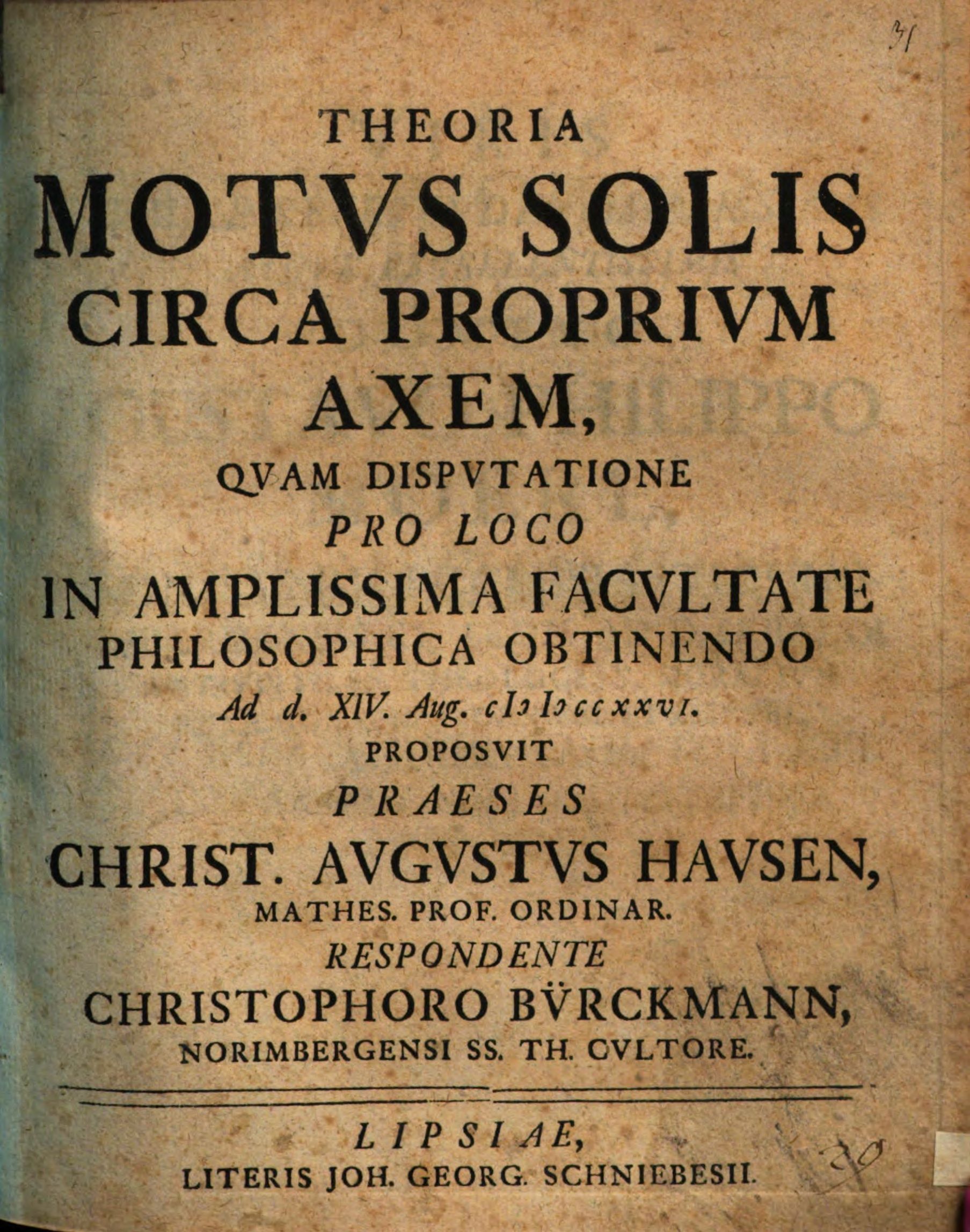
Theoria motus solis circa proprium axem
‘On the motion of the sun about its own axis.’
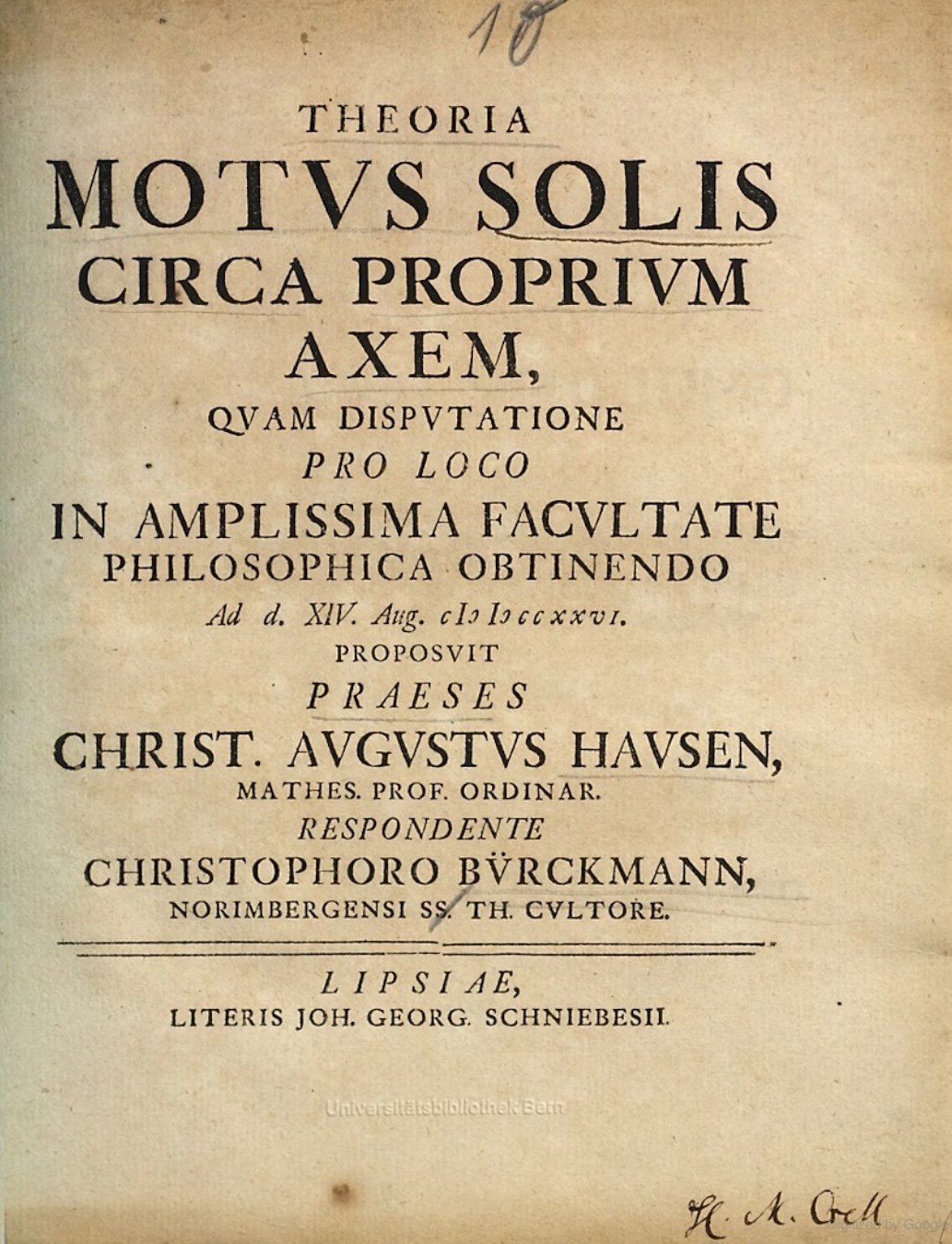
Dissertation, 14 August 1726, Leipzig, faculty of
philosophy.1
– Professor Christian August Hausen:
praeses2
– Christoph Bürckmann (or Birkmann): respondens
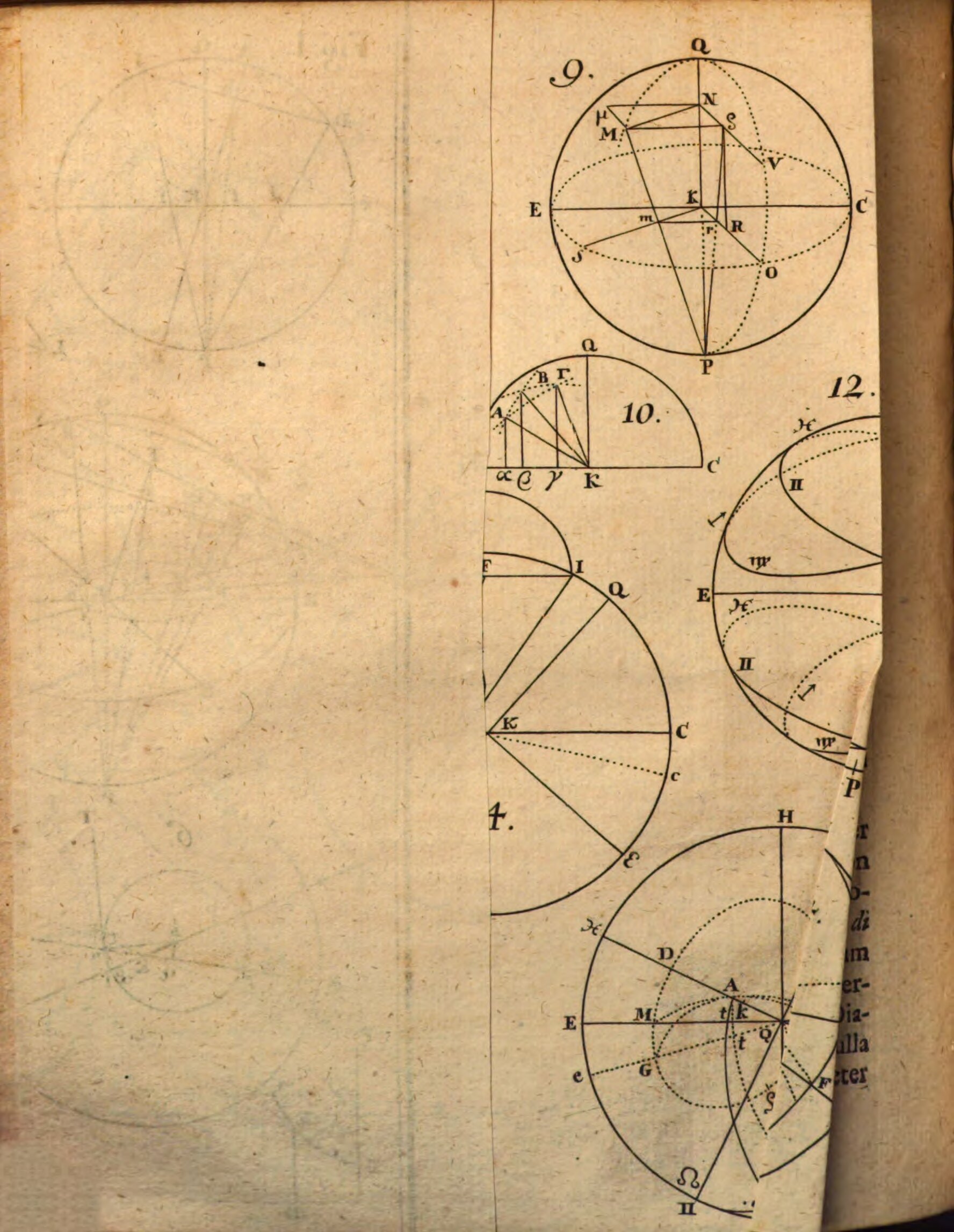
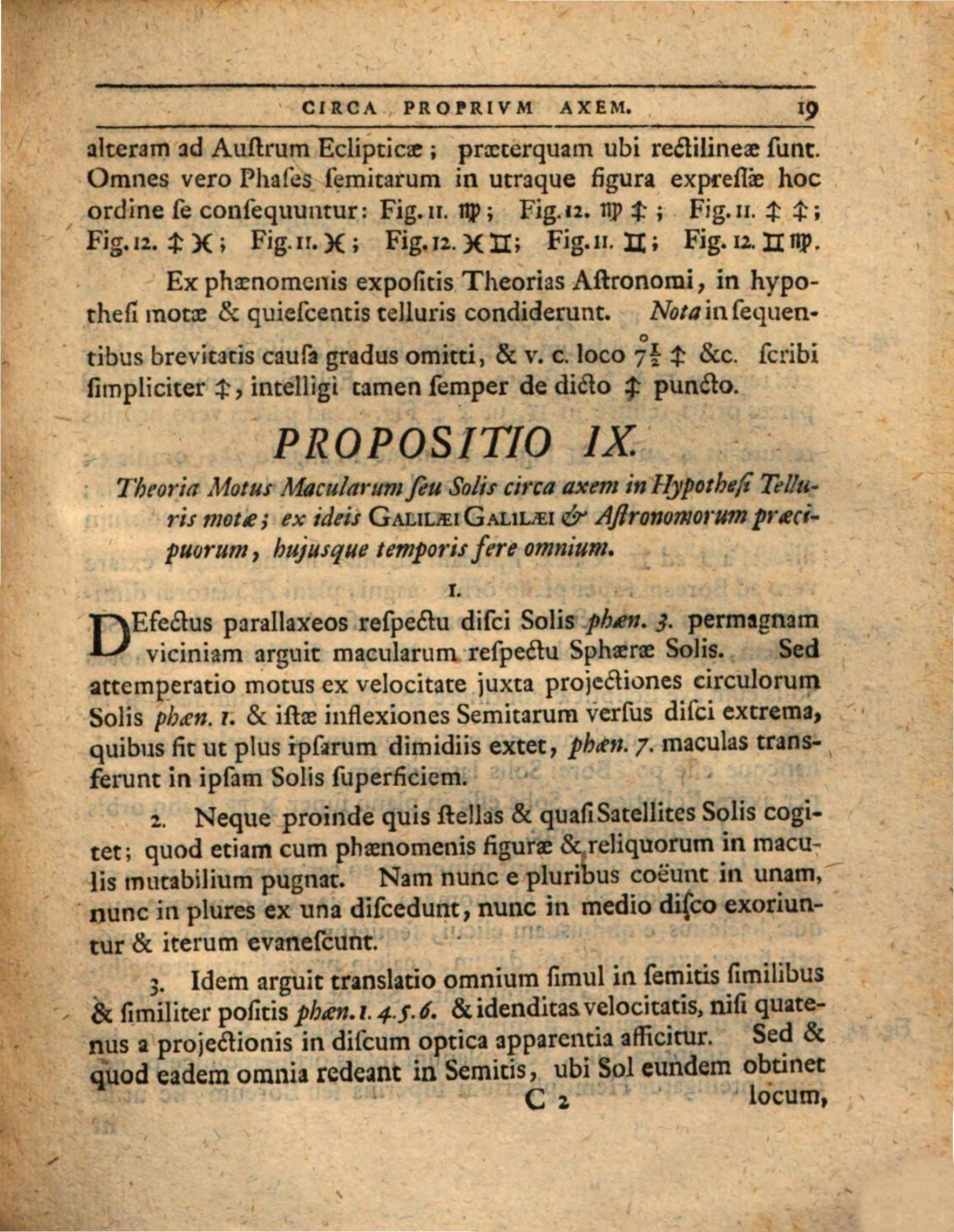
The subject of the dissertation is the calculation of the tilt of the sun’s axis, on the basis of careful observation of the motion of sunspots, which is then analysed mathematically to arrive at the result. The images below reproduce the principal thesis and its demonstration – Proposition IX, pages 19 to 25.
In general: the dissertation contains observations and drawings of the sunspots at various moments (size, motion and so on), followed by calculations – the projection of a circle onto a sphere, for instance – and an attempt to work out precisely what the displacement of the observed lines over time implies for the tilt of the sun’s axis. That tilt is put at 7.25°, which is correct.
What defending a dissertation meant
Defending a dissertation in the eighteenth century was a different matter from today. The professor (praeses) formulated the propositions and their proofs, whether or not in consultation with the candidate, and the publication went out into the world under his name. The respondent – here Birkmann – then had to defend those propositions and their mathematical demonstrations publicly, before a jury of learned men. If he succeeded he was ‘master of the matter’ (magister) and had earned a place in the faculty; hence the subtitle, disputatio pro loco… in facultate philosophiae obtinendo. Once through, he could teach, and go on to study one of the higher faculties: theology, law or medicine.
The student in question is the later pastor of Nuremberg, Christoph Birkmann (1703-1771). The title page already indicates the direction he would take: he is described as SS. Theol. Cultore (Sacrosanctae Theologiae Cultore), a student of sacred theology. Besides being scientifically gifted, as this dissertation shows, he was gifted musically and poetically. He sang in Bach’s cantatas between 1725 and 1727, his student years in Leipzig, and supplied the texts for a series of solo and dialogue cantatas in late 1726 and early 1727. It is not even impossible that he had a hand in the thorough revision of Bach’s St John Passion in 1725.
Below the images is a summary of the dissertation. It was made with the help of Google Gemini, and should be read as a guide to the argument rather than as a translation.
The pages of Proposition IX
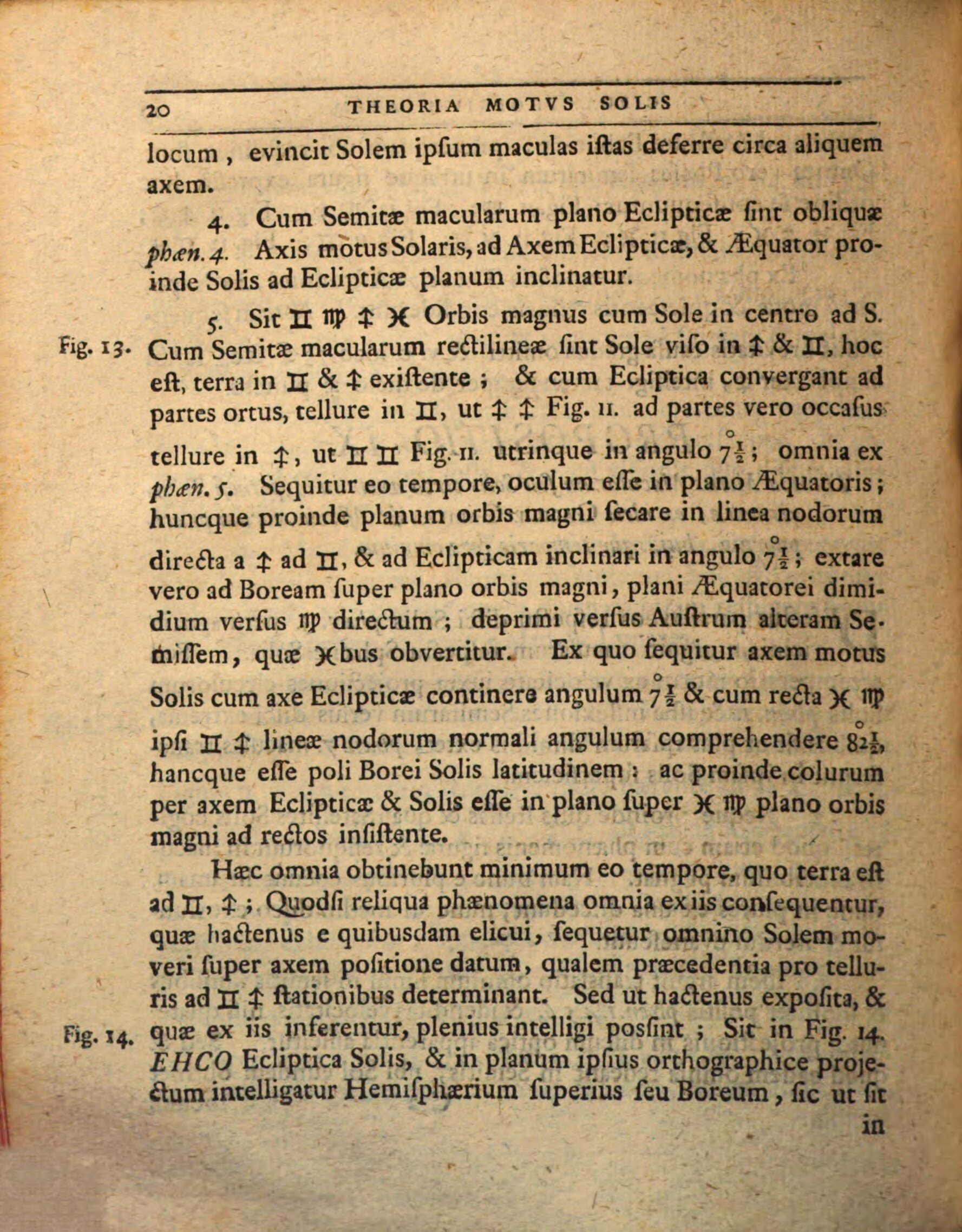
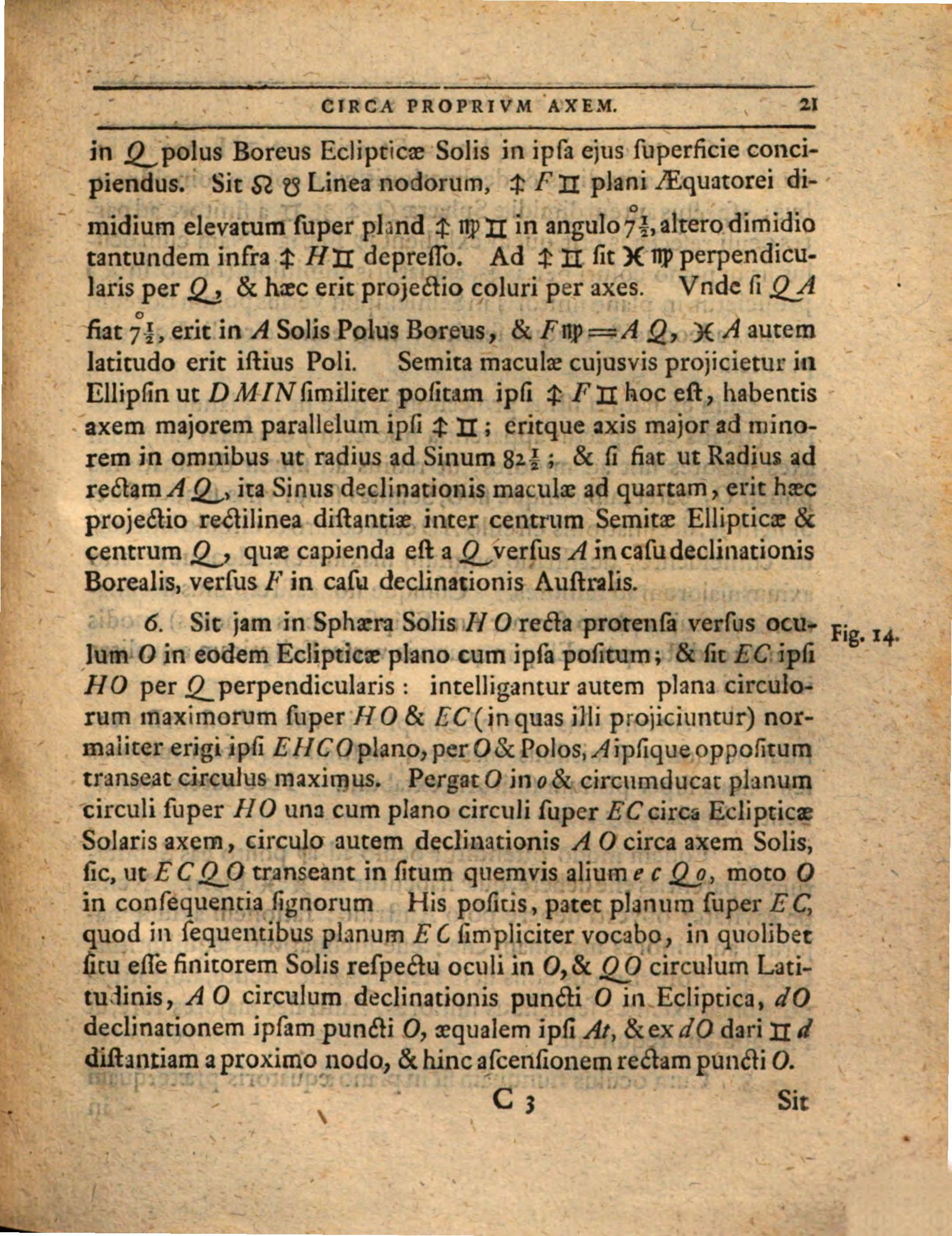
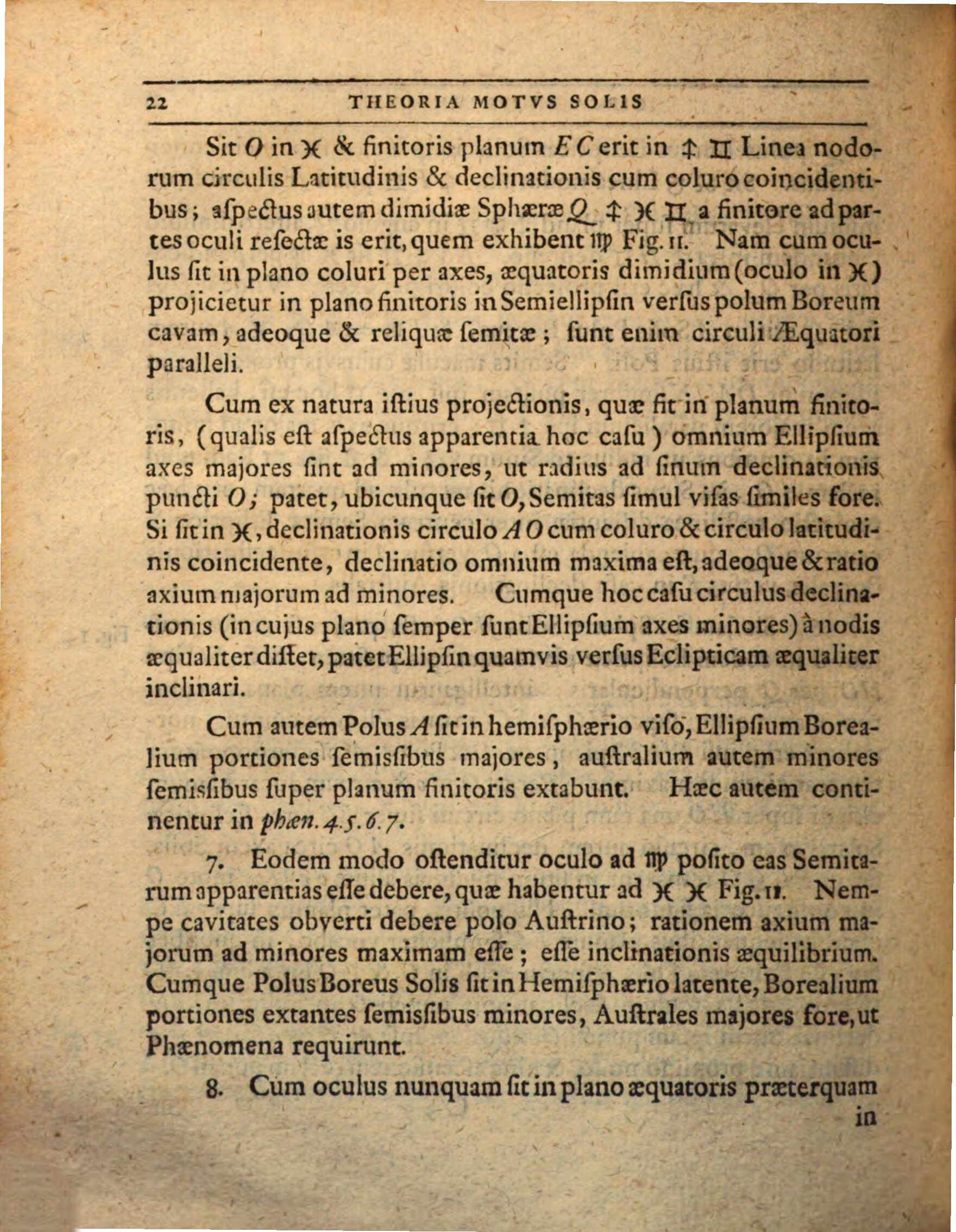
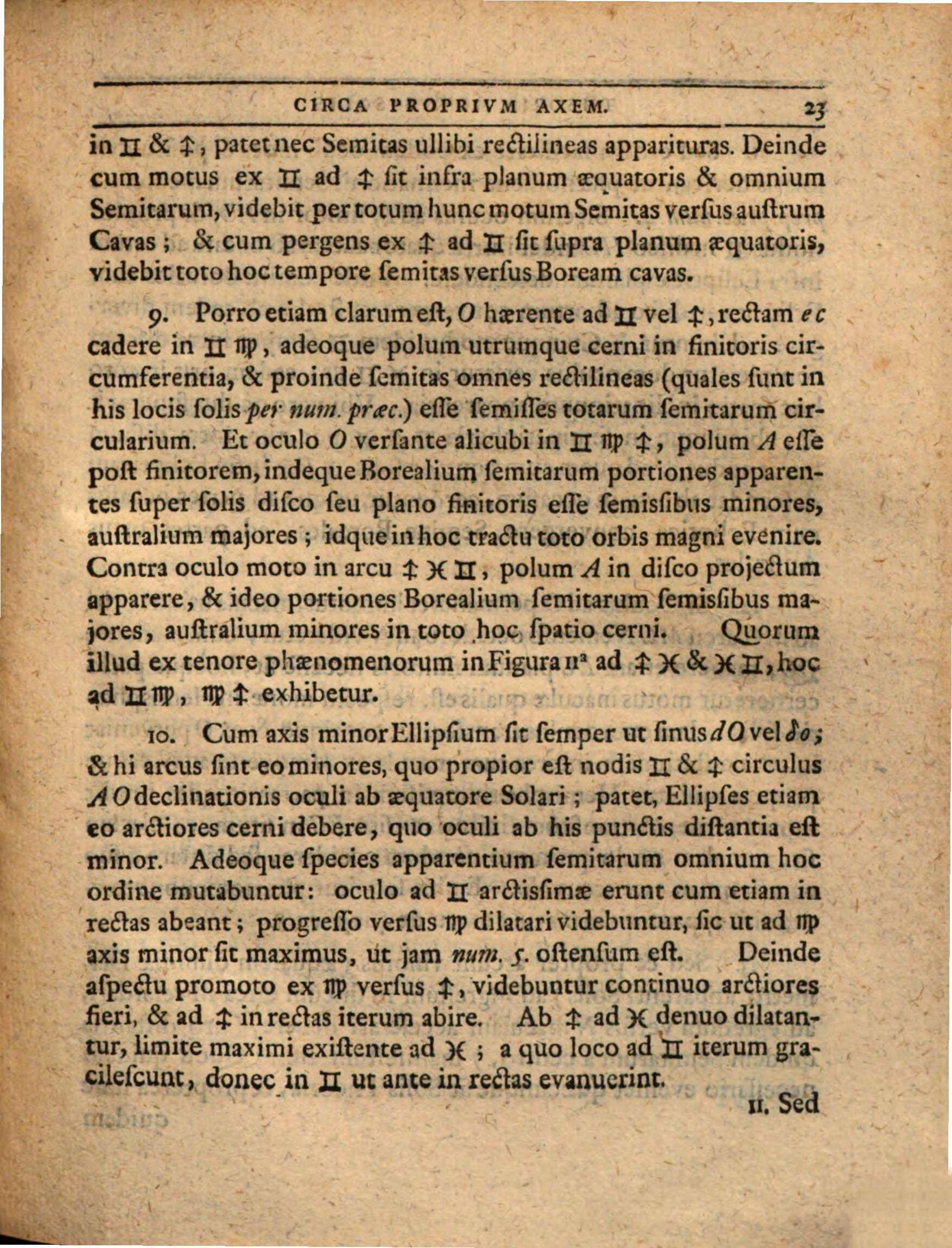
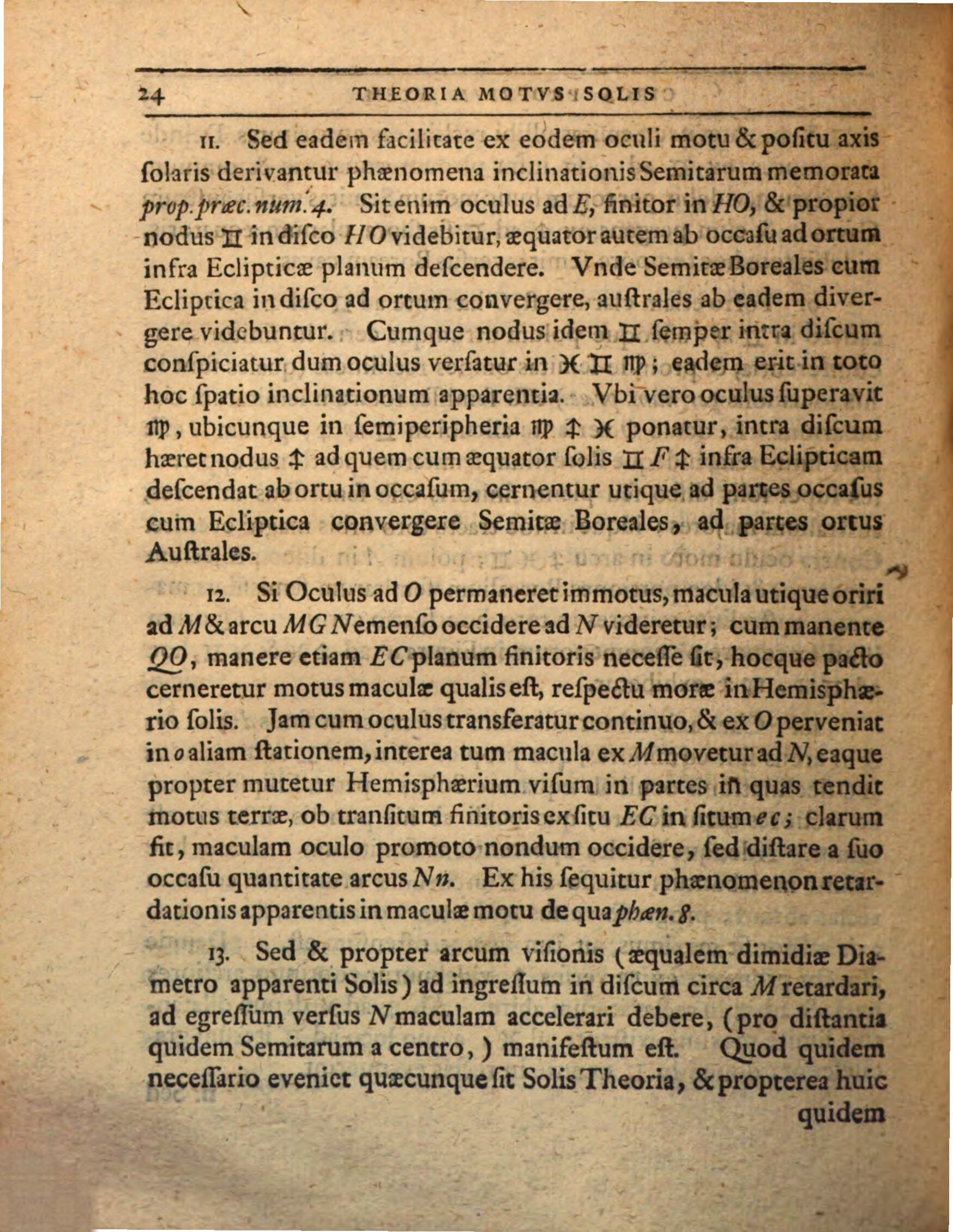
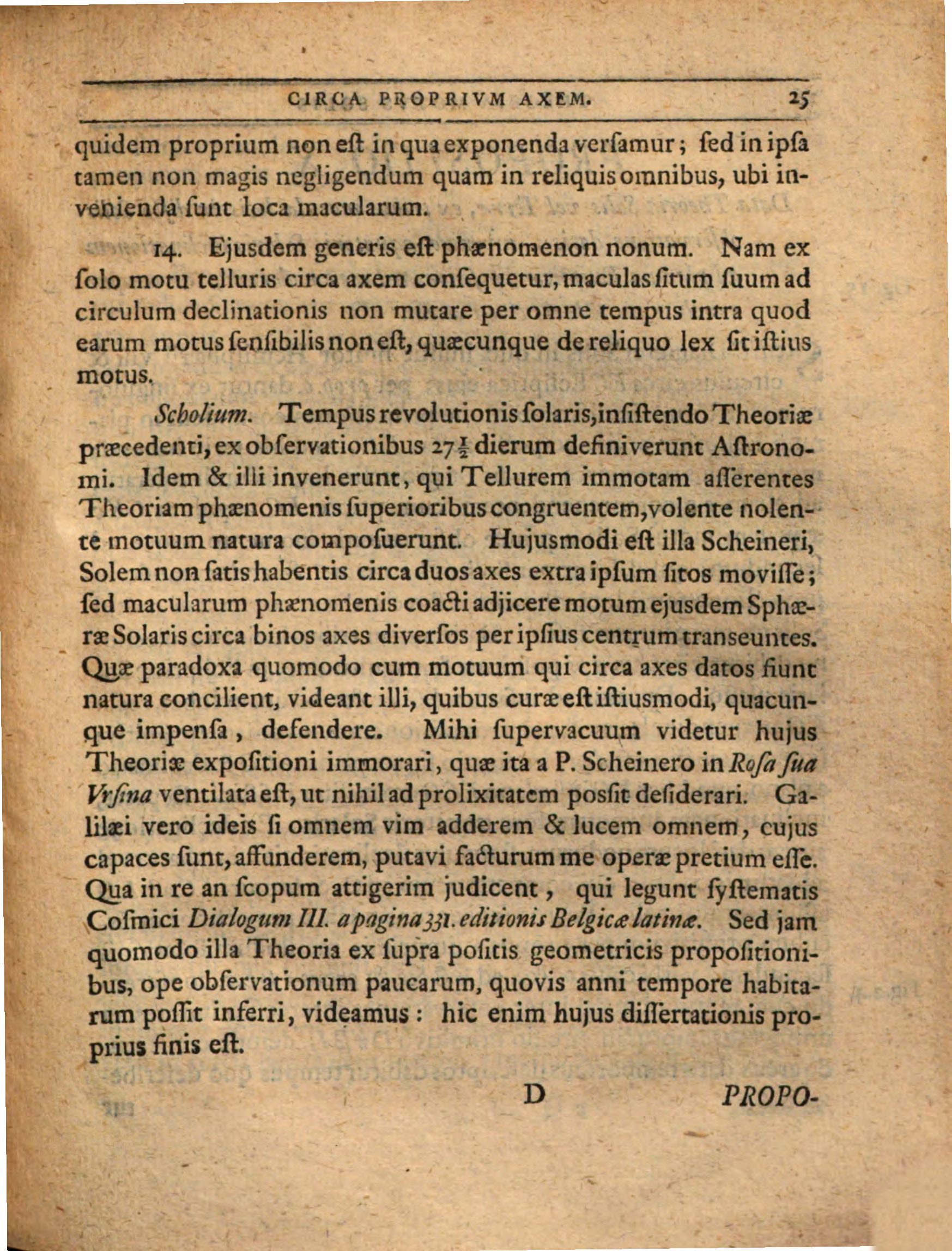
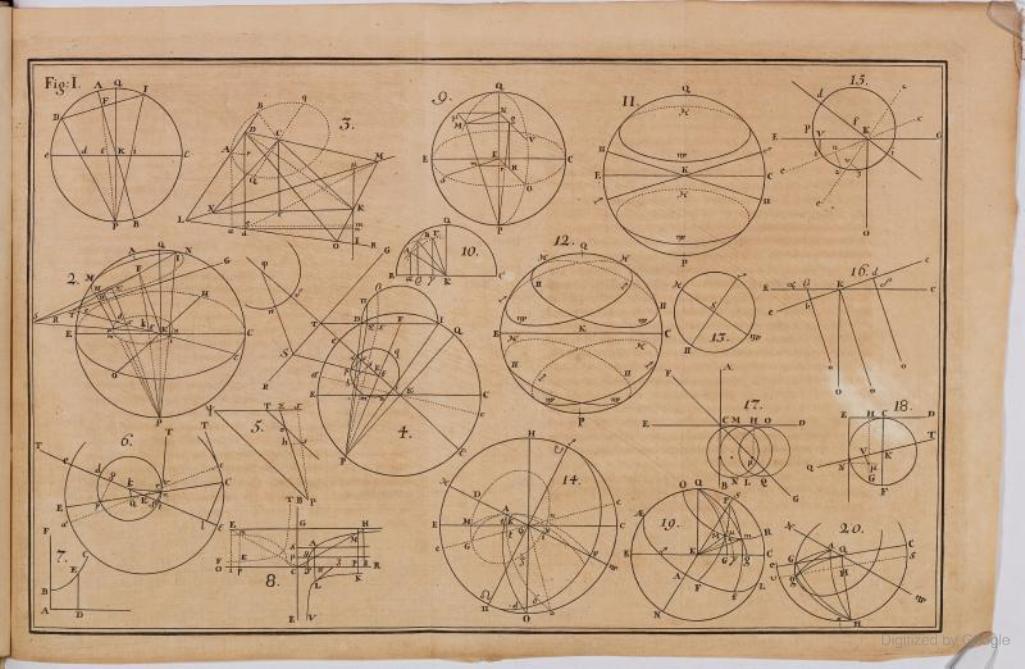
Proposition IX: a summary
The theory of the motion of sunspots, or of the rotation of the sun about its axis, on the hypothesis that the earth moves; founded on the ideas of Galileo Galilei and the principal astronomers of the present day.
§ 1-3: that the spots lie on the sun
The author argues that sunspots are not separate satellites or planets orbiting the sun. His arguments:
- No parallax. The spots show no difference in depth relative to the solar disc.
- Perspective. The spots appear to slow down and to flatten towards the limb of the sun (inflexiones semitarum). This proves that they lie on a spherical surface.
- Variability. They come into being, grow, split and disappear on the surface itself.
- Common motion. All the spots move at the same speed along parallel paths. This indicates that the sun rotates as a whole and carries the spots along with it (solem ipsum maculas istas deferre).
§ 4-6: the tilt of the sun’s axis
Here the author calculates how far the sun is tilted.
- The ecliptic. The earth moves in a plane, the ecliptic. Relative to that plane the paths of the spots are usually curved lines – ellipses.
- Straight lines. The author observes that the paths of the spots appear as straight lines only when the earth stands in the signs of Gemini (June) and Sagittarius (December).
- The angle. From the curvature of the spots’ paths at other times of year, Hausen calculates the tilt of the sun’s axis at precisely 7.25 degrees (7° 15′).
- The pole. The sun’s north pole therefore lies at a latitude of 82.75 degrees relative to the earth’s orbit.
Conclusion and scholium (points 14 to 25)
The text closes with a tribute to the history of the question:
- Christoph Scheiner. The author cites Scheiner’s famous Rosa Ursina. He praises him, but points out that his own mathematical method is the more exact.
- The period of rotation. A value of about 27.5 days is given for the sun’s rotation – the time it needs to turn once about its axis, as seen from the earth.
- The end. The text ends on page 25 with the formal close: Hic enim hujus dissertationis proprius finis est (‘for here is the proper end of this dissertation’).
Some explanation
The apparent motion of the sunspots is used to determine the orientation of the sun in space. As for the tilt of 7.25 degrees: in June and December we look edge-on at the sun’s equator, and the spots seem to travel in a straight line. In March and September we look more towards the sun’s north or south pole, so that the spots describe a curved path, an ellipse. The signs ♊︎ (Gemini), ♐︎ (Sagittarius) and ♍︎ (Virgo) are used to indicate the position of the earth in its orbit; that was the standard way of recording the time of year and the angle of observation.
The remainder of the dissertation gives a practical account of how the measurements were made and which instruments were used, and ends with a theory about the nature of sunspots – Hausen proposes volcanoes as an analogy.
An honourable mention: De Lalande, 1803
In this bibliography of important astronomical publications – arranged chronologically, from the foundation of the world to 1802 – Hausen’s dissertation is still listed. And Birkmann’s, therefore, though he is not named.
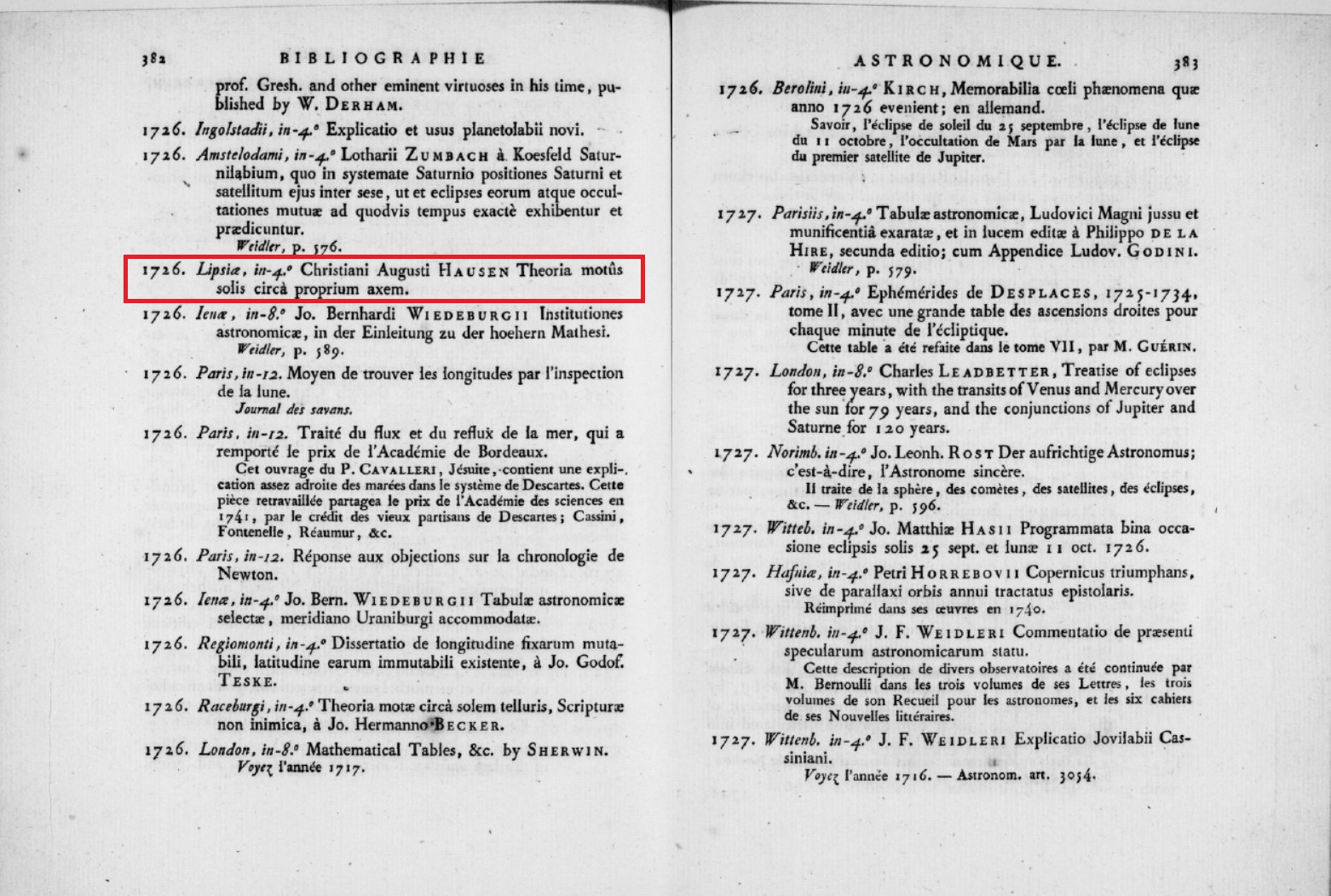
Jérôme de Lalande (1732-1807) was an influential French astronomer. In the book Chasing Venus he is the brilliant but rather vain scientist who stays at home and analyses the data the observations will yield. His handbook Astronomie (1764) was the astronomers’ bible for decades. He maintained an enormous correspondence with scholars all over the world, which made him the central node for the transits of Venus of 1761 and 1769.
- All the sciences belonged to this faculty. The natural sciences came under the heading of natural philosophy – in Greek, physica. Compare the title of Newton’s book: Philosophiae Naturalis Principia Mathematica, mathematical principles of natural philosophy.↩
- Christian August Hausen (1693-1743) was already a professor at Leipzig at the age of 21. He is best known today for his pioneering work on electricity and conductors.↩