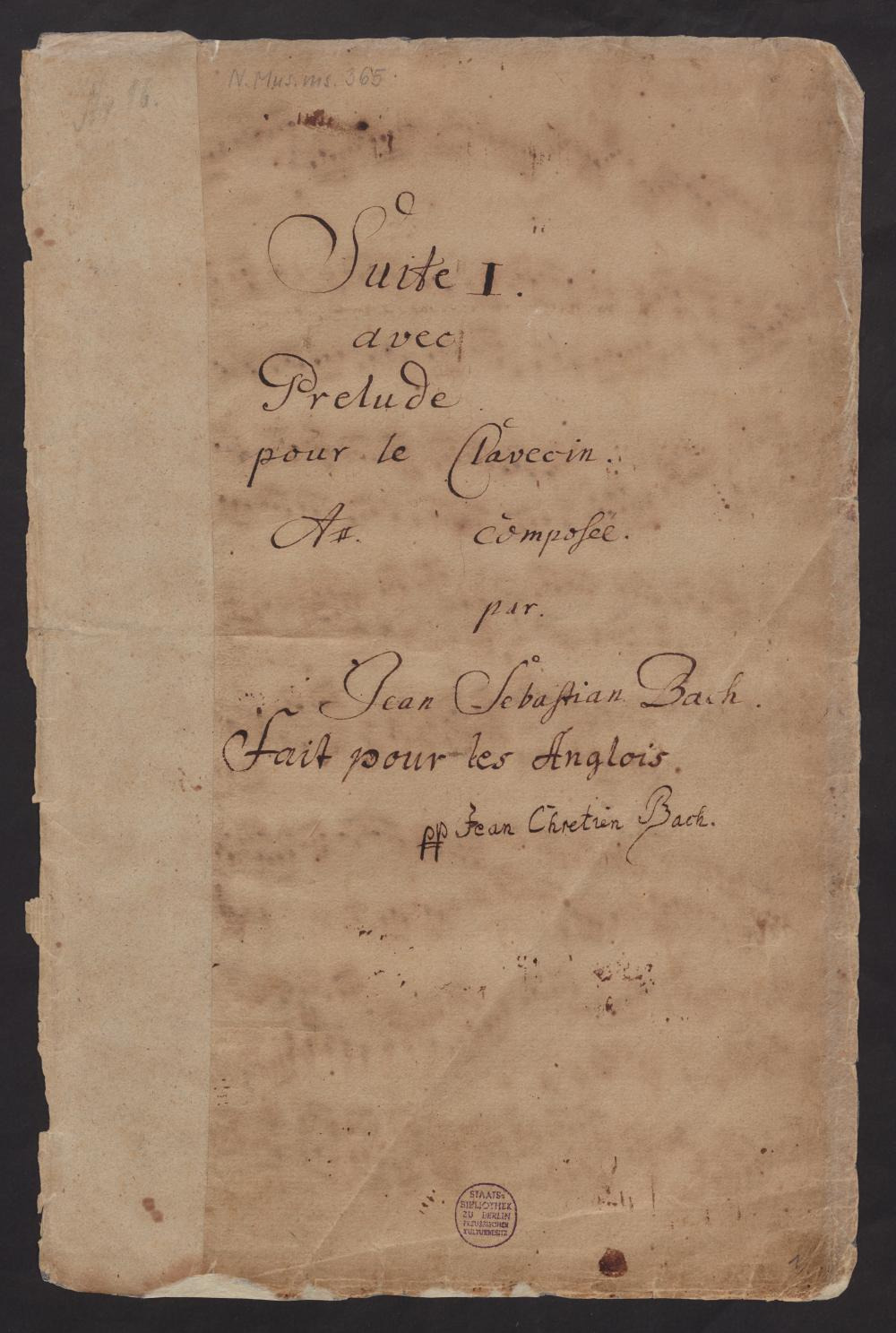
„Fait pour les Anglois”
How the English Suites got their name – a hypothesis by Bernd Koska
Bach never called his six keyboard sonatas, BWV 806–811, “English Suites”. The name was attached to them by others. But, unlike the Brandenburg Concertos the title of which is entirely a 19th century invention, this one does go back to people in Bach's own circle in the 18th century. To what, or to whom "English" refers, however, has never been securely established. In 2021 (Bach-Jahrbuch) Bernd Koska proposed a new hypothesis. His argument consists of a chain of individually well-documented facts/links with an original way of comnecting them. This makes his conjecture worth retracing: the reader can weigh/test the solidity of the chain for himself.
The inscription
The trail begins with a manuscript in the Staatsbibliothek zu Berlin, N. Mus. ms. 365: a copy of the set of suites made in the 1740s by Johann Nathanael Bammler, a pupil of the Thomasschule. On the title page, in a hand other than the copyist's, stands the addition (in 'broken French') Fait pour les Anglois. Who added it is not certain; the name most often put forward is Bach's son Johann Christian, whose own name appears on the leaf in its French form. Bach digital is more cautious, attributing it simply to a Bach copyist.
The second clue is Bach's first 'admirer' Johann Nikolaus Forkel, writing in 1802, that these pieces were written "für einen vornehmen Engländer" (for a distinguished Englishman). His information generally came from Carl Philipp Emanuel and/or Wilhelm Friedemann. Two traces, then, both brief, both from the closest we can get to J.S. Bach (pupil, sons), but both without being in anyway precise about 'Les Anglois', resp. ein Engländer. There the question rested for a long time.
A detour through Hamburg
Koska approaches it from an unexpected direction: through a hitherto neglected Bach pupil. Hinrich Conrad Kreising (d. 1771) became organist of the English church in Hamburg. That church belonged to the Merchant Adventurers, the company of English cloth traders privileged in the Hanseatic city since the early seventeenth century. By Bach's day they had shrunk to a closed and status-conscious circle past the height of its power: they kept to their own kind, and insisted on the recognition that the city's burghers no longer granted them as a matter of course.
Mattheson, not as a writer on music
This is where Johann Mattheson enters, in a capacity his fame as a music theorist almost always obscures. Mattheson's principal employment was as secretary to the English envoy in Hamburg. He was married to an Englishwoman, and in 1735 he demonstrably supervised the building of a new organ in the English church. He is not an incidental witness here but the pivot: he connects the English colony to the musical life of the city, and he is also the source for what Bach did there in 1720.
Cyrill Wich
The envoy Mattheson served was Cyrill Wich (1694–1756). As a boy Wich had keyboard lessons from the young George Frideric Handel during Handel's Hamburg years, and afterwards from Mattheson himself. Mattheson testifies that he became highly accomplished: he dedicated to him a sonata for two harpsichords addressed to the gran Virtuoso, and records the anecdote that Wich once improvised for half an hour at the court in St Petersburg, to the astonishment of the whole court, the Empress included.
This matters. The English Suites are not music for amateurs; they require a player who can meet them. A candidate who satisfies only the social condition will not do.
Wich satisfies that condition abundantly all the same. He had married into a Schleswig-Holstein political family, inherited estates in England and in North and South Carolina – on the strength of which he was styled landgrave of both Carolinas – and was created a baronet by George II in 1729. Forkel's distinguished is thus no empty courtesy.
November 1720
Bach's Hamburg journey of November 1720 is known in the literature for something else: his application for the organist's post at the Jacobikirche, which he withdrew. Koska suspects that the application was not the main purpose and that the journey was conceived rather as a concert tour. The Obituary reports at unusual length on a much-discussed appearance by the Köthen capellmeister before influential Hamburg dignitaries. And it is Mattheson again who records that during that stay Bach was heard on the finest instruments in the city – in the plural.
Was the organ of the English church among them? The English House in the Groningerstrasse stood immediately beside the Katharinenkirche, where Bach demonstrably played. And the annual banquet of the Merchant Adventurers fell on 7 November, during Bach's stay. Neither fact proves anything; together they make a meeting far from far-fetched.
The objection, and the proposed sequence
Koska names the obvious counter-argument himself. The first suite survives in a copy by the Weimar organist Johann Gottfried Walther and therefore dates from before 1718, well ahead of the Hamburg journey. The divergent numbering in the earliest copy, by Bernhard Christian Kayser, further suggests that this first suite may not originally have belonged to the set at all.
In Koska's reconstruction that becomes the key. He suggests (imagines), that in November 1720 Bach might have played an already existing single suite for his English audience; And then was asked for more pieces of the kind; his Köthen obligations – Prince Leopold's birthday on 10 December, the new year, the completion of the Brandenburg Concertos in March 1721 – kept him from it; and some time later he added five new suites to the old one to form the collection we know.
What is established and what is not
The value of the hypothesis lies in keeping the two apart.
Established: Mattheson's dual role, Wich's
training under Handel and Mattheson, Bach's presence in Hamburg in
November 1720, the date of the banquet, Kreising's later post at the
English church.
Conjecture: that Bach played in the English House,
that a commission followed from it, and that the collection is the
answer to that commission.
Koska presents it as such – a possible course of events, not a proof. For the time being the name remains what it always was: an inscription in another hand. But for the first time Forkel's "distinguished Englishman" has a face, a teacher and an address... if he is 'the One'.
The absence of a dedication, in my opinion, remains the weakest link.
After Bernd Koska, „Fait pour les Anglois”. Wie die Englischen Suiten zu ihrem Namen kamen, in: bach magazin (Bach-Archiv Leipzig). The full version with complete documentation appeared in the Bach-Jahrbuch 2021. For the source description of N. Mus. ms. 365 and the early transmission of BWV 806, see Bach digital.