From Bach, with ♡
In Part IV of the Christmas Oratorio, Bach four times replaces the word Hertz (heart) with a small drawing of a heart. The passages are reproduced and discussed below. I should say at the outset that I see no hidden meaning or deeper significance in it – just a passing thought, perhaps born of a shortage of space the first time, and then kept up through the rest of the cantata. Why not.
In the fourth cantata of the Christmas Oratorio the way inward is taken: by the ideas of the time, the heart must be opened to the newborn Lord. What does his birth mean for me? That is what happens in this cantata. After the gospel text has been quoted (Luke 2:21 – Jesus formally receives the name the angel had whispered to Mary, Jeshua, ‘the Lord saves’), the singers meditate on what this sweet name means for their own lives. The soprano sings a chorale, and the bass enumerates what Jesus means to him. And now something odd happens in the score – not in the notes, but in the text Bach writes beneath them.
Immanuel, o süßes Wort!
Mein Jesus heißt mein Hort,
mein Jesus heißt mein Leben.
Mein Jesus hat sich mir ergeben,
mein Jesus soll mir immerfort
vor meinen Augen schweben.
Mein Jesus heißet meine Lust,
mein Jesus labet ♡ und Brust.
Immanuel1,
what a sweet word!
My Jesus is my refuge,
my Jesus is my life.
My Jesus has given himself to me,
my Jesus shall from now on
hover before my eyes.
My Jesus is my delight,
my Jesus refreshes ♡ (heart) and breast.
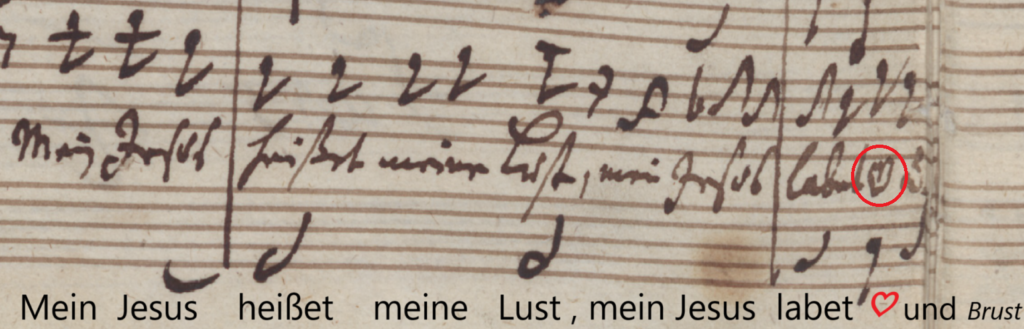
Ah yes, observes the shrewd musicologist2: Bach had no room left at the end of the line to write the word out in full, so he used the symbol. That could be – although Bach is a master at abbreviating text to fit it under the notes. But this time there is more to it. From this moment on, Bach replaces the noun Hertz (singular) with the symbol every time it occurs in this cantata.3 See for yourself. In the echo aria (Flößt, mein Heiland, flößt dein Namen) the word does not occur, but in the recitative that follows (Wohlan, dein Name soll allein in meinem Hertzen sein) it turns up again.4 Again it is the bass who sings the text. He is responding to the fine chain of epitheta the soprano addresses to Jesus in the chorale:
Jesu, meine Freud und Wonne,
meine Hoffnung, Schatz und Teil, […]
mein Erlösung, Schmuck und Heil,
Hirt und König, Licht und Sonne…
So will ich dich entzücket nennen,
wenn Brust und ♡
zu dir vor Liebe brennen.
Jesus, my joy and my delight,
my hope, my treasure and my portion, […]
my redemption, my adornment and salvation,
shepherd and king, light and sun…
So, enraptured, will I name you
when breast and ♡
burn with love for you.
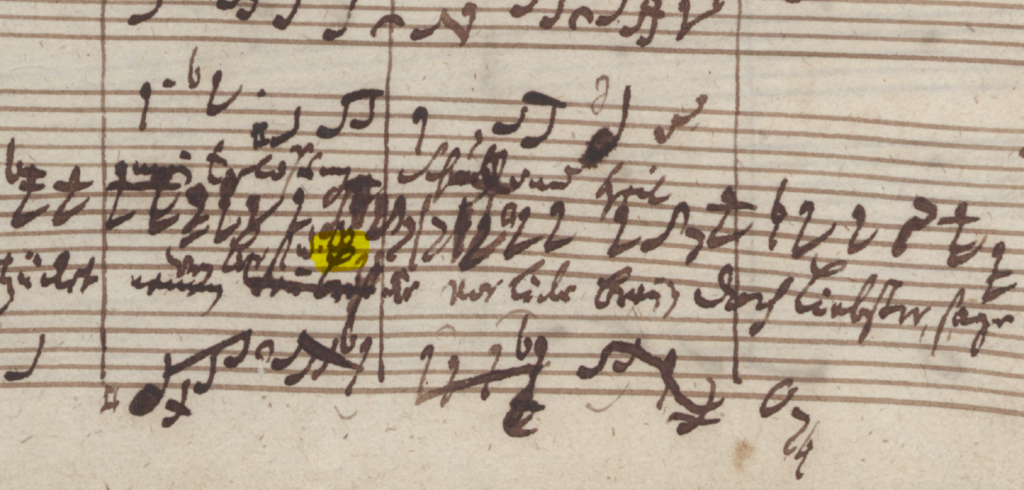
My apologies: Bach made rather a mess of this page – he too was only human. Apparently,he had evidently the text under the notes too quickly and then had to squeeze “wenn Brust und Hertz zu” in between “nennen” and “dir”. So: cross out, and write above. There seems to be a correction in the notes as well. Once more, sorry for the chaos..., but the symbol is undeniably there again in place of the spelled-out word: Hertz.
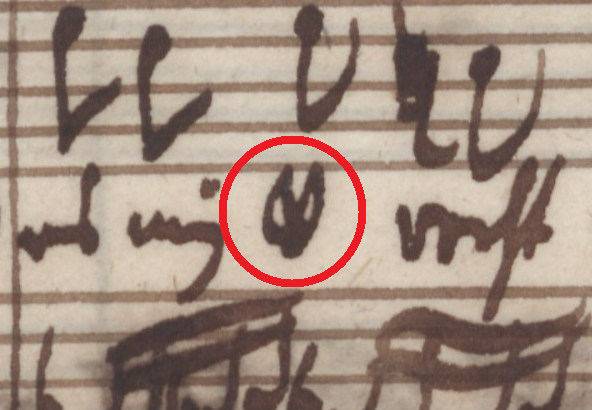
Is it still shortage of space? Yes, could be – were it not that in the pièce de résistance of this cantata, the tenor aria that follows (Ich will nur dir zu Ehren leben), Bach has all the time and room he needs to write the word out, and does not. Twice. Below the text I reproduce first the whole page, then the last instance in close-up.
Ich will nur dir zu Ehren leben,
mein Heiland, gib mir Kraft und Mut,
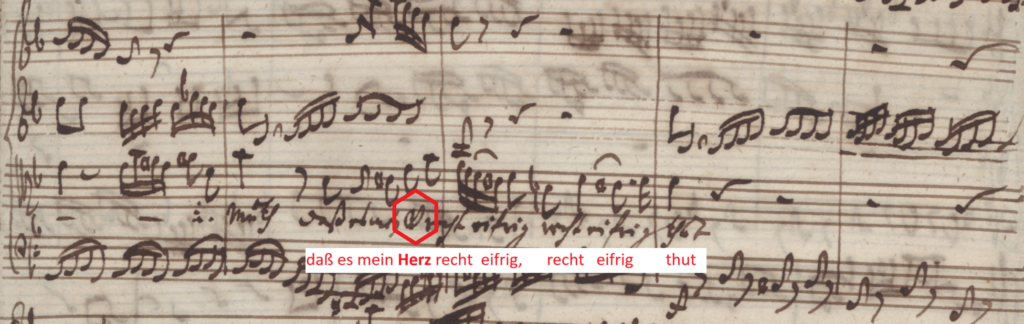
daß es mein ♡ recht eifrig tut!
I will live only to your honour;
my Saviour, give me strength and courage,
that my ♡ may do it with true zeal!
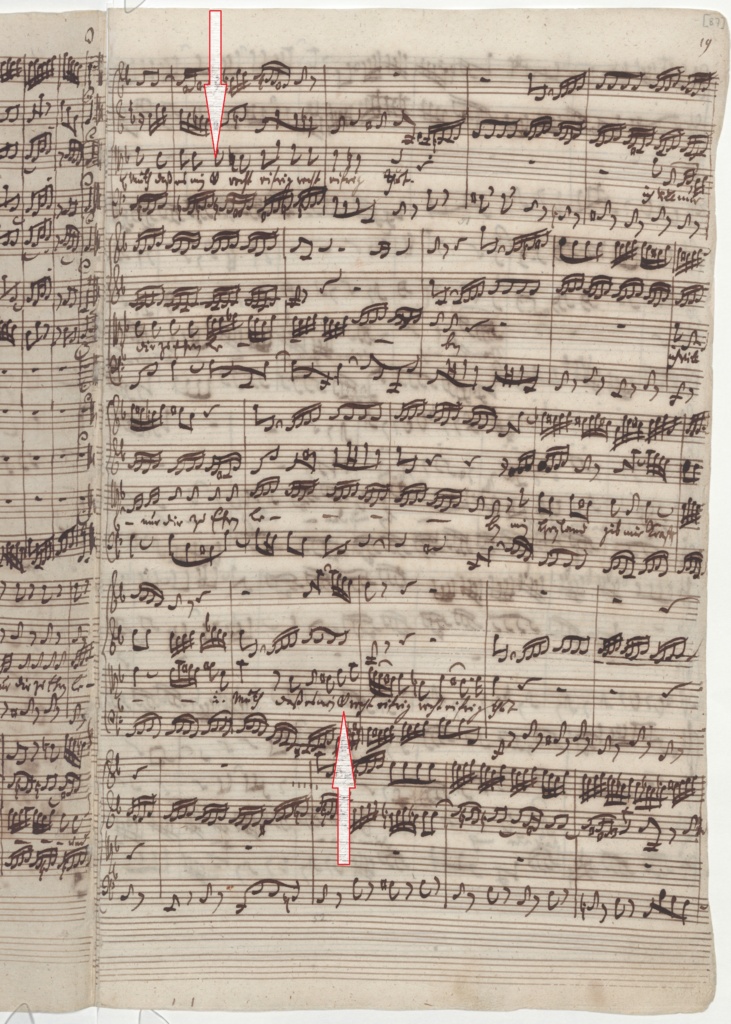
As you can see, the first time on this page Bach certainly had room enough to write Hertz out in full. There too he draws the symbol.
Do listen to this aria, by the way: it is a fugue and an aria in one. An up-tempo performance by Rudolf Lutz is here. In passing: the music of this aria comes from the secular cantata Hercules auf dem Scheidewege (more about that here). There the text speaks of soaring on eagles’ wings – and you can still hear it when the tenor sings Leben: in the original the word at that point is schweben.
Conclusion
So what is the deep meaning of all this, you ask; the profound significance? Well – there is none, unless of course you see one. Bach probably just thought it rather nice, once he had done it the first time. People do – thank God – things that carry no deep meaning at all, done for no reason, but which, once done, raise a smile.
New Year 2025, Dick Wursten.
With thanks to Martin Petzoldt, Bach-Kommentar II (p. 213),
who notes the presence of this symbol in the text – not the first to do so, but he is the one who opened my eyes...
All images of BWV 248 from Bach digital.
- ‘God with us’.↩
- Markus Rathey, Johann Sebastian Bach’s Christmas Oratorio.↩
- Martin Petzoldt, Bach-Kommentar II, p. 213, signals the presence of this ‘symbol’ (‘drawing’) in the three movements of this cantata. He offers no comment on the occasion or the reason for it.↩
- Not in the opening line, since Hertzen there is a dative. That would give “♡-en”, which makes little sense and looks worse.↩