Bach on ‘Numbers’ and ‘Deuteronomy’ (Calov)
In this section, we notice that Aaron’s blessing is abundantly marked by Bach, with underlinings and a lot of obliques in the margin, emphasizing words/phrases. It even looks he has done this in two stages. There are almost invisible (bleached) underlinings and quite black ones. Also some other quite interesting passages about excommunication, borrowing and debts.
Book of Numbers (Numeri – 4 Mose)
Column
766 (fac. 67).
Num 1 v. 47 But the Levites according to their
ancestral tribe were not counted. (because they
were not a part of war. Therefore
our bishops violate God’s commandment when they offer themselves
for war. Matthew XX 15. 16. and II Timothy II. 2.)
Der offentliche Hohepriesterliche Segen (the Aaronic blessing)
Aaron’s blessing is abundantly marked by Bach with underlinings and markings in the margin (= italics in the text below), emphasizing words/phrases. It even looks that he has done this in two stages. There are almost invisible (bleached) underlinings and quite black ones..
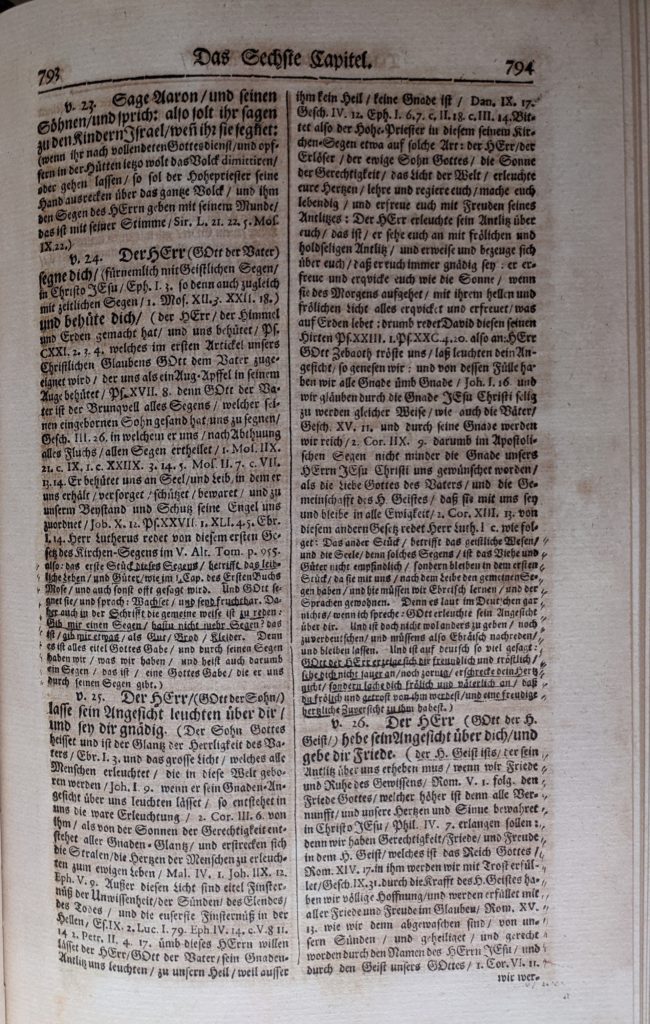
Column 793-797 (fac.
68).
Num 6 v. 24 The Lord (God the Father) bless
you … and keep you … (He keeps us in soul and
body by holding us, caring for us, protecting us, sustaining us, and
by dispatching his angels for our support and protection. job X. 12.
Psalm XXVII. 1. Psalm XLI. Hebrews I. 14. Luther speaks of
this first law of the church blessing in Altenburg, vol. V, p. 955,
as follows: the first part of this blessing concerns
the physical life and goods as is stated in the first
chapter of Genesis and elsewhere. And God blessed them and spoke:
Grow and multiply. Thus in the Scripture it is common expression:
Give me a blessing, have you no further blessing? That is, give
me something such as property, bread, clothing. For it is
all God’s own gift, and through His blessing we have what we have,
and it is called a blessing because it is a gift of God which He
has bestowed upon us through His blessing.)
v. 25 The Lord (God the Son) make His face to shine upon you and be gracious to you. (… of this second law Luther speaks loco citato [the place mentioned] as follows: The second part concerns the spiritual being and the soul, for such a blessing means nothing in terms of cattle and property, but remains with the first part of the law for they have a common blessing after the physical life. And here we must use Hebraic phrasing and get used to this language. For it means nothing at all in translation when I say: God make His face to shine upon you. And there is really no other way to say it and translate it and we must paraphrase the Hebrew and let it be. In translation it means roughly: May the Lord your God show Himself to you in a friendly and comforting way, may He not look at you bitterly or angrily, not frighten your heart, but rather smile upon you joyfully, like a father, that you be glad and comforted by Him and that you have a happy heartfelt trust in Him.)
v. 26 The Lord
(God the Holy Spirit) lift up His countenance upon you
and give you peace. ([still Luther?]
It is the Holy Spirit that must lift its countenance above us
if we should gain peace and solace of conscience, Romans V. 1. and
following, the peace of God which passes beyond all understanding
and which sustains our hearts and senses in Jesus Christ,
Philippians IV. 7. For we have righteousness, peace, and joy in
the Holy Spirit, which is the kingdom of God, Romans XIV. 17. in
Him we are filled with comfort, Acts IX. 31. through the power of
the Holy Spirit we have complete hope and are filled with peace
and joy in faith, Romans XV. 13. as we have grown free of our sins
and are saved and brought to justice through the name of Jesus and
through the spirit of our God, I Corinthians VII. 11.
Column 795 (fac. 69).[…] therefore the Israelite
church together with the goodness of the true God, God the Father,
Isaiah LXIII. 7. 16. and with the love of God the Son, the angel
not created who stands before God the Father, the angel of His
countenance who aided them and delivered them as their Jesus and
Savior; v. 8. v. 9. as Jacob too has acknowledged Him in his
patriarchal blessing, Genesis XLVIII. 16. , as the angel who is
his ‘Goel’ [redeemer] who saved him from all evil
of body and soul; it [the soul] praises and honors God the Holy
Spirit who stood among them and guided Moses their leader
with His glorious arm, that is, with His divine force in his right
arm which they however turned away in the wilderness, making Him
their enemy and causing Him to struggle against them … Isaiah LXIII.
10. 12. […]
Column 796 (fac. 69) […] Luther also speaks loco citato
[at the place mentioned] about the third part of the law: The
third part also concerns the spiritual being and the soul
and is a wish for consolation and eventual victory beneath the
cross, death, the devil, and all hellish gates together with the
world and all other evil spirits of the flesh. For if He has been
merciful to us and has forgiven our sin and adorned us with His
spirit. We still face the task for ourselves of engaging in
struggle with the devil and with all other sin. And following that
point: here we must also turn to Hebraic wording, for it means
nothing if I say in translation, the Lord lift up His
countenance upon you. And one cannot really translate the meaning.
For the meaning should be: when God causes His countenance
to shine or to beam upon you then the attack and persecution of
the devil, the world, and our flesh makes such a raging
storm in our heart that it seems to us that the dear light of the
cherished divine Word were to perish and to leave us in darkness.
[…]
Column 797 (fac. 70)… this blessing is not much
different from the other common blessing which one speaks in Latin
and is rendered in German as follows: May God the Father,
the Son, and the Holy Spirit bless you, Amen. For to the
Father is attributed the work of the creation which our blessing
also touches and expresses more clearly when it says: the Lord
bless you and keep you, meaning, may He often provide graciously
body, life, and everything that belongs with it. To the Son is
attributed the work of salvation which this blessing also touches
and makes clear when it says: the Lord make His face to shine upon
you, i. e. , meaning, may He help you from sin and be merciful to
you and give to you His spirit. To the Holy Spirit is attributed
the work of daily salvation, comfort, and strength against the
devil and eventually the awakening from death which this blessing
also touches and makes clear when it says: may the Lord
lift His countenance, i.e. meaning may He strengthen you, comfort
you, and give you eventual victory.)
Some corrections
–
Column 800 (fac. 71).
Num 7 v. 19 His offering was one silver plate
worth one hundred thirty shekels[Bach inserts in margin
“eine silberne Schale siebenzig Seckel werth” (one
silver basin worth seventy shekels)], according
to the shekel of the sanctuary both filled with fine flour mixed
together with oil as a cereal offering: 20 one golden spoon
worth ten shekels of gold filled with incense; 21 one young
bull, one ram, one lamb a year old for a burnt offering; 22 one
male goat for a sin offering.
– Column 803-804 (fac. 72).
Num 7 v. 61vv His gift was one silver
plate worth one hundred and thirty shekels [Bach
inserts (scribal sign) ‘Ƒ’) at the outer margin “Ƒ eine
silberne Schale seibenzig Seckel werth” (one
silver basin worth seventy shekels)] according
to the shekel of the sanctuary, both filled with fine flour
mixed together with oil as a cereal offering. 71 And as an
offering of thanksgiving two oxen [Bach inserts “5
Widder” (five rams) placed in the empty space
above)], five male goats, and five lambs a year
old. This was the offering of Ahiezer, the son of Ammishaddai.
72 On the eleventh day the leader of the children of Asher,
Pagiel, the son of Ochran. v. 73 His gift was one silver plate
worth one hundred and thirty shekels .[Bach
inserts in the empty space after the end of the previous phrase.
“eine silberne Schale siebenzig Seckel werth” (one silver
plate worth seventy shekels)] according to the
shekel of the sanctuary, both filled with fine flour mixed
together with oil as a cereal offering.
The journey through the Waste Land (Num. 9)
Column 814 (fac. 73). Noteworthy: Bach highlights an edifying text about ‘life as a journey’, a pilgrim’s progress towards Jerusalem. (Opvallend deze lange ‘markering’ van een stichtelijke tekst over de ‘levensreis’).
Context: Numbers 9:16-23: The cloud by day and the fire by night protect and guide tje people of Israel during their journey through the desert.
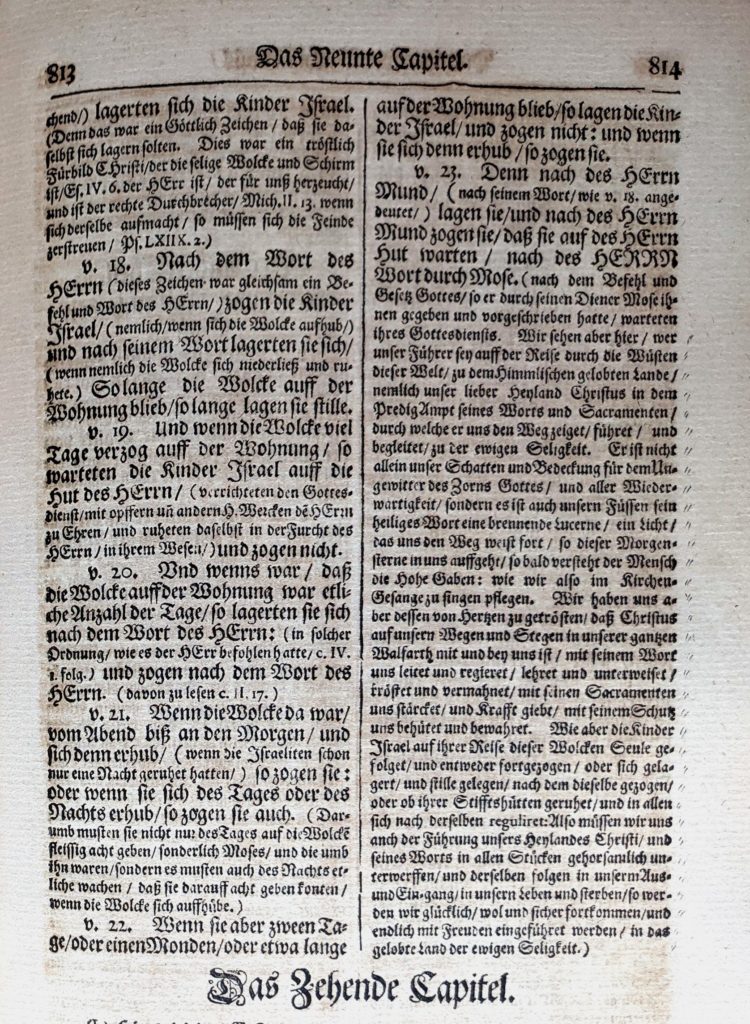
Num 9: v. 23
Deutsch…
v. 18: Nach dem Wort des HErrn
zogen die Kinder Israel (nemlich / wnn sich die Wolcke
aufhub /) und nach seinem Wort lagerten sie sich /
(wenn nemlich die Wolcke sich niederließ und ruhete)…
… Denn nach des HErrn Mund […] lagen sie
/ und nach des HErrn Mund zogen sie / daß sie auf des HErrn Hut
warten / nach des HERRN Wort durch Mose. (..
Wir sehen aber hier / wer unser Führer sey auff der Reise duch die
Wüsten dieser Welt / zu dem himmlischen gelobten Lande / nemlich
unser lieber Heyland Christus in dem PredigAmpt seines Worts und
Sacramenten / durch welche er uns den Weg zeiget / führet / und
begleitet / zu der ewigen Seligkeit. Er ist nicht allein unser
Schatten und Bedeckung für dem Ungewitter des Zorns Gottes / und
aller Wiederwartigkeit / sondern es ist auch unsern Füssen sein
heiliges Wort eine brennende Lucerne / ein Licht / das uns den Weg
weist fort / so dieser Morgensterne in uns auffgeht / so bald
versteht der Mensch die hohe Gaben: wie wir also im Kirchen-Gesange
zu singen pflegen. Wir haben uns aber dessen von hertzen zu
getrösten / daß Christus auf unsern Wegen und Stegen in unserer
gantzen Walfarth mit und bey uns ist / mit seinem Wort uns leitet
und regieret / lehret und unterweiset / tröstet und vermahnet / mit
seinen Sacramenten uns stärcket / und Krafft giebt / mit seinem
Schutz uns behütet und bewahret.
Wie aber die Kinder Israel auf ihrer Reise dieser Wolcken Seule
gefolget / und entweder fortgezogen / oder sich gelagert / und
stille gelegen / nach dem dieselbe gezogen / oder ob ihrer
Stifftshütten geruhet / und in allen sich nach derselben reguliret
: Also müssen wir uns auch der Führung unsers Heylands Christi / und
seines Worts in allen Stücken gehorsamlich unterwerffen / und
derselben folgen in unserm Aus- und Ein-gang / in unsern Leben und
Sterben / so werden wir glücklich / wol und sicher fortkommen / und
endlich mit Freuden eingeführet werden / in das gelobte LAnd der
ewigen Seligkeit.)
At the command of the Lord (at the word of the Lord, as suggested by v. 18) they encamped and at the command of the Lord they set out so as to keep the charge of the Lord according to the word of the Lord by Moses (by the order and law of God as he had given and prescribed it through His servant Moses they awaited their service to God. We see here who the guide must be for our journey through the wilderness of this world toward the heavenly promised land, namely our dear Savior Christ in the ministry of His word and sacraments by which he shows, leads, and accompanies us upon the path to eternal blessedness. He is not only our shadow and covering before the storm of God’s wrath and all adversity, but His word is also a beacon, a lantern for our feet that points us to the path onward, and when this morning star rises in us man understands the sublime gifts: as we are accustomed to singing in church hymns. We must have this comfort in our hearts that Christ is with us and among us along every path and climb of our pilgrimage, that He, with His word, leads and governs us, teaches and directs us, comforts and admonishes us, and that He strengthens us and gives us power with His sacraments, and that He shelters and sustains us with his protection. Just as the children of Israel on their journey followed the pillar of cloud and moved forward or rested in camp as the cloud passed, or stayed in their Tabernacle governing themselves in every matter according to the movement of the cloud: Thus must we surrender ourselves obediently in every matter to the guidance of our Savior Christ and His word, and comply with it with our leaving and coming, our life and death, then we shall proceed happily, well, and safely and finally be ushered joyfully into the promised land of eternal blessedness.)
Some corrections
Column 834 (fac.
74).
Num 13 v. 30 And the Amorites dwell in the land
toward the south(they actually lived in the land of
Canaan but they were [Bach inserts “nicht” (not)]
located so close to the border that by appearances they could bar
the passage of the children of Israel. Genesis, XIV. 7.)
Columns
844-845 (fac. 75).
Num 15 v. 6 When a ram is to be sacrificed you
shall prepare for a cereal offering two[Bach crosses
out “Semmel” as a duplication misprint and writes in “zehenden”
(tenths)] units of fine flour mixed with a third
of a hin of oil.
Column 849 (fac.
76).
Num 16 v. 1 And Korah(Numbers XXVI. 9.
XXVII. 3. Jude v. 11.) the son of Jezehar(he was
[Bach crosses out ‘Aarons’ and inserts ‘Amrams’]
brother, who was the father of Moses and Aaron, so they were the
closest blood relations, Exodus VI. 18. 21.)
Column 858 (fac.
77).
Num 16 v. 49 Now those who died by the plague
were fourteen thousand seven hundred[Bach writes in the
margin the number ‘14700]..
besides those which died with Korah.
Column 870 (fac.
78).
Num 19 v. 13 But if anyone touches a dead
person and does not want to cleanse himself he defiles the house
of the Lord (when he enters this place with others who
are clean) and such a soul (such a person) shall
be cut off from Israel because the water of purification was not
poured over him: thus he is unclean as long as he does
[Bach restores the missing “nicht” (not)]
let himself be cleansed by it.
Deuteronomium (4.Mose)
Column 991 (fac.
79).
Deut 6 v. 3 Israel, you shall hear and remember
that you do these things so that you shall fare well and ever grow(this
applies to the entire people, as all were admonished in particular
earlier) as the Lord the God of your fathers has spoken(promised,
vowed) to you, [Bach writes (the missing
words) “im
Lande” (in the land)] where milk and honey flow.
(Exodus III. 8.)
Column 1002 (fac.
80).
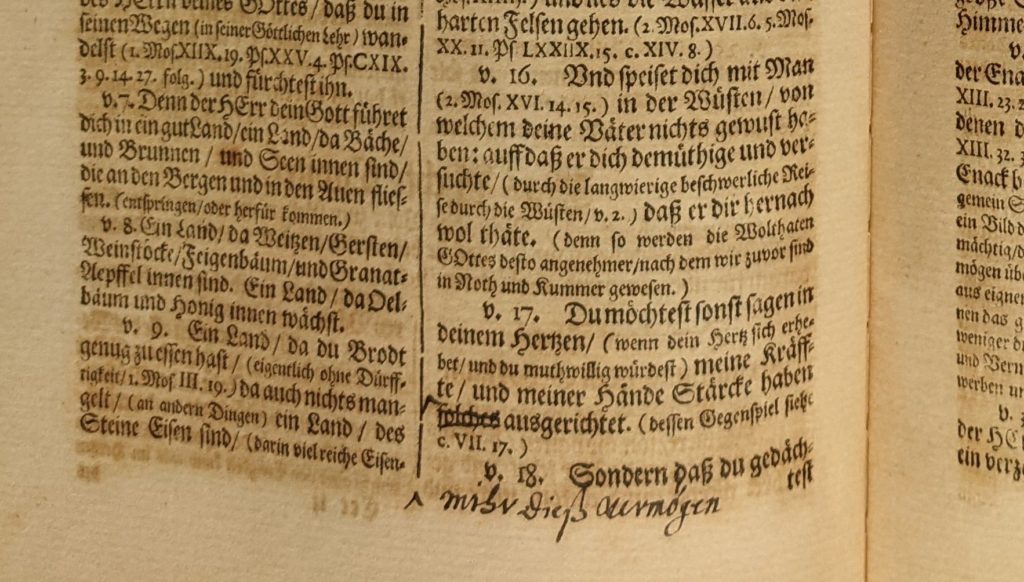
Deut 8 v. 17 Lest you might say in your heart(if
your heart should exalt itself and if you should become wanton) my
powers and the strength of my hands have gotten such things. [Bach
crosses out “solches” (such things) and replaces it with ‘mihr diess
vermogen’ (enabled me thus)] (the counter example of which
is found in VII. 17.)
Column 1047 (fac.
81).
Deut 17 v. 12 And where someone would act
presumptuously by not obeying the priest who stands in the office
of the Lord your Cod(X. 8) or the judge, that
man shall die(so earnestly does God wish to prevail over
haughtiness and power of the [Bach inserts “Obrigkeit”
(authorities)] and shall put the evil out of
Israel.
Von Zeugen (about Witnesses), doing justice and punishment
Bach’s interest in ‘justice’, and how ‘judgment is passed properly’.
Column 1052 (fac.
82).
Deut 19 v. 15 A single witness shall not confront
anyone(nor shall it be allowed that one pass judgment
following a single testimony Numbers XXXV. 30. , Deuteronomy XVII.
6. , Matthew XVIII. 16. , John VIII. 17. 2 Corinthians XIII. 1.
Hebrews X. 28.) over any kind of misdeed or sin, whatever
kind of sin it may be that one can commit: instead let the matter
be proven in the testimony of two or three witnesses.
(If however the two witnesses speak falsely, what then shall
the judge do? Luther answers fol. 1099 (=Altenburg ed.?). If
he knows that they are bearing false witness then he shall not
pass judgment; if he does not know it, then he shall pass
judgment according to the testimony, for that binds the order of
the court as established by God which requires that one give
credence to two witnesses. God will, however. exact
retribution from the witnesses and the witnesses will have to see
how they account before God for abusing His order and power for
the ruin of their neighbor, as the deceitful witnesses did toward
Naboth the Israelite, toward Christ and Stephen, and whoever
perishes thus shall include his loss among those which we cited
above, that every citizen must expect from the other man, as there
are flames, epidemics, pestilence, war, torment, and all sorts of
power and injustice. For just as he is forced to suffer the danger
of flames and fire from his neighbors, so he must also suffer
false witnesses and all sorts of harm.)
[…]
Columns 1052-1054 (fac. 83) Bach underlines the principle of intent-based ethics and endorses capital punishment.
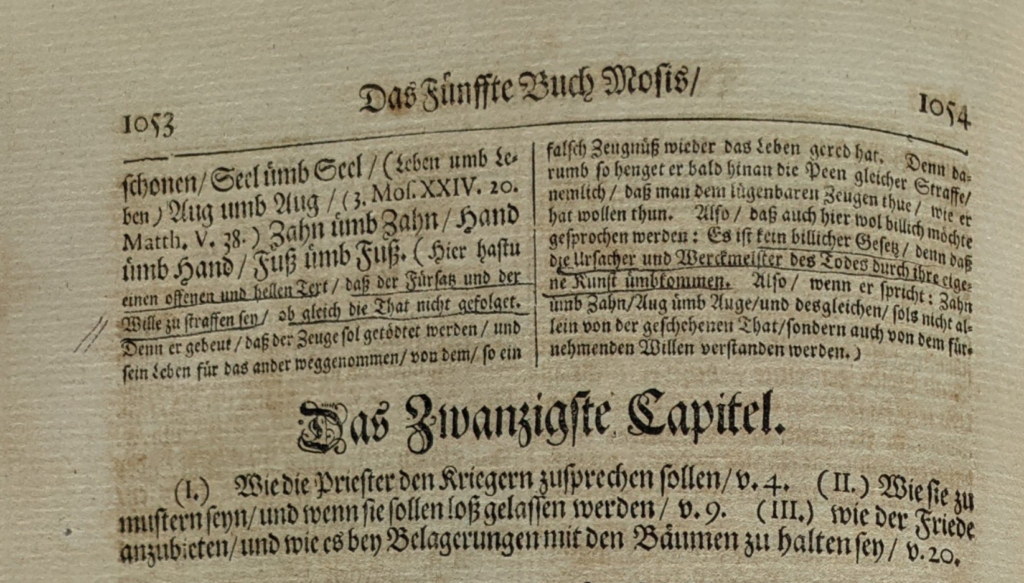
Deut 19 v. 21
Seel ümb Seel / (Leben
umb Leben) Aug umb Aug / (3.MOs XXIV. 20.
Matth.V. 38.) Zahn umb Zahn / Fuß umb Fuß. (Hier
hastu einen offenen
und hellen Text / daß der Fürsten Wille in straffen sey / ob
gleich die That nicht gefolget.
[…]
Also / daß auch hier wol billich möchte gesprochen werden: Es ist kein billicher Gesetz / denn
daß die Ursacher und Werckmeister des Todes ducht ihre eigene
Kunst ümbkommen.
Your eye shall not take pity, spirit for spirit (life for life) eye for eye(Leviticus XXIV. 20. Matthew v. 38.) tooth for tooth, hand for hand, foot for foot. (Here you have an open and clear textual evidence that intent and will are punishable even if the deed does not occur. For He commands that the witness be killed and his life taken away in exchange for the other, as a false witness has testified against life. Thus he applies the pain of equal punishment, namely that it be done unto the deceitful witness as he himself had wanted to do. Therefore let it be fittingly said: there is no fairer justice than having the purveyors and executors of death themselves succumb to their own art. Thus when He speaks, tooth for tooth, eye for eye, and so forth, it should be understood not only for the committed deed but also for the presumptuous will.)
About excommunication
Columns 1067-1068 (fac.
84).
Deut 23 v. 4 Because they did not come unto you
with bread and water as you journeyed out of Egypt, and because
they hired against you Balaam the son of Beor from Pethor of
Mesopotamia to curse you. (Numbers XXII. 3. 4.
these pagans , says Luther, shall not only suffer from the failing
of flesh and birth but from their crime and hatred: by not only not
cooperating with the Israelites, but instead wishing that they be
slain, that they prayed that they [the Israelites] would be cursed
by Balaam, by which they established their eternal intrinsic hatred
which they will bear forever and ever, as will subsequently be shown
by the histories. [Bach
marks the following passage “NB”: ] If you want
to turn into a guardian or a superior someone who you know seeks
your ruin out of inborn hatred, that is not merely disreputable
and ungainly, but also foolish and an outrage and a temptation
of God: but to enter into marriage with them and to
join in society and community with them is not forbidden here.)
Column 1070 (fac.
85).
Deut 23 v. 78 You shall not bring the hire of a
whore or the price of a dog into the house of God for any vow. For
that is an abomination to the Lord your God. (Exodus
XXII. 25. Leviticus XXV. 36. Nehemiah V. 2. Luke VI. 3. For God does
not want, says Luther, for plunder
to be offered to Him in sacrifice, and everything gained through sin and evildoing he
disavows, for he wants to be praised honorably and with fear;
therefore one should not carry as sacrifice or as an edifice into
the house of the Lord anything that is a trifle, a disgrace, and a
vileness lest God also be reviled by it; whoever allows that He be
honored with such meager, negligible, and base things is like the
common people that are accustomed to despising those that they see
by developing a lust for disgraceful things. For He wants the common
people to be grasped and held with a reputable appearance in fear
and in its worthiness. And that is the reason that money
that a dog is sold for should not be sacrificed. For in
the Scripture the dog is held to be the lowest creature… .)
Von Pfänden und Menschenraub (about debts and pledges, and punishment)
Column 1073 (fac. 86).
Deut 24 v. 6 You shall not take the upper or the
lower millstone in pledge(of a hand mill which everyone
needs at home to grind his grain, compare Exodus XI. 5. Numbers XI.
8. Jeremiah XXV. 10). for he(your neighbor) has
taken his spirit(his life, that is, that with which he
must provide for his life) in pledge. (This
law, says Luther, teaches with a common proverb that one should not
be guilty of thwarting anyone’s handicraft by which he sustains
himself, as it is an
outrage among us common people that they cast the debtors into
prison until they pay us completely or that we forbid them
to do their handicraft and their labor. [Bach marks the
preceding “NB”. – Is there a
personal memory – Weimar? Once again we notice Bach’s social engagement,
sym-/empathy for ordinary people, laborers, craftsman] For
here he speaks that it is sufficient that he has given his soul in
pledge, that is, because he is completely your debtor and that he
must make payment to you with earnings from his handicraft.
Therefore it is cruel and unfair to charge someone that by which he
with twofold harm is forced to pay the one debt: it is a
shame that for this time his millstone stands idle; a further
shame that he makes new debts elsewhere or sells his goods so that
he may pay.)
Von Schuldforderung (Pledges / debts]
Column 1074 (fac.
86).
Deut 24 v. 12 And if he is a poor man, you shall
not sleep in his pledge:
v. 13 Rather; you shall return to him his
pledge when the sun sets(Exodus XXII. 26.) so
that he may sleep in his cloak(so that he may sleep more
comfortably) and may bless you(that is, that he
may remember your charity in prayer and blessings before God, that
he may thank you) and it shall be righteousness to you
before the Lord your God. (a work pleasing unto
God which, because it originates with a believer, through the Lord’s
Messiah, is gratifying to Him; chapters VI. 25. IX. 5. Psalm CVI.
31. Luke I. 74- 75. Romans VI. 18-19 Galatians V. 6. Philippians I.
11. Hebrews XI. 6. Others understand righteousness to be a blessing
of God and reward; II Corinthians IX. 9. In pledges of debt as in all other Contracten
Christian love should be Empress, in that we distribute to
the needy one who does not have his. daily bread and that we also
take no such pledge from one another that he and others are not
forced to sus pend their lives.)
Von frembden und Wäysen [the poor and their support]
Column 1075 (fac.
87).
Deut 24 v. 17
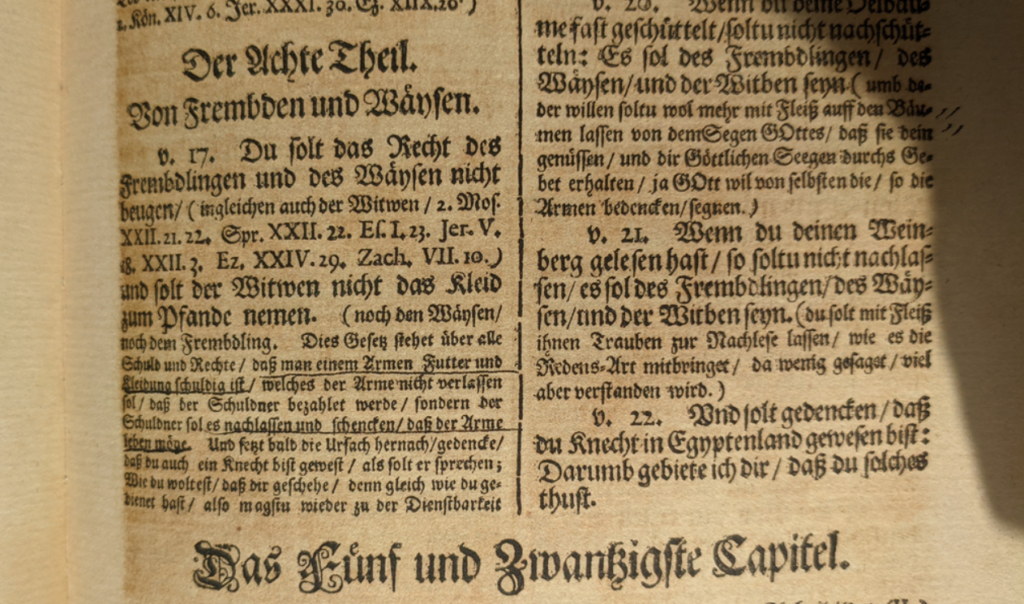
Dt 24:17
Du solst dat Recht des
Fremdlingen und des Wäysen nicht beugen (ingleiche auch
der Witwen / 2.Mos…
..) und solt der Witwen nicht das Kleind zum Pfande nemen.
( noch den Wäysen / noch dem Frembdling. Dies Gesetz stehet über
alle Schuld und Rechte / daß
man einem AermenFutter und Kleidung schuldig ist / welches
der Arme nicht verlassen sol / daß der Schuldner bezahlet werde /
sondern der Schuldner sol es nachlassen
und schencken / daß der Arme leben möge
You shall not pervert the justice due the sojourner or the fatherles (also widows, Exodus XXII 21-22. Proverbs XXII. 22. Isaiah I. 23. Jeremiah V. , XXII. 3. Ezekiel XXIV. 29. Zechariah VII. 10.) or take the widow’s garment in pledge. (nor the orphan’s nor the sojourner’s. This law stands above all debt and rights that one is obligated to the poor man for food and clothing. Further, that the poor man should not rely on the debtor being repaid, but instead the debtor should remit it and make it a gift so that the poor man may live. And the reason is this: be mindful that you also have been a wretch, as he shall speak: As you willed that it be done unto you, thus may you be returned in service just as you have served, thus learn from your own example what you owe to them and what you should do for them.)
Column 1076 (fac.
87).
Deut 24 v 18 Denn du solt gedencken / dass du
Knecht in Egypten gewesen bist / und der HErr dein GOtt dich von
dannen erlöset hat: daumb gebiete ich dir / dass du solches
haltest.
Dt19 v. 19 -20