Bach on Job and the Psalms (Calov)
Many people expected to find quite a lot of markings in the Book of Psalms, but that is not the case. This does not imply he failed to read them (he did, as his corrections attest); rather, it simply indicates he felt no need to highlight passages–likely because the text held "nothing new" for someone so thoroughly familiar with it. That, however, makes the few sections he did mark all the more interesting.
Aside: we now open the second book of the Calov-bible commentary of Bach, In Bach’s edition, this is the second part of the first volume.

J.N.J (= In nomine Jesu )
Der
H. Göttlichen Bücher
Andere Theil /
Darinnen begrieffen sind Die
Poëtischen Schrifften der H. Bibel / Die von den Männern Gottes /
gleichsam in Versen / beschrieben sind / wiewol derselben Versen
eigentliche Art / Form / und Weise niemand bis jetzo erforschen konnen /
Wie sie zur Lust / zum Gesang / oder mit Rythmis, und mit Reimen /
nach Art und mensur der kurtzen / und langen Syllaben,
abgefasset seyn. Als da sind:
Das Buch Hiob
Das Buch der Psalmen
Die Bücher Salomonis
Job – Hiob
Only two corrections
Column 49 (fac.
114).
Job 8 v.11 Can reeds grow where it is not moist?
Or grass without water? (Thus the godless
cannot blossom and grow if they are not quickened by the water of
heavenly rain and blessing, through the word and; pirit, or if they
are touched by the head of God’s wrath.) v. 12
Otherwise (without water’and necessary
moisture) even when still in bloom (or not yet)
[Bach adds
“ehe es” (before it)] is
cut down it withers (it must wither) before one
can make hay. (others: above all grass.)
Column 150 (fac. 120).
Job 31 v. 38 If my land cries out against me
(for revenge, Genesis IV. 10. Habakkuk 11. 11. Job IIX. 18. James V.
4) and all its furrows like an
other (or the ridges between each of two furrows) weep
(that I have not compensated those people who farmed them
for me.) [Bach
tries to restore the propter text, but only partly succeeds:
– Lutherbibel: “Wird mein
Land gegen mich schreien und werden miteinander seine Furchen
weinen….
– Calov Wird mein Land
gegen mich schreien und wie ein ander
seine Furchen weinen…
– Bach edits Calov: Wird mein
Land gegen mich schreien und wie
mit
ein
ander seine Furchen weinen…]
The Psalms
Columns 217-218 (fac.
121). (wrongly numbered 214-215) – Vorrede/Preface
… This book [Psalms] is thus regarded as a magnificent jewel in the
church as a whole and is referred to as a book of praise and thanks
by those who worship in Hebrew, Latin, and German; the Greek church
calls it a book of hymns and songs of praise because it contains
many excellent psalms of praise and thanks: thus the whole book is
named Psalterium, from a musical instrument with which the psalms,
hymns, and songs of thanks are actually played. And they have been
given many pleasing names: Basil the Great speaks of it as a rich
common “promptuarium” [storehouse] of all good teachings, in which
may be found what is needed for everyone’s blessing-a treasure of
perfect theology and a wealth of spiritual remedies for driving out
poisons and evil spirits and for preserving the protective vigilance
of the angels; all means of celebrating festive and joyful days: to
invoke many kinds of spiritual offerings, to
sound many kinds of beautiful melodies, and to give form to the
songs of angels. (allerley schöne Melodeyen / anzustimmen /
und Engliche (sic) Gesänge einzurichten)
Columns 222-223 (fac. 122).
The penance Psalms are sufficiently known: Psalms VI, XXXII,
XXXVIII, LI, CII, CXXX, and CXLIII. The Psalms of thanksgiving and
the Psalms of instruction cover the entire body of Psalms, and they
have all been earnestly used by the kings of Israel who were blessed
by God. But all Psalms ‘ hat are without title or which bear no name
are attributed to the king and prophet David [of which there are
fifty-one), along with those that expressly bear his name in the
heading (of which there are 72); thus there are one hundred
twenty-three which are ascribed in common to King David. The
remaining 27 stand with other names, according to title: namely,
Psalm XC to Moses; the two Psalms LXXII and CXXVII to King Solomon;
twelve to the prophet Asaph, David’s director of music: Psalms L,
LXXIII, LXXIV, LXXV, LXXVI, LXXVII, LXXVIII, LXXIX, LXXX, LXXXI,
LXXXII, and LXXXIII; one to Ethan the Ezrahite, namely Psalm LXXXIX;
eleven to the children of Korah, namely Psalms XLIII, XLIV, XLV,
XLVI, XLVII, XLVIII, XLIX, LXXXIV, LXXXV, LXXXVII, and LXXXVIII;
several are attributed to Jeduthun. But of these we find none except
for the title of Psalm LXXVII which reads, · Psalm of Asaph to be
sung for Jeduthun; ‘ meaning that Asaph composed it and assigned it
to be sung for Jeduthun: as also Psalm LXXVII indicates by title
that the children of Korah composed it and assigned it to Heman the
Ezrahite for his use and recitation. For though Heman and) Jeduthun
were prophets 1 Chronicles XXVI. 1. : Heman a seer, that is, a
prophet of the king’s in the words of God who is named to raise the
horn [in sound] 1 Chronicles XXVI. 5. 2 Chronicles XXXIV. 15. And
Jeduthun a seer of King Josiah: they
nonetheless attended to Instrumental Music as
ordained by David in service to their office, to execute it with
harps, psaltery, and cymbals. (original German: So
haben die doch auffgewartet bey der Instrumental Music,
wie sie verordnet gewesen von David zum Werck nach ihrem Ampt / mit
Harffen / Psalter / und Cymblen / solches zu verrichten)
Psalm 32:2 The blessedness of imputative justice
Column 362 (fac.
123). – von der waren Gerechtigkeit (Bach underlines
a very succinct summary, by Luther I presume, of the benificial
effect of imputative justice)
Ps. 32:2 Blessed the man to whom God assigns no sin. Thus
is blessedness: relief of the heavy burden of sin that until now
drove us into hell and the merciful covering of the horrible shame
of our misdeed and the forgiveness, not the attribution, of all
our transgression.)
Psalm 55:23: God’s providence: rhythmic casting…
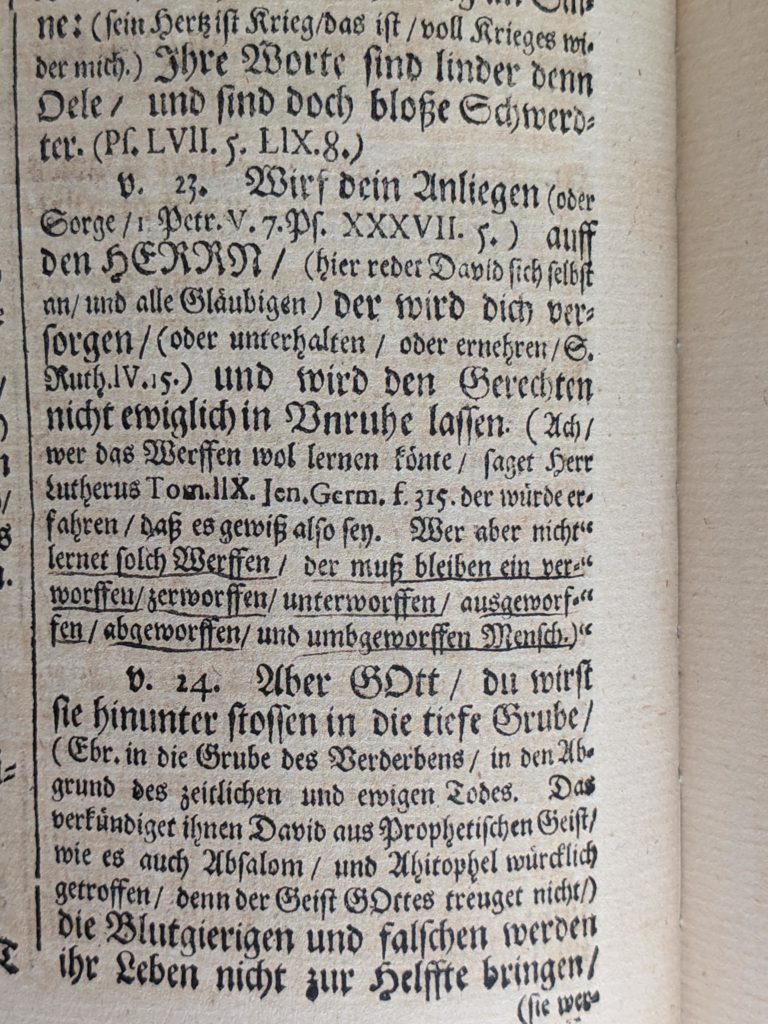
Column 468 (fac.
124).
Ps. 55:23 (Is it the
rhythm, the wordplay, that made Bach underline this – and/or the
content?)
Wirf dein Anliegen (oder
Sorge /1Petr.V.7. Ps.XXXVII.5.) auff den HERRN /
(hier redet David sich selbst an / und alle Gläubigen) der
wird dich versorgen (/oder unterhalgen / oder ernehren /
S. Ruth. IV.15) und wird den Gerechten nicht ewiglich in
Unruhe lassen. (Ach / wer das Werffen wol lernen könte /
saget Herr Lutherus Tom IIX.Jen.Germ.f.315 Wer aber
nicht lernet solch werffen
/ der muss bleiben ein verworffen, zerworffen, unterworffen,
ausgeworffen, abgeworffen, und umbgeworffen Mensch”).
Cast your care (or
worry, I Peter V. 7, Psalm XXXVII. 5.) upon the Lord [here
David speaks to himself and to all the faithful) and He
will care for you (or sustain or nourish, see Ruth IV.
15.) and He will not leave the righteous eternally in
unrest. (Oh he who cannot master this casting, says
Luther volume IIX German Jena edition, f. 315, will
realize this as certain. But he who does not master
this casting must remain a downcast, outcast, castaway,
castastray, castaside person.)
A number of corrections
Column
530 (fac. 125).
Ps. 68:36 Wondrous is God in His sanctuary (in
His church). He is the God of Israel (of the
spiritual Israel). He will give His people (that
He has acquired for it, Acts XX. 28. the holy people, the (Bach inserts
‘Volkes” (people)] of his own I. Peter; II. 19) power
and strength.
Column 535 (fac. 126).
Ps. 69:30 [in error for v. 29-Editor] But
I am afflicted (Psalm XLI. 1.) and in pain;
God, may [Bach changes “Meine” (my)
to “Deine” (Your)] help protect me. (Psalm
X. 18. Psalm XXXV. 3. 10. 17. Psalm XXXI. 17. 25. Psalm XXII. 22.
25. Psalm CX. 1. 7.)
Column 626 (fac. 127).
Ps 91:13 On (or upon) the lion (the
wild Iion) and adder [Bach adds what is
omitted:”wirstu
gehen” (you will step)] (with these wild animals are
included for example all others from the animal kingdom which
could be harmful to us, also serpents and reptiles) and
tread upon the young lion and dragon (we may step upon
poisor: tous, dangerous, and fierce animals or they may come into
contact with us and strike us, as eve·r may happen; if we trust in
God nothing can harm us. Ezekiel XI. 9. Hosea II. 18 compare I.
Samuel XVII. 37 Daniel 111. 16. VI. 22. Acts XXIIX. 5.)
Column 652 (fac. 128).
Psalm 100: 4 Gehet zu seinem Thoren ein mit Dancken zu seinen Vorhöfen mit Loben…. Bach adds the remainder: Dancket ihm, Lobet Seinen Nahmen.
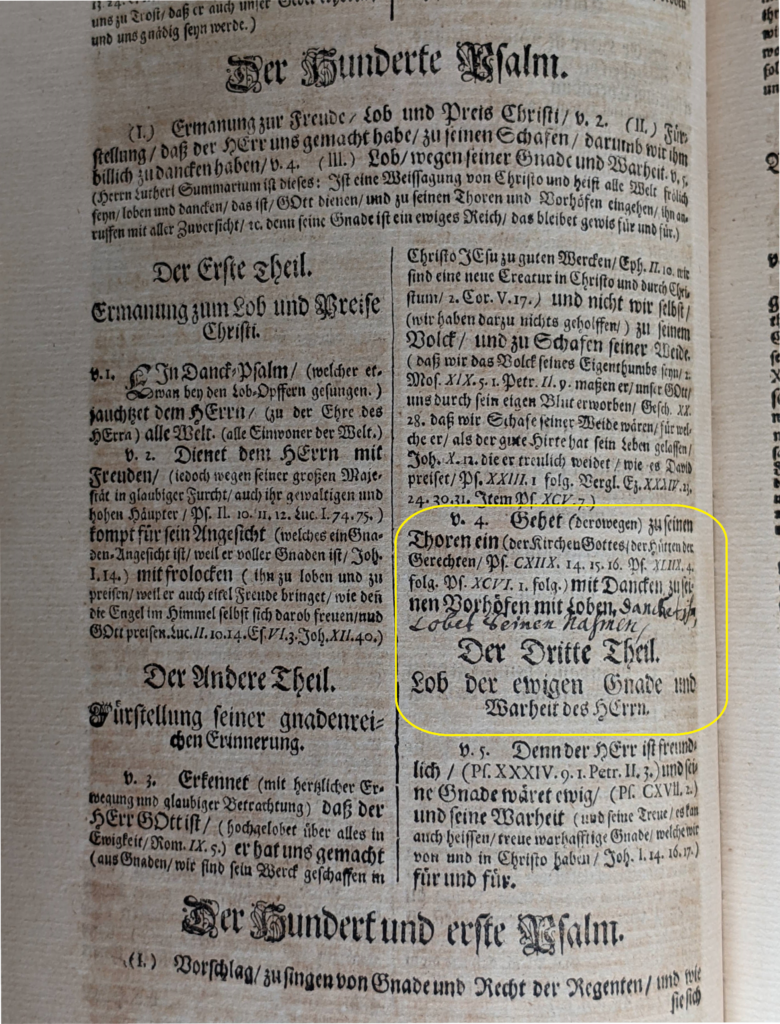
Ps. 100:4 Enter His gates with
thanksgiving, His courts with praise. [Bach inserts the
missing biblical text) “Danket
ihm, Lobet seinen Nahmen” (Give thanks to Him and praise
His name.)]
Ps. 101 Sound political leadership
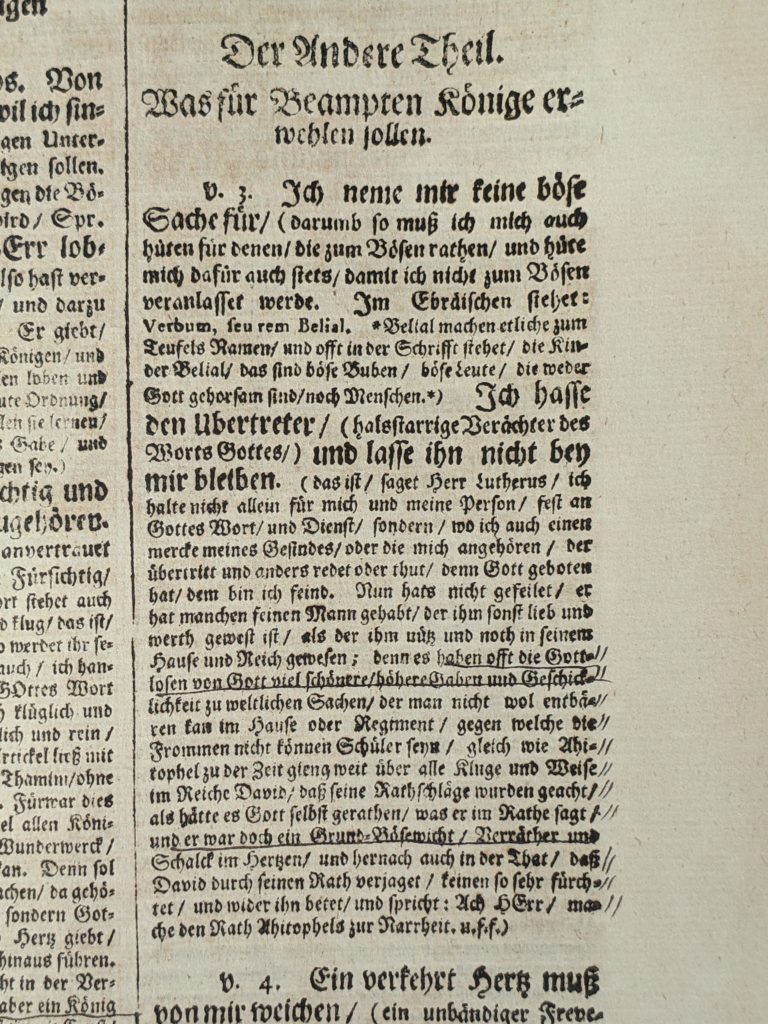
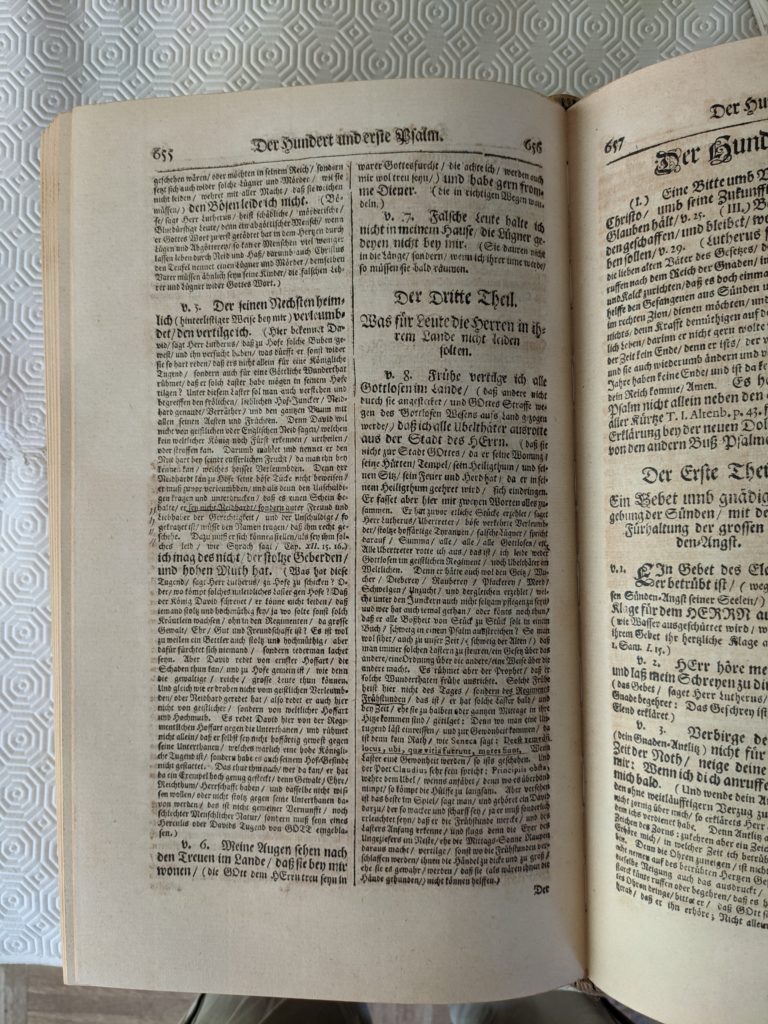
Columns 653-656 (fac. 129). = 4 columns with markings (both marginal and underlinings). This Psalm (better: Luther’s explication) must have appealed to Bach
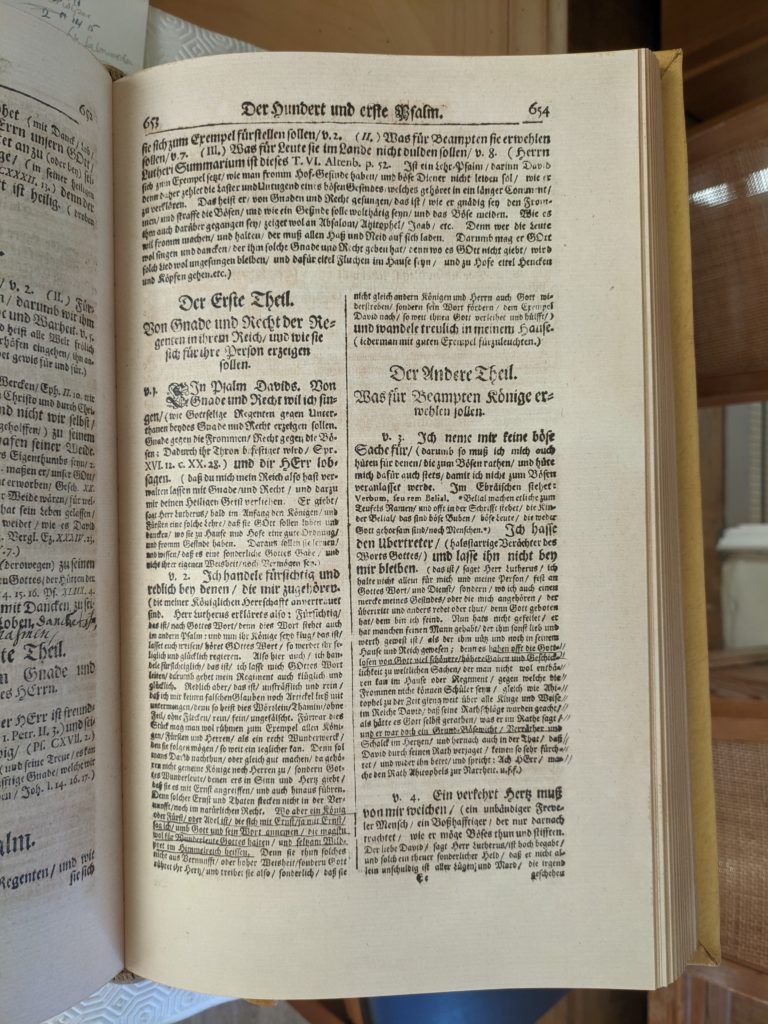
Von Gnade und Recht der Regenten in ihrem Reich / und wie sie sich für ihre Person erzeigen sollen
Psalm 101: The King as Gods (civil) servant
Ps. 101:2
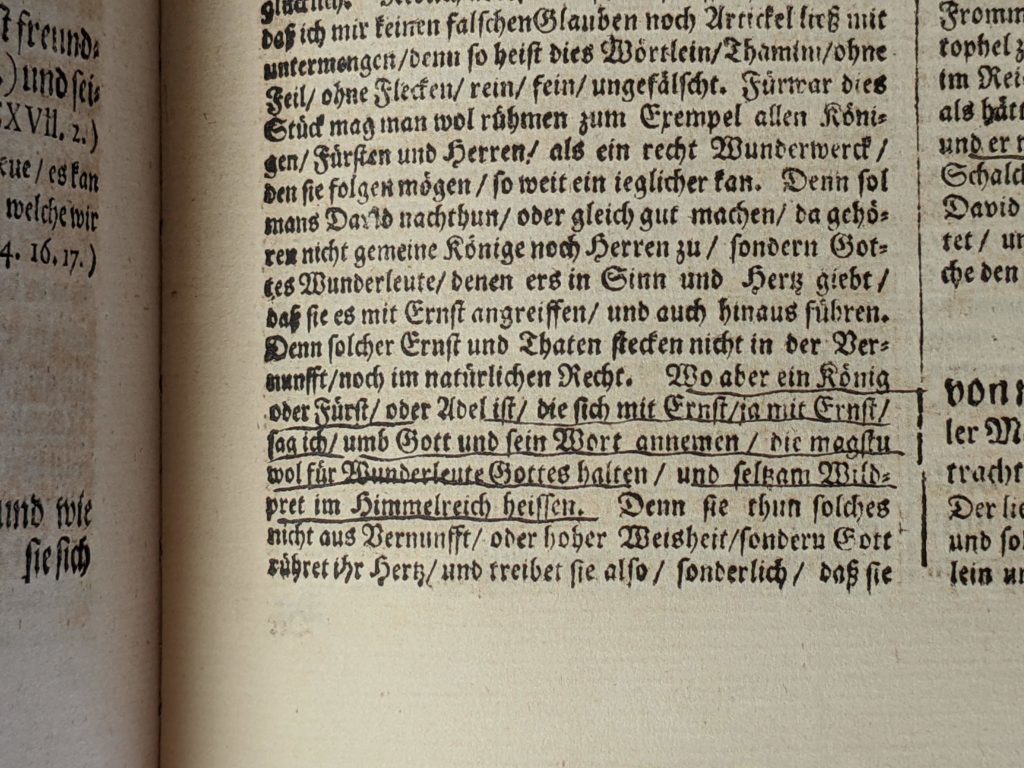
Ich handele fürsichtig und redlich bey denen / die mir zugehören – Herr Lutherus erkläret also: Fürsichtig / das ist… Redlich / das ist… Fürwar dies Stück mag man wol rühmen zum Exempel allen Königen / Fürsten und Herren / als ein recht Wunderwerck / den sie folgen mögen / so weit ein jeglicher kan. Denn sol mans David nachtun
I deal fairly and honestly with those who are of my household ..
If one were to follow David’s example or enact goodness in his manner, not common kings or masters but rather special servants of God would be needed whom he has inspired in heart ano mind to seize and carry out His will with earnestness. For such earnestness and acts are neither part of man’s reason nor his natural right. However, where there is a king or prince or nobleman who earnestly-yes I say earnestly-embraces God and His word, count these men among God’s special servants and think of them as the choice fare of the heavenly kingdom. For they act not by reason or by high wisdom but rather, God guides their heart and prompts them not to resist God like other kings and masters but to advance His word according to David’s example, insofar as God grants and aids them, and I will walk with integrity of heart within my house (to enlighten everyone by my example).
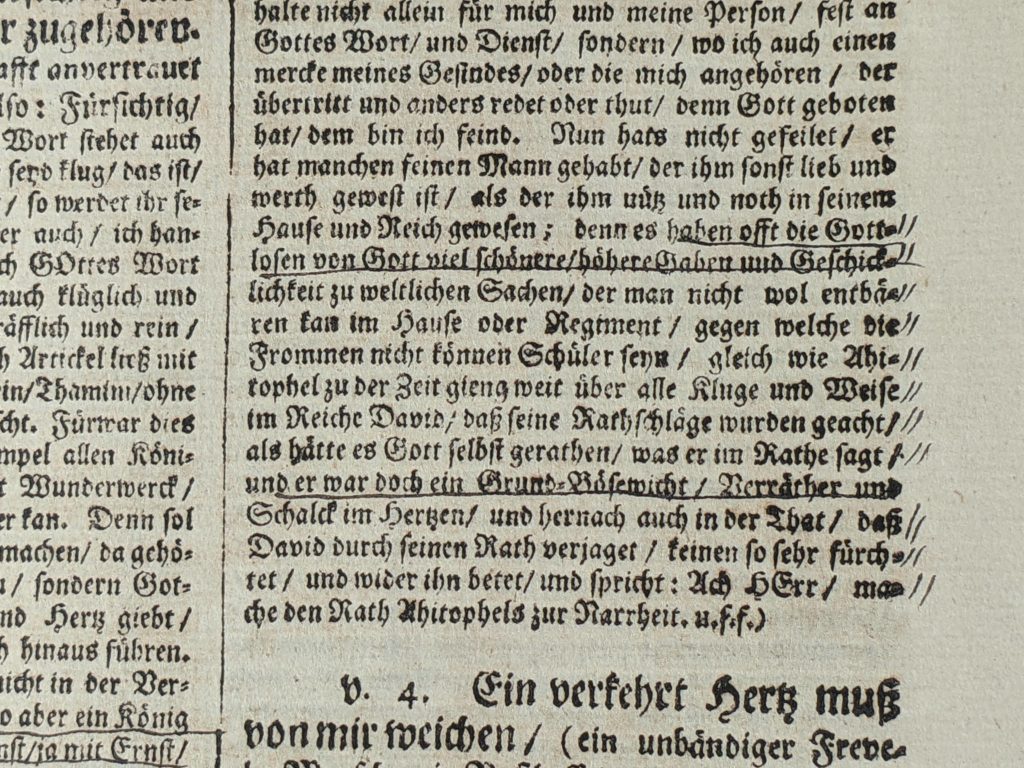
Psalm 101: Civil servants, goddless men
Was für Beampten Könige erwehlen sollen
Ps. 101:3 … I hate the transgressor (stubborn
despisers of the word of God – halsstarrige Verächter des
Worts Gottes) and I will not let him stay with me
(that means, according to Luther, not only do I hold myself to God’s
word and service, but that anyone of my household or those who
belong to me whom I find offending against God’s commandments is my
enemy. One has known many men who are otherwise worthy for being
useful and necessary in one’s household and kingdom. For godless men often have
received from God finer and higher gifts and aptitude (denn
es haben offt die Gottlosen von Gott viel schönere / höhere Gaben
und Geschicklichkeit) for worldly things which one
cannot do without in the home and! government, on whose example
however the pious cannot be students, just as Ahitophel so
exceeded all clever and wise men in David’s kingdom that his
counsel was respected as if God himself had proposed what was said
in council. He however
was a base scoundrel, traitor, and villain (und
er war doch ein Grund-Bösewicht / Verräther und Schalck) in
his heart and, thus, in his actions, so that David drove him away
by his counsel and feared no one so greatly and prayed against him
saying: Dear God turn Ahitophel’s counsel into folly. Etc.)
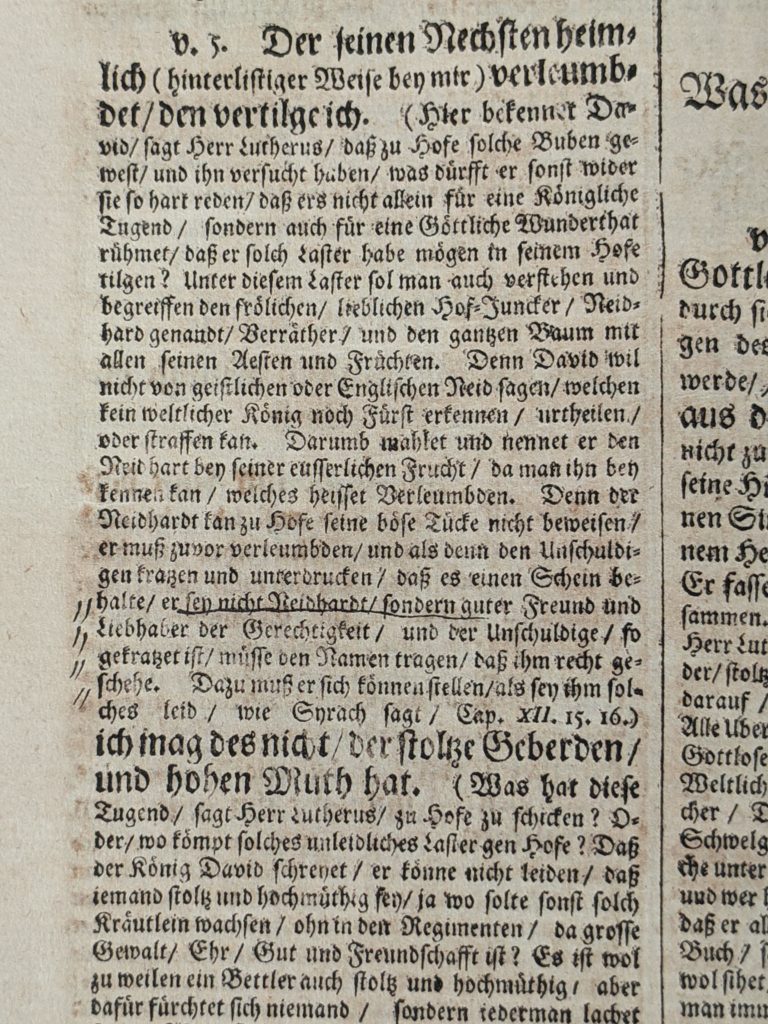
Psalm 101: Appearances are deceptive: Juncker Neidhardt
Column 655 (fac. 130).
Bach underlines: Dass es einen Schein behalte / er sey nicht Neidhardt, sondern ein Freund und Liebhaber der Gerechtigkeit…
Ps. 101:5
Quote from Luther’s sermon on Ps. 101 (published 1535 – 45 pages, the source Calov excerpts) – I also copied from this source…
Unter diesem Laster soll man auch verstehen und begreifen den fröhlichen lieblichen Hof-Juncker Neidhart und den ganzen Baum mit allen seinen Ästen und Früchten. Denn David will nicht von dem geistlichen und engelischen Neid sprechen, welchen kein weltlicher Fürst erkennen beurteilen oder strafen kann. Darum malt er und nennt er den Neidhart bei seiner äußerlichen Frucht, an der man ihn erkennen kann, nämlich beim Verleumden. Denn der Neidhart kann zu Hofe seine böse Tücke nicht ausüben, ohne zuvor zu verleumden. Alsdann kratzt er und unterdrückt er den Unschuldigen, daß es so aussieht, als sei er nicht ein Neidhart, sondern ein guter Freund und Liebhaber der Gerechtigkeit. Der Unschuldige aber, der gekratzt ist, muß den Namen tragen, daß ihm Recht geschieht. Dazu muß sich Neidhart so stellen können, als sei es ihm leid, wie Sir. 12(,15 f.)
In this category we must put the happy carefree court squire named Neidhard – a traitor, a veritable tree with all its branches and fruit. For David does not mean to speak of spiritual or angelic envy [German: “Neid’) which no king or prince can recognize, judge, or punish. Therefore he names Neidhard by his external fruit for which he is recognized and which is called slander. For Neidhard does not show openly his evil tricks at court; he first of all commits slander and then mutilates and suppresses the innocent one, all the while maintaining the appearance that he is not Neidhard but rather a good friend and lover of justice and that the innocent one who was mutilated must bear the charge that justice was done to him. To do that he must be able to give the appearance that such a thing is painful to him, as Sirach says. Chapter XII. 15. 16.)
Column 656 (fac. 130).
Was für Leute die Herren in ihrem
Lande nicht leiden solten
Ps. 101:8 (… The prophet prides himself on carrying out such
miraculous deeds early. Here earliness means not that of the day but
rather the early hours of
the regime (sondern des Regiments Frühstunden)
. That means he has done away with such vices in a timely way and at
an early hour before it grows to the half or full heat of midday.
For whenever one allows a vice to establish roots and to become a
habit, then there is no help for that person, as Seneca [‘Ovidius’, as
mentioned in Errata, not corrected by Bach] says: Deest
remedii locus, ubi, quae vitia fuerent, mores sunt [there
is no place for remedy when meanness takes the place of vice].
Whenever evil becomes a habit the matter is over and done with… .)
Column
673-674 [fac. 131).
Ps. 105 (Luther gave the following summary of this Psalm: A psalm of
thanksgiving is made for the people of Israel, to give thanks for
all the old miracles which He had performed for them from Abraham
onward until they had been led into the land of Canaan, as He had
told all ofthem and contracted with Moses, Deuteronomy XIX, that God
performed such miracles not for the sake of their piety or merit,
but because of the covenant and promise [Bach strikes out the
misplaced
“nicht” (not)] which He made with Abraham, for how pious they
have been and what they had merited the following Psalm sings.)
Column 687 (fac.
132).
Ps. 107:27 They shall thank the Lord for His goodness and [Bach
fills in the missing biblical text: “umb
seine” (for His)] wonders which He performs for the sons of
men.
Column 773 (fac. 133).
Ps. 119 Jack-never-mind / Hans-acht-sein-nicht
Ps. 119: 158 I see the despisers and it grieves me that they
do not keep your word. (v. 53 above, Luther says: they
who are above us pay no heed to such matters, they let it happen and
still want to be pious, they add nothing to their character in which
they are drowned. It
almost hurts, when a matter is great and one sees that those for
whom it would be most appropriate do not accept it. I call it to
be “Jack-never-mind’������ [Bach marks the above
passage with
“NB” in margin. ]
Ps. 120: Complaint: Unity and Peace is lost (Church)
Column 777 (fac.
134). Wehe mir / dass ich ein Fremdling bin under Mesech /
ich muss wohnen under den Hütten Kedar
Ps. 120:5 (… It is thus David’s view that I console myself with hope
and patience. I wish
greatly that the church were at peace and that the pastors were
themselves in agreement about things, but it is not the case.
Therefore I will commend
everything to God through prayer and will teach faithfully. All
the while one must suffer this anguish and overcome evil with
good. Thus we see that teaching and preaching is a
wearisome profession, for over and beyond all torment and suffering
that a preacher must bear is the fact that the false brethren
falsify doctrine and cause the church -unrest… .) The feeling
expressed here is that of ‘vreemdelingschap’, not feeling at
home/ease in the (present) world
Column 796 (fac.
135).
Ps. 126:2 (… Such words are first given to the Jews, for laughter
shall first be offered to the people to whom it had been promised.
Now it has come to the nations, whom He also calls into the
community of this laughter.) then one shall sing [Bach
writes above this verb “sagen” (say).
This
is the correct rendering of the Luther-bible. Curious: he does not
cross out the incorrect vers ‘singen’] among the
nations, the Lord has done great things for them. …
v. 4Lord, turn away our captivity, as you dried up [Bach
alters verb “trocknete” to present tense, “trocknest” (dry up)
the waters toward the south. (that is, it shall be
so pleasing to us as streams of water in a parched or hot
draught-stricken land, like a southern land. judges I. 15.)
Psalm 127: Wer nun den lieben Gott lässt walten – Gelassen-sein, Trust, Providence
Column 798 (fac.
136).
Ps. 127:1 (… The Lord God, as the wise man says, did not
simply shape and create everything and then walk away from his
creation, for he did not create the house and civic structure the
way a builder or carpenter makes a ship, leaving the structure
when it is finished and turning it over to the sailor to command.
Rather; the Lord God remains with His creatures, He governs and
maintains house, land, and people. People do not realize this and
think that God no longer concerns Himself with anything and lets
us do whatever we please… .)
A number of corrections
Column
818 (fac. 137).
Ps. 132:6 (… Now, he says, the place is fixed and set where the
ark of the covenant and temple are to be; if it is not to be at
this place it will be found nowhere on earth. Why is it that he
says that it will be in Ephrathah? For one reads that it has
[Bach inserts “nicht” (not)] been in Ephrathah, but
rather in Bethlehem. As obscure as this phrasing may seem, it is
nonetheless certain that the kingdom of Judah is indicated by the
place-name Ephrathah… .)
Column 828 Ps. 133:3
(Clement)
Column 640 [incorrect numbering for
840] (fac. 138).
Ps. 139:3v. 3 Wherever I walk or lie (you harbor
my going and my lying down, you observe it and study everything
with exactness. Job XXXI. 4.) you surround me and
see all my torment [Bach “Plage’‘ “Wege” (ways)]
Job XXXIV. 21. you have knowledge of all my actions and being.)
Column 843 (fac. 139).
Ps. 139:13 You have my inner parts in [Bach “der”
“deiner” (your)]
power: (you possess my inner parts, meaning that
my innermost desires are known to you. Compare Job XIX. 27.) you
were in power over me in my mother’s womb. (that is,
from the moment that I was conceived in the womb, that you drew
flesh and skin upon me in the womb, Job X. II.)
Column 872 Ps. 148:14 erhöret >
erhöhet (Clement)
Column 929 Spr. 10:7
vermessen>verwesen (Clement)
Proverbs
- One correction – column 929: Prov. 10:7 ‘vermessen ‘ > ‘verwesen’
- No markings
- – WA 51, 200-264. // Dr. Martin Luthers Psalmen-Auslegung, hrsg. v. Erwin Mühlhaupt, 3. Band: Psalmen 91-150, Göttingen: Vandenhoeck und Ruprecht, 1965, S. 63-123. ↩︎