Bach on Genesis (Calov) – markings
Coincidence, certainly, but Bach’s first annotation in Volume 1 does highlight commentary on the biblical text itself–it unpacks (in the margin) an implicit Scriptural quotation (in the body text) in the dedicatory chapter. And –surprise– Bach uses a Greek symbol, the letter Psi (Ψ ), as shorthand for "Psalm." Let’s take a closer look and then continue with the commentary itself.
Prae – scriptum: The first marking is in Calov’s introduction (Unterthänigste Zueignungsschrift, dedication).
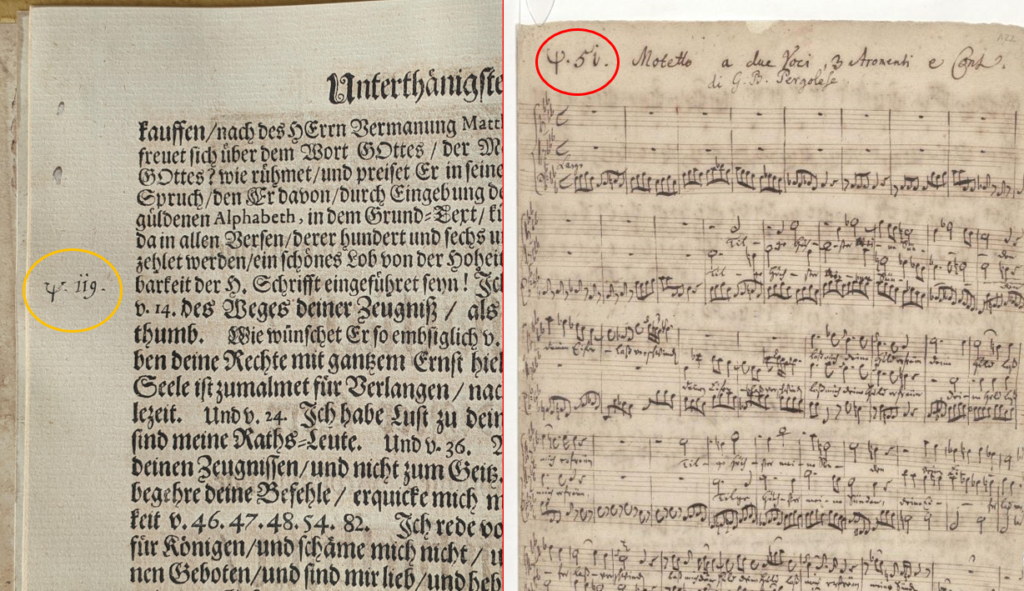
Dedication Foreword (fac. 4). Bach notes in the margin of Calov’s introduction of his Bible: Ψ 119 = Psalm 119, using the Greek character for Psi indicating the book of Psalms. Compare the reference to Ps. 51 in the heading of Bach’s refurbished version of Pergolesi’s Stabat Mater (using Ps. 51 as text underlay – paraphrased).
For information the translation of the beginning of this Dedication
(translation R. Leaver 1985, appendix 1 / Ellis Fingers – in Cox 1985)
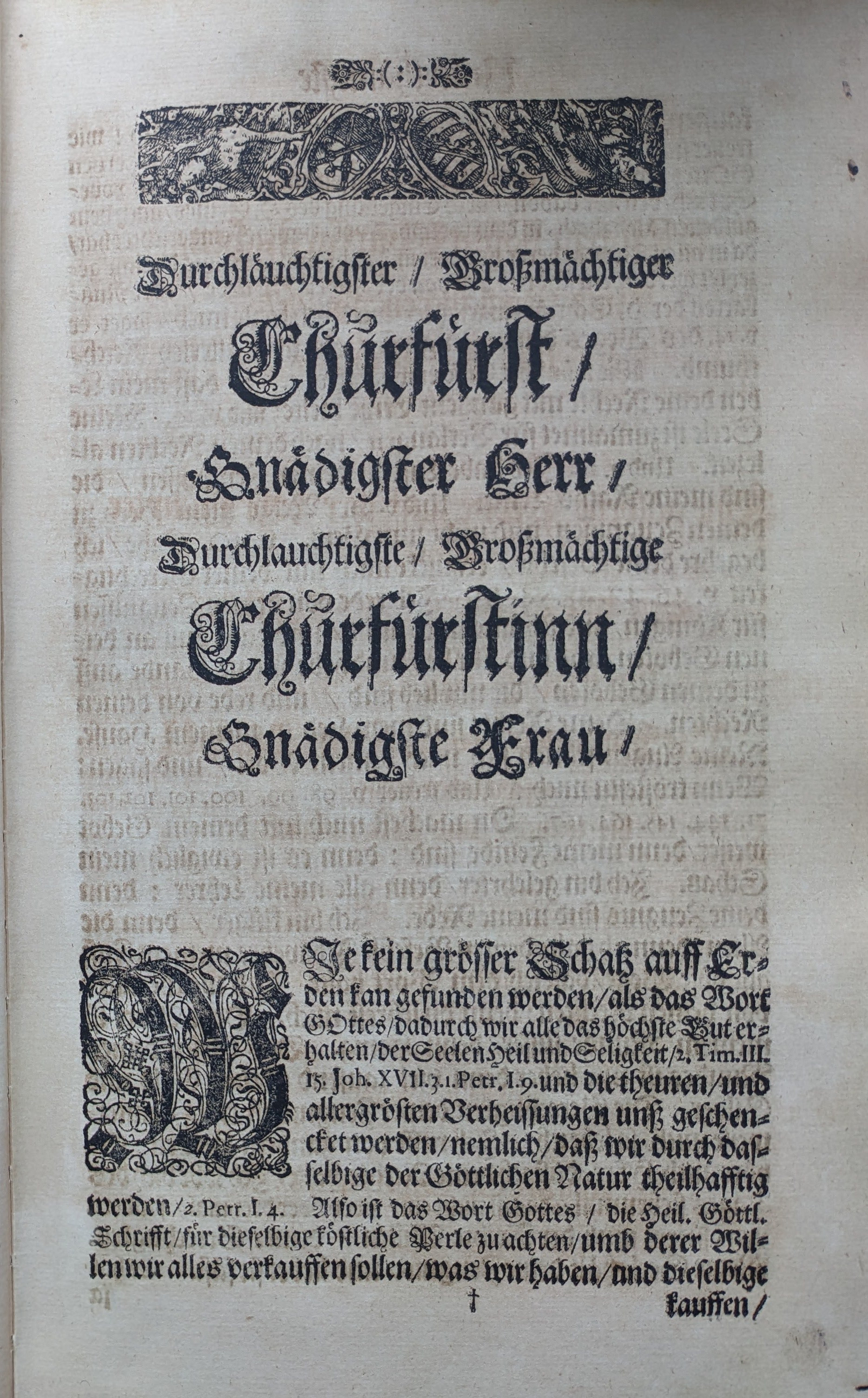
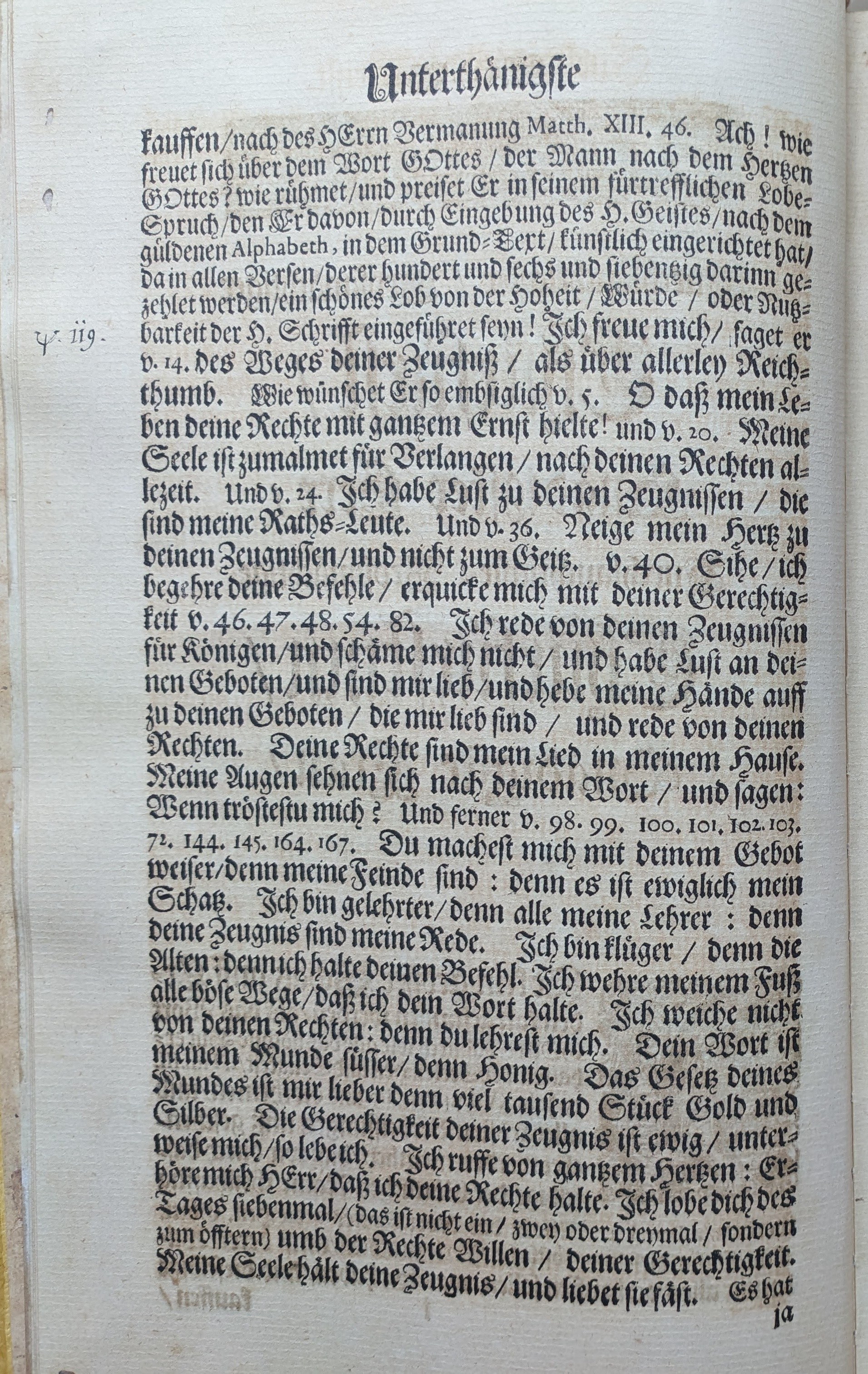
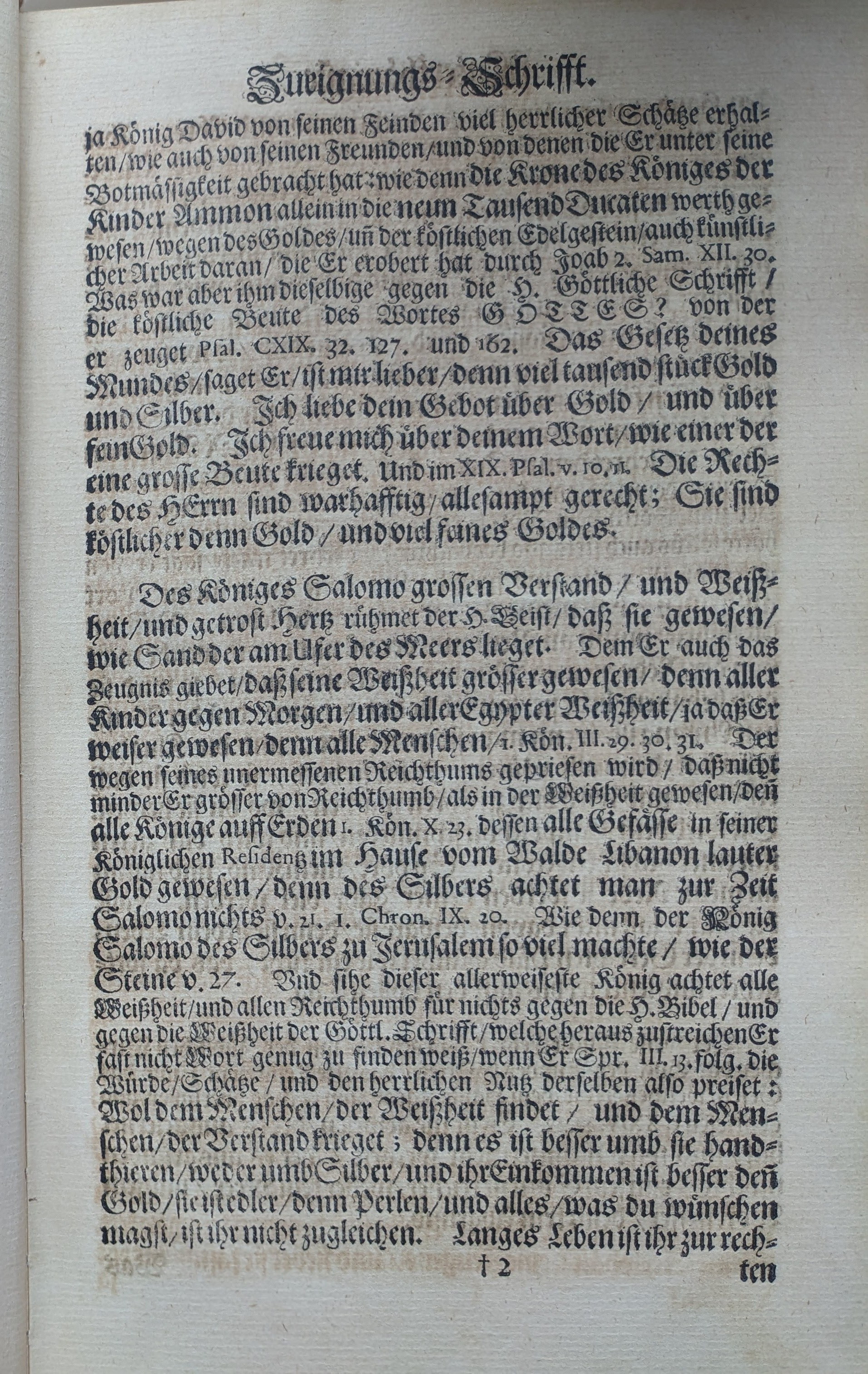
“Since no greater treasure can be found on earth than the Word of God, through which we all have received the highest good, the soul’s salvation and blessedness (2 Tim. 3:15; John 17:3; 1 Peter 1:9 ), and the precious and greatest promises are presented to us, namely that through the same we become partakers of the divine nature (2 Peter 1:4), the Word of God, Holy Scripture, is to be considered the pearl of great price for which we are to sell all that we have and buy it, [fol. † verso] according to the Lord’s direction in Matthew 13:46. Oh how greatly the man according to God’s heart rejoices over the word of God? How he glorifies and praises Him in his splendid words of tribute which He has arranged artfully according to the golden alphabet, in the original text by the inspiration of the Holy Spirit, for in all verses, of which there are one hundred seventy-six, a beautiful exaltation of majesty, worthiness, or usefulness of the Holy Scripture is presented. I rejoice he says in v. 14 [that’s the orphaned verse number that Bach assigns to its Psalm] in the course of your testimony as being above all sorts of wealth. How diligently he expresses the desires in verse 5: O that my ways may be steadfast in keeping Thy statutes! And in verse 20: My soul is consumed with longing for Thy ordinances at all times. etc…
Genesis
Columns 27-28 (fac. 9).
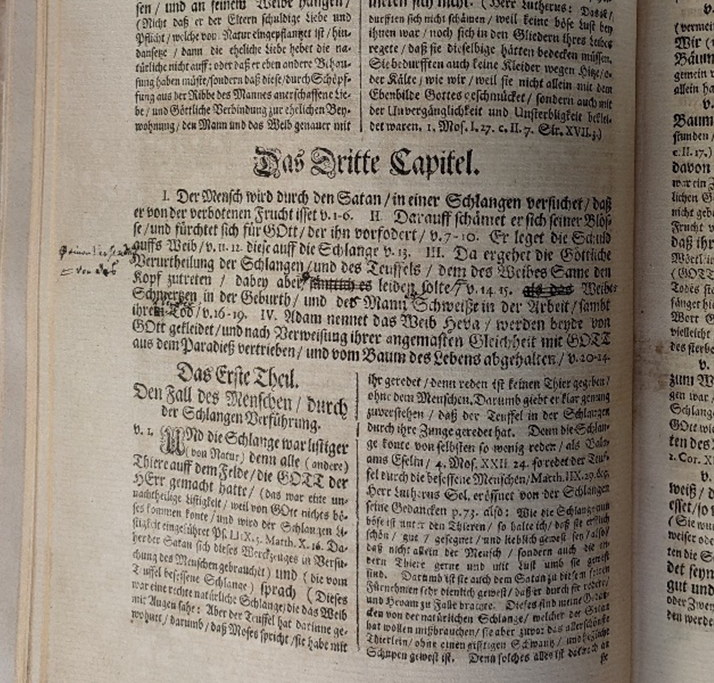
Gen. 3 (chapter
heading) [offering
a summary of the chapter]
I. The human being is tempted by Satan in the
form of a serpent to eat of the forbidden fruit vs. 1-6.
II. Afterwards he is ashamed of his nakedness and
trembles before God who had commanded him. vs. 7-10. He puts the
blame on woman. 11. 12. and she puts blame on the serpent. v. 13. Ill.
Then occurs God’s condemnation of serpents and the devil,
whose head the woman’s progeny will step upon, thereby, however;
suffering a heel wound vs. 14. 15. of the woman’s pain in childbirth
and of the man’s sweat with labor, together with their mortality.
16-19. Adam names the woman Eve, both are clothed by God, and
following rejection of their presumptuous equality with God they are
driven out of paradise and separated from the tree of life.
[Here
Bach corrects several errors – see image above (signalled
in the Errata, Calov vol. 3 addenda), using several ‘scribal’ signs
(crossed circle and F-like sign) to mark the insertion points. He
inserts ‘einen Versenstich’ (a heel wound), and corrects the
possessive forms ‘von des Weibes’, ‘des Mannes’ and adds ‘ihrer
beyder’ (both).]
Column
31 (fac. 10)
Gen 3: 6… . [Bach strikes through an erroneous repetition of two
lines]
Did Bach study the dogma of ‘original sin’?
Column 32 (fac. 10). about original sin.
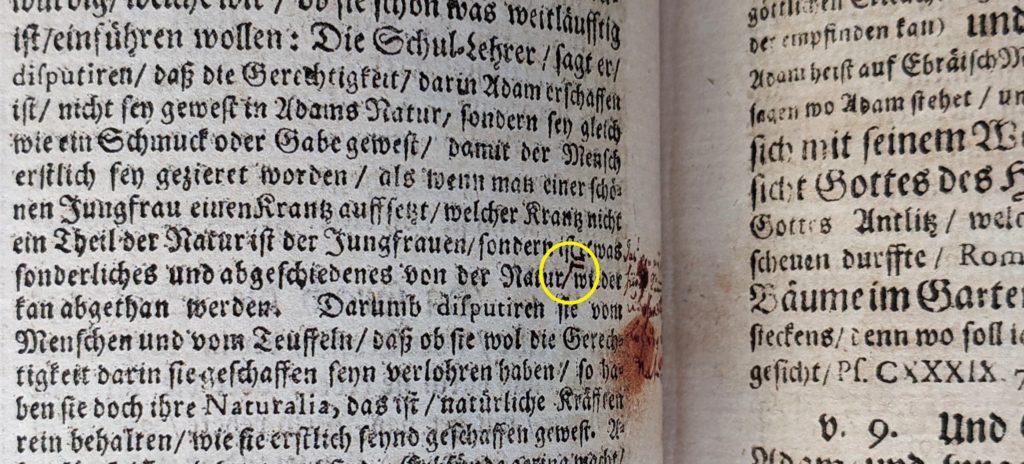
In introducting
this long excerpt from Luther, Calov explicitly refers to the
(then) actual Theologenstreit on original sin (‘Hier
ist Herr Lutheri Meinung wegen der heutigen Neulinge merckwürdig /
welche wir / ob sie schon was weitläuffig ist / einführen wollen)
:
Gen 3: 7 (Luther says: The schoolmasters argue that the
righteousness in which Adam was created was not in Adam’s nature,
but instead was an adornment or endowment with which man must first
be embellished, as when one sets a garland upon a beautiful maiden
and the garland is not a part of the maiden’s nature but something
separate and distinct from her nature [which comes to
her externally and without violation of nature]
can once again be taken away. Therefore they argue of man and the
devil that although they have lost the righteousness in which they
were created they still have retained their “Naturalia” meaning the
natural powers as they were originally created…
Comment:
The addition (above in italics, in German: “das
von aussen hinzu komt, u. ohne Verletzung der Natur” The missing
text is supplied by the Errata in Vol. III. ) is a correction of a
printing error (omission). Leaver (1975, 1979) infers
from this insertion that Bach must have studied this section, and
then noted that part of the text was missing. Then he must have
consulted another Luther edition with the commentary on Genesis
(he owned) to find the omitted phrase. Adding it in the margin.
For Leaver, this is ‘direct evidence’ of Bach’s keen interest in
lutheran theology. Only afterwards he
discovered that the omission was in the Errata
(vol III), and is marked there by Bach as ‘implemented‘
(crossed out in the Errata, with the same red ink). So in his book
about the Calov glosses (Bach and Scripture, 1985) he
nuanced his hypothesis, but did not abandon it (Leaver 1985,
p.33-34).
Column 81
(fac. 11).
Gen 9: 22 Story
of Noah’s drunkenness, and the sin (and punishment) of one of his
sons: ‘Ham’ (…
This story [of Ham] is however an example of divine terror and
justice that we should let Ham’s peril be a warning to us and that
we not refrain from making judgment when we see that a civil or
spiritual authority or even one’s parents err and fail. For who
knows why God does such things? and although we should
neither defend nor excuse such cases we still see that they serve
greatly to comfort the pious as they show and teach that God can
remedy his saints’ stumbling and falling so that when we also are
overtaken by sins we may hope for God’s mercy and not despair.)
Column 82 (fac. 11).
Gen 9: 25 idem. The
three sons of Noah – Shem, Ham, Japhet – are considered the
forefathers of all peoples. (… But though Ham
was damned, he had nonetheless the greater part of the world at
his command and established large kingdoms. Once again Shem and
Japhet are blessed, but when one compares them with Ham they are
actually beggars next to him, with all their lineage. For if one
examines the chronicles, one will find that he is a lord in the
land of Canaan, but that Abraham, Isaac, Jacob and their
descendants who carry the blessing live among the Canaanites as
servants and because Ham’s descendants
are the Egyptians, behold what a miserable captivity
Israel must bear under these people… .)
A large number of corrections
Column 84 (fac.
12). Gen 9: 29 (… When he [Noah] had lived … with Terah, Abraham’s
father, for 128 years who learned to believe about the first and
second world from these great patriarchs and about which he could
preach to and teach his son Abram who was only 75 years old when Abraham
Terah
died… .)
[Bach crosses out “Abraham” and inserts “Thara”]
Column 100 (fac. 13). Gen 13 : 3And he journeyed on from the south … as far as Bethel to the place where his tent had first stood between Bethel and Ai. (chapter XII. 8.) [Bach adds “v. 4 Eben an dem Ort, da er vorhin den Altar gemacht hatte, u. er predigte alda den Namen des Herrn” (to the place where he had made an altar at the first, and there he preached the name of the Lord.) Biblical verse missing, inserted at its proper place using insertion mark.]
Column 112 (fac. 14). Gen 15: 15 And you shall go [Bach inserts in margin ”zu Deinen Vätern mit Friden” (to your fathers in peace). idem] … and be buried in a good(peaceful) old age.
Column 245 [misnumbering of 145] (fac. 15). Gen: 20 [Chapter heading: “Der Andere Theil” (The Second Part) changed to “Der Dritte Theil” (The Third Part). ]
Column 246 [misnumbering
of 146] (fac. 15). Gen 20: 16 And he spoke to Sarah,
behold, I have given your brother a thousand pieces of silver
(equals 500 Reichsthaler). Behold, that shall be for you
a cover for the eyes for all that are with you and for all
places … and that was her punishment(that is, the king
not only gave to her [Bach
strikes through “von” (from) and writes in “an” (to)] no
gift, but she was also punished by him, not out of hate but out of
pure love, for in this way he wanted to protect and preserve her
reputation, her modesty, and her honor. This, says Luther, is the
correct meaning of this text… .)
Column 162 (fac. 16). Gen 33: 13 (… Of this ram
Augustine says in book XVI of the City of God chapter 32 ‘Who
other than Christ Jesus is represented by the ram that was caught
in the thicket, who was crowned with Jewish thorns before he was
crucified, who was caught in our sins which were laid on his head
as on the sacrificial ram and other offerings, but according to
the will of God was sacrificed in our place, just as the ram was
sacrificed in Jacobs Isaacs
place.)
Column 182 (fac. 17). This is the race of Ishmael, Abraham’s son whom Hagar, Sarah’s maid from Egypt, bore to him(chapter XVI. 15. Because Moses wanted to describe the actual origin of the Israelites he briefly introduced only a few peoples [Bach inserts “sc. [scilicet] des Ishmaelis Geschlecht” (such as the lshmaelite lineage)] because of some tribes which are also mentioned in the Holy Scripture so that the truthfulness of God’s promise is represented which is recorded in Genesis XVII. 2. XXI. 13. 18.) At first he seems to have written “Die Ishmaeliter”, later correcting it again, based on the Errata? (Observation Cox, p. 16)
Isaac – Jacob : about the spiritual danger of wealth
Column 195
(fac. 18).
Gen 26: 20
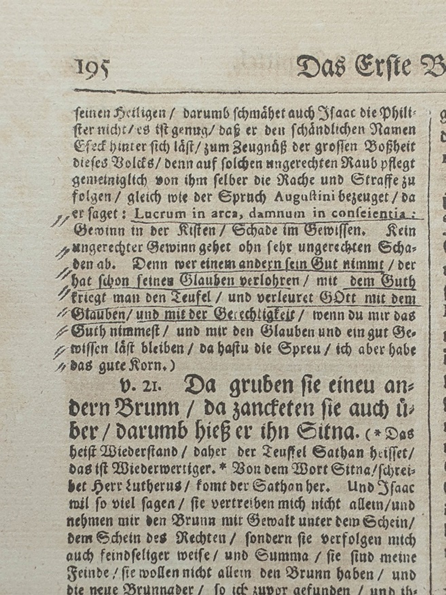
(… therefore Isaac does not despise the
Philistines, it is enough that he left the shameful name of Esek
behind as evidence of the great evil of this people, for vengeance
and punishment commonly follow as a matter of course upon the heels
of such unjust plunder just as the saying of Augustine shows:
lucrum
                  in arca, damnum in conscientia
: Wealth
in the coffers, damage in the conscience. No unjust
wealth occurs without extremely unjust damage. For whoever
takes the property of another has already lost his faith; with
the property one gets the devil and loses God with faith and
with righteousness. If you take my property and leave me
my faith and good conscience, you have the chaff and I have the
good wheat.)
Column 197 (fac.
19).
Gen 26: 26 Then Abimelech went to him from Gerar with
Ahuzzath his friend and Phicol the commander of his army.
(Now follows for augment of the consolation the fact that
Abimelech himself who earlier had driven him [Isaac] away now
voluntarily makes peace and a covenant with him. From this one must
first recognize that it is a blessing and boon from God that Isaac
is reconciled with the king. Thus says Solomon in Proverbs
chapter XVI: If anyone’s paths please the Lord He will
make his enemies accept peace with him. Following
this the example clearly proves what great power patience has to
appease the hearts of men, for it is an omnipotent power which can
make of an enemy the very best friend.
Column 198 (fac.
19)
. . This stems from the fact that Isaac persevered with his patience
and did not cease doing good to the ungrateful ones, and he himself
did not become angrier because of the ingratitude and meanness of
others; just as the grape vine or fig tree does not turn into a
thorn bush when it has been cut and mistreated, but instead remains
a good tree. Thus is Isaac also like the good tree that is planted
by the waters to receive its fruit abundantly and fortunately.
For by being so patient and being able to bear the injustice
that confronted him, he opened his neighbor’s eyes and appeased
their hearts that they recognized and confessed the sins that
they committed against him and considered what force and
injustice they had done to him… .)
A trivial remark (fun fact): distance Erfurt-Schwerborn
Column 199 (fac.
20).
Gen 26 v. 32
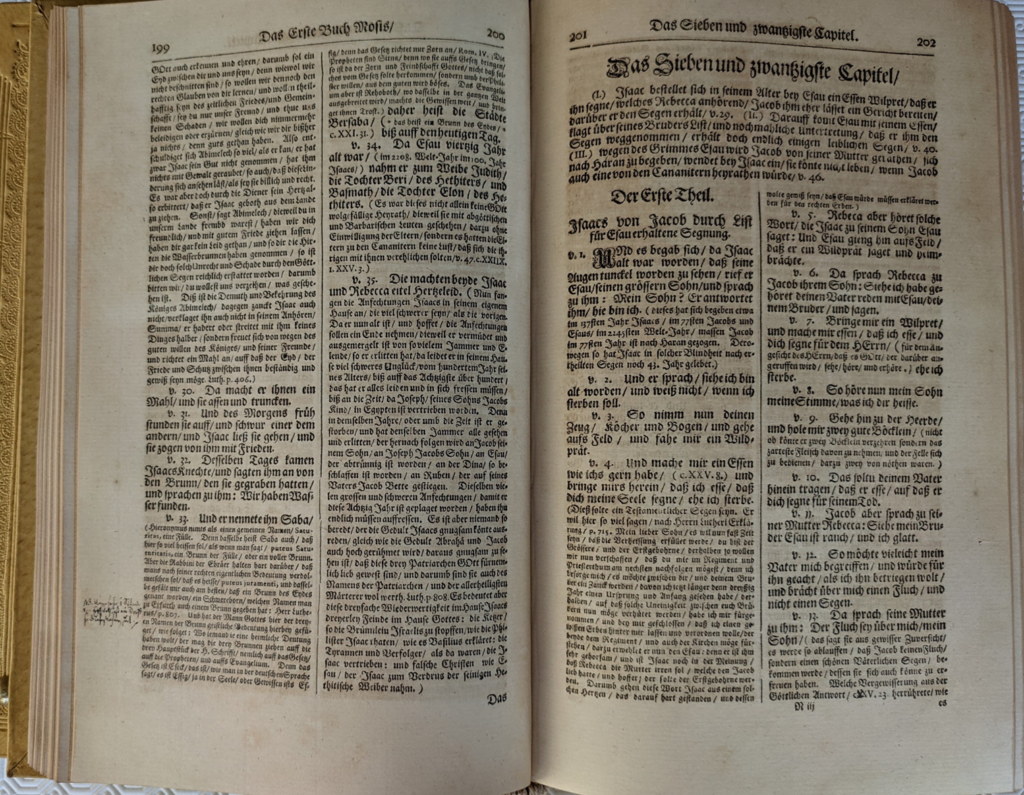
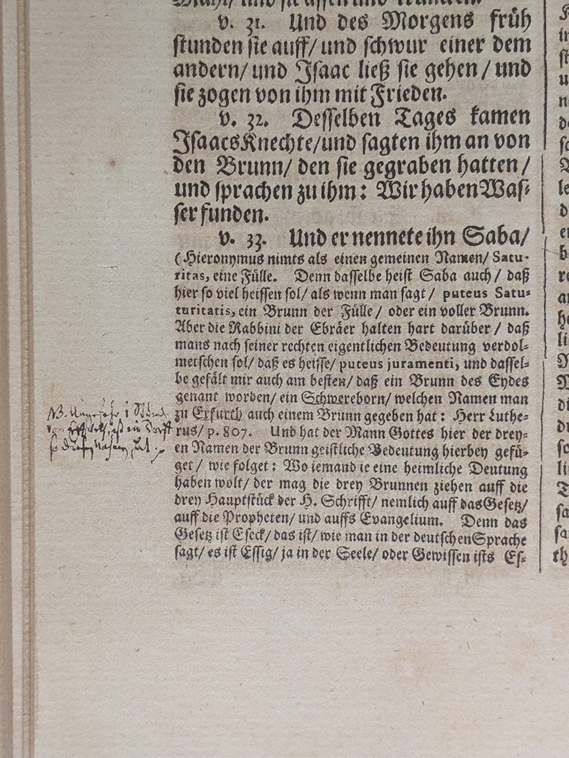
the name ‘Schwereborn’ is underlined. foto: Van Wijnen facsimile 2017
Gen 26 v. 32 That same day
Isaac’s servants came and told him about the well that they had
dug and said to him: We have found water. v. 33 And
he named it Shibah (Hieronymus considers it a common
name, “Saturitas”, “a fullness”. For Shibah (German: ‘Saba’)
means the same thing as if one says “Puteus Saturitatis”, “a well of
fullness” or “a full well”. But the Rabbis of the Hebrews hold
firmly to translating things by their correct special meaning so
that it would be “Puteus Juramenti”; and that would also please me
best that it be called a “Well
of the oath”, a sworn water source , a name which has also
been given to a well near Erfurth: Mr. Luther on p. 807
Explanation: (“Schwereborn” =
Schwöre-born = ‘swearing well’, ‘well of taking an oath’)
[Bach underlines “Schwereborn” and adds in margine
“NB. Ungefehr 1 Stunde von Erfurth, ist ein Dorf so diesen
Nahmen hat, usw: ‘ (NB about an hour from Erfurt is a
village which has this name, etc.)
Schwerborn is a suburb north of Erfurt]
A number of corrections
Column 226 (fac. 21). Gen 29: 35 (… We should follow also this example and learn that God, following the vexation [such as Leah experienced] tends to give redemption and consolation effusively, by which all sadness and terror are overcome. God for example showed great mercy to the despised Leah before Rachel, that not only Levi stems from her, from which stems the lineage of high priests and the entire priesthood [original: “das ganze Priester” [Bach inserts in margin “thum” (hood), marking the insertion point after “Priester”. So: “Priesterthum” = priesthood] and cultic lineage of the Old Testament, and in which is modelled Christ’s priesthood, but also Judah, from whose lineage the seed of the blessed woman should come, Genesis XLIX. 10. for whose sake all blessed women wish to be fruitful and to bear sons. We see however that only God has the “bodily key” to unlock the bodies of women. I Samuel 11. 5. Psalm CXXVII. 4.)
Column 230 (fac. 22). Gen 30 v. 14 Reuben went out at the time of the wheat harvest and found mandrakes (‘Dudaim’ in Luther’s bible (lilies) in the field (it seems that it was some kind of a beautiful fruit because he took pleasure in the color, exactly what kind of a fruit or blossom it was we cannot know. In the usual German translation it reads that he found Mandragoras and the other translators have rendered it thus and it is supposed to be a kind of fruit that grows by the water. Thieves put to death by hanging and scribes who have written of these Mandragoras have spread all sorts of nonsense about these plants, but this is nothing but fables and lies and may derive from the jews. The boy however did not [Bach inserts “mit” with insertion mark before “nichtem” forming the negative emphasis, “mit nichtem” “by no means”] go to the gallows but to the field. It must certainly have been a kind of fruit which tends to ripen near the time of the wheat harvest, which comes there somewhat late. Or it must have been blackberries which have a delightful sweet taste.)
Column 248 (fac. 23). Gen 32 v. 1 Jacob went on his way and the angels of God met him. v. 2 And when he saw them he said: They are God’s army and he called the name of that place Mahanaim. (Thus are named the hosts of angels, therefore the soldiers, watchmen, masters and governors among the creatures of God. For that is their assignment on earth, in heaven their assignment is to sing Gloria in Excelsis: Glory be to God in the Highest. Here on earth toward us and the creatures their assignment is to be watchful, to govern, and to fight, not only for the godly but also [Bach strikes through “für” (for) and replaces it with “wider” (against)] the godless. just as it is written in the prophet Daniel where the angel says that he has come to fight against the prince in Persia… .)
Column 250 (fac.
24).
Gen 32 v. 9 Jacob spoke further: God of my father
Abraham God of my father Isaac … Lord who said to me, return to
your land and to your kindred. (As if he wanted
to say, You haye brought me into this danger, this challenge and
this peril of my life. But it is a
great comfort to be able to say, Lord God, I have not come into
this danger through my own wickedness or thirst, nor through any
counsel of wise men or fools. Rather, You commanded
it, You ordered it of me and I have done right that I have left
Laban. And this is now Your affair, Your promise and Your loyalty
is now challenged, You will have to save Your loyalty and faith
and not my faith in all avenues.) […] I served Laban for
fourteenyears in vain, there I was poor and needy and barely
had bread to eat, and: You, my dear God, have made me within
six years so rich that in this short time I have become two
armies. That is indeed an open and rich blessing, my God.)
Jacob and Esau – life lessons
Column 251 (fac.
25).
Gen 32 v. 13 And he [Jacob] stayed the night
there … and took from what he had with him a gift for his brother
Esau. (Augustine says of this text that we
should be admonished by this example that no matter how much we
believe in God we must still do what must be done so that –
supposing we leave something undone – we are not regarded as those
who test God.)
Column 257 Gen
33: 10 (fac. 26).
(… Jacob still remains in a humble state so that he may receive his
brother with friendliness. For God wants us to honor the worldly
splendor, or as they have named it, the sanctum
seculare meaning the secular shrine in its order.
It has its honor and its majesty. Those people that exceed others in
splendor shall not be despised, rather one should grant them their
due honor, according to God’s order. The Hebrew word Hanan or Chen,
means in Latin dare animo promto et benigno, and in
translation “to be gracious to someone”. Thus Jacob says here quod
donavit Deus servo tuo [which God has given to your
servant] with that God has been gracious to me. He thus recognizes
God’s grace and benefit and he thanks Him for it. He embellishes his
cause with words as only he can do to keep his brother’s friendship.
And he teaches us by his example to show our
superiors proper reverence and honor; we should not be hard,
rough, or disobedient toward them, we should not rile them, but in
stead endeavor to gain their favour with humility and respect.
This is their lesson about good manners.)
Column 267 (fac.
27).
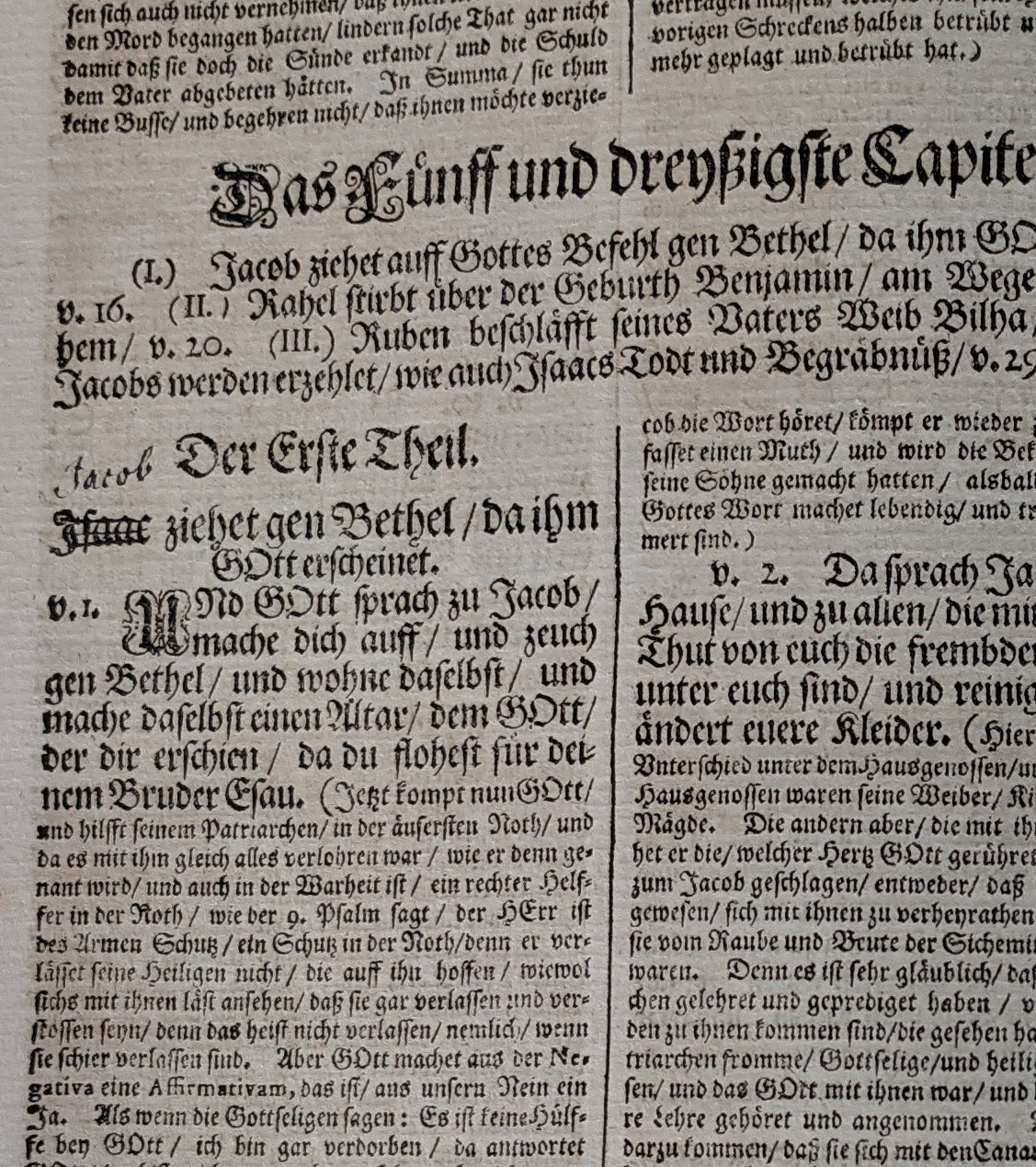
Gen35. Section
heading: [Bach strikes “Isaac” and writes in its place “Jacob”]
journeys toward Bethel where God appears to him.
Historical interest
A lot of markings can be found on the page with column. 281-282. Based on the content of his underlining/marking, it seems Bach was interested in historical (i. c biographical, genealogical) facts. The ‘I’ in this section of the commentary = professor Abraham Calov.
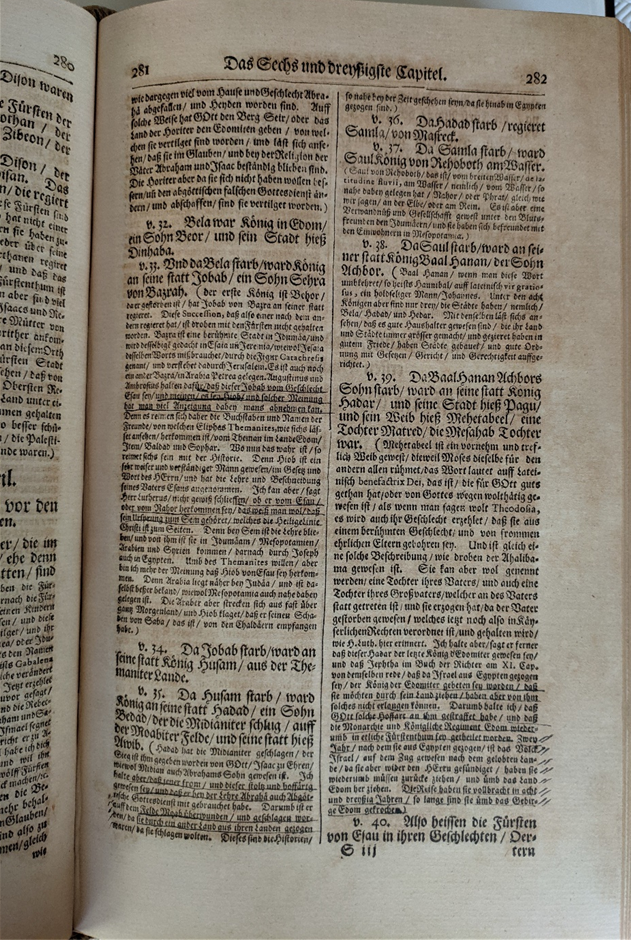
Column 281 (fac.
28).
Gen 36: 33 (… There is also another Bozrah located in Arabia Petrea.
Augustine and Ambrose believe that
this Johab is from the lineage of Esau and that he is Job (the
author of the Bible book with this name), and there is much
evidence to support it. The (alphabetic) letters and the names of
the friends sound similar, of which Eliphas the Temanite, as can be
seen, comes from Ternan in the land of Edom. Thus also, Bildad and
Zophar. If this is true, it fits with the chronicle. For Job was a
very wise and reasonable man in the law and word of the Lord, and he
took on the teaching and the custom of circumcision from his father
Esau. But Luther says that he cannot decide whether he is a descendant
from Esau or Nahor. We know only for certain that his origins lie
with Shem, thus apart from the holy lineage of Christ… .)
[…] 35 Husham died, and Hadad the son of Bedad,
who defeated Midian in the country of Moab, reigned in his stead
the name of his city being Avith(Hadad had slain the
Midianites, the victory was given to him by God in tribute to Isaac,
even though Midian was also Abraham’s son. I believe however
that the former [Hadad] was pious and the latter was proud and
overbearing and that he practised idol worship with the
teachings of Abraham. Thus he was overcome on the field
of Moab and slain, as they moved through another land from out
of their own when they were ready to attack. These
are the chronicles, so close together in time with their journey
into Egypt.)
Column 282 (fac.
28).
Gen 36: 39 (… I believe, he says further, that this Hadar was the
last king of the Edomites and that Jephtha speaks of this man in the
XI. chapter of Judges. For when Israel was traveling out of Egypt
the king of the Edomites
was asked that they might travel through his land but they were
not able to gain such permission from him. Thus I believe that God
punished his arrogance and that the monarchy and royal regiment
was divided into several principalities. Two years
after they left Egypt the people of Israel were on the journey
toward the promised land, but since they sinned against the Lord
they were once again forced to withdraw and circumvent the land of
Edom. They completed
the journey in thirty-eight years, and for this long period they
crept around the mountains of Edom.)
Column 326 (fac. 29). Gen 43 v. 28 They answered: Your servant our father is well and is still alive, and they bowed and fell down before him.(The word “adorare” means to bend the knee or to fall at the feet of another. Moses says they fell at Joseph’s feet, that they touched the ground with their knees. Thus the dream was fulfilled that he had told above to his brothers [Bach strikes “Jüng- ” in “Jüngern” (disciples) and writes in “Brüd- ” to make “Brüdern” (brothers)] Gen. 37... .)
Why Joseph pleased the king, and how he was rewarded
Column 341 (fac.
30).
Gen 45: 16 (… The reason why this pleased the king so much is shown
by Lyra, that as much as he liked Joseph because of the great
benefits that he had rendered to the entire kingdom, he could
not deem it praiseworthy that a purchased slave that was recently
led out of captivity should be lord over so great a kingdom. For
we see, as Cicero says, how people who have risen by means of
virtue and adeptness and become powerful, though they may have
come from common parents, are regarded by some of the upper class
with hate and animosity. Therefore Lyra says it was almost dear to
the king and he was happy to be able to become acquainted with
Joseph’s lineage and the parents that he descended from.
Although the whole lineage of cattle herdsmen had been vexing to the
Egyptians, the king was so godly and so pious that he was not
bothered by this meagre and contemptible station. Let the shepherd
govern, he is to have said. He (Joseph) was dearer to him
than many noblemen and great masters in the same kingdom. And
there is no doubt that Joseph will have told the king his entire
lineage, from Terah and Noah, and that he will have indicated and
given evidence to him how he was born from the famous race of the
most prominent men.And such accounts were very dear and
pleasing to the king.)
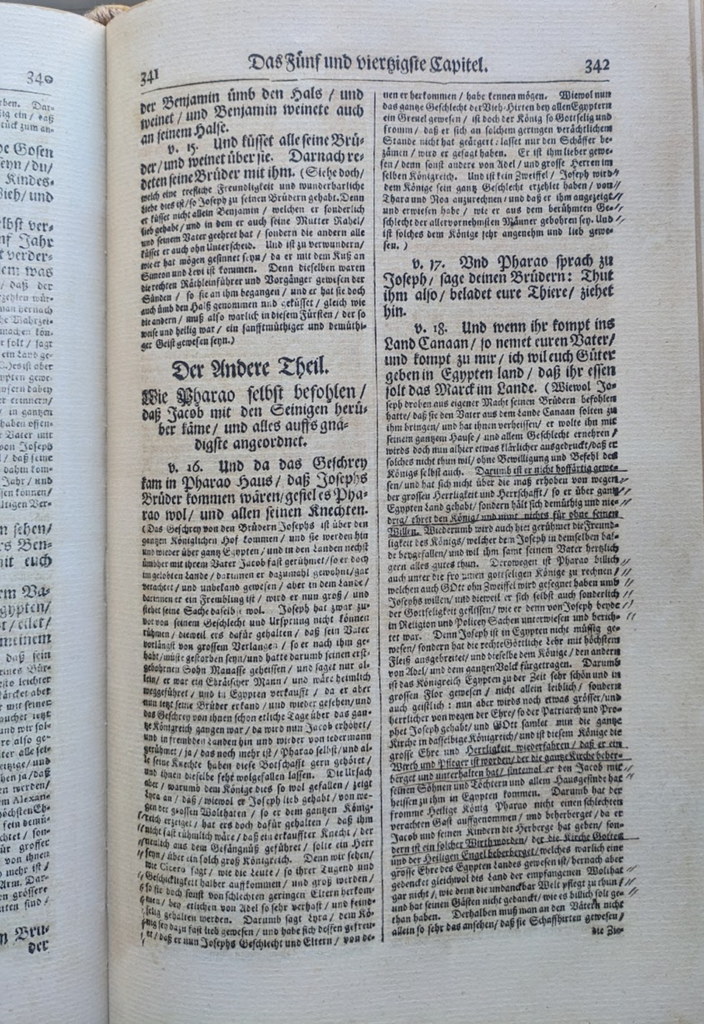
Column 342 (fac.
30). Gen 45: 18
(… Therefore he (Joseph)
did not grow arrogant and did not raise himself
unduly as a result of the great splendor and dominion that he now
had over all of Egypt. Instead, he kept himself humble and modest,
honored the king and
presumed nothing without his [the king’s] will. Once again
the friendliness of the king is praised, who soon gives ap proval to
Joseph and wants to do everything good for him ana his father. For this reason Pharaoh is
rightly to be included among the godly kings whom God without
doubt will have blessed for Joseph’s sake and because he himself
practiced his piety and let himself be informed by Joseph in
matters of religion as well as civil order. For Joseph was
not idle in Egypt, spreading the divine teachings with great
industry and presenting them to the king, the other noblemen, and
the entire people. For that reason the kingdom of Egypt was at that
time very beautiful and flourishing, not just physically but also
spiritually: now it became even greater and more splendid because of
the position of honor which the patriarch and prophet Joseph
enjoyed. God gathered together the entire church in that kingdom and
the great honor and gloriousness
were returned to the king by his serving as host and patron who
sheltered and supported the entire church, especially
by inviting Jacob and his sons and daughters and the entire
household to come to Egypt. Therefore the pious holy king
Pharaoh did not receive a poor despised guest when he took Jacob and
his children into his home, but rather he was the kind of host that
shelters the church of God and the heavenly hosts, which was a great
tribute to the Egyptian land. Afterwards, however, this land was not
mindful of the benefits received and, as the ungrateful world
tends to do, it did not thank its guests, as it should have done…)
Column 344 (fac.
31).
v. 22 (… He (Joseph] shall also give to each his cloak and to his
brother Benjamin he gives three hundred pieces of silver, to his
father he sends three [Bach writes
in “zehn” (ten)] donkeys loaded with grain and other goods
from Egypt… .)
(… Their rooms are full and give forth one provision after another,
by which is meant all sorts of goods in the home, such as bread,
meat, drink, butter, cheese, eggs, and other things that one needs
for daily sustenance. Therefore he brings all supplies for his
father and brother, for they had different numbers of household
members, and they were not able to live together and to eat
at a single table with Jacob: Benjamin was the father of twelve
children and the others had also become heads of households, with
separate needs and supplies with their wives, children, animals,
etc.)
v. 14 Thus he left his brothers and they traveled on, and
he spoke to them: do not quarrel with each other on the way.
Columns 346-347
(fac. 32).
Gen 46: 1 v. 1 Israel made his journey with all
that he had (Exodus I. 1. 2. Psalm CV. 12.
Isaiah LII. 4. Acts VII. 14.) and when he came to Beersheba
he offered sacrifices unto the God of his father Isaac.
(With this there was without doubt a sermon given on the
promise of God for the blessed woman’s seed. And Luther, not
unreasonably, described these thoughts of his people [Israel’s]. We
shall linger for a while here and I shall call unto God and say: O
dear merciful God and Father, who are wonderful in Your counsel, I
long to see my son Joseph before I depart from this life. I have
been up till now uncertain whether I was committing sin or whether
it pleased You; therefore govern and dispatch my endeavors and my
works according to Your will, help dear Lord God. Thus one
sees that he had a pure holy conscience and trusted everything to
God and His will, in whose fear and honor he ever wandered… .)
. Bach adds: “das von aussen hinzu komt, u. ohne Verletzung der Natur” The missing text is supplied by the Errata in Vol. III. (fac. 33).
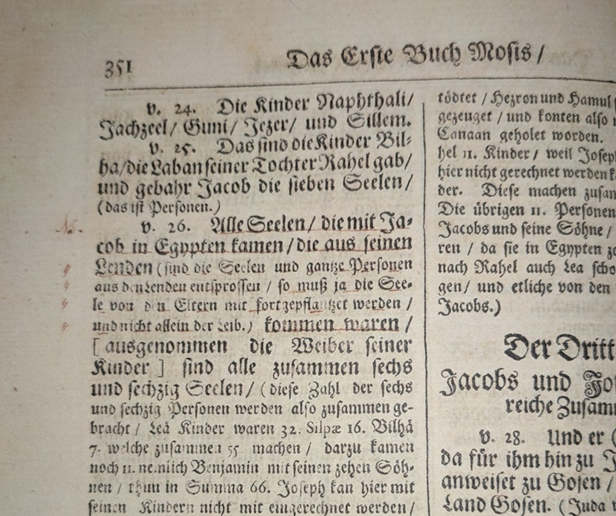
Gen 46 v. 26 All souls who with Jacob came
into Egypt, who were his own offspring (and the
souls and entire persons sprung from the loins, thus
the soul must also be propagated by the parents and not
only the body) [ except for the wives of his children ]
were sixty-six persons in all. [Bach
marks
this passage + “NB + underlining
– hard to see.]
Some corrections
Column
365 (fac. 34).
Gen 48: 2 (… And the Holy Scripture uses without variation the two
names Ephraim and [Bach strikes out “Joseph” using black ink and
writes in “Manasse”
(Manasseh) with red ink] as is seen in the prophet Hosea and also
in the LXXVIII Psalm 10…)
Column 374 (fac. 35). Gen 49: 8 (… For
this tribe (Judah] is the first to step into the Red Sea and the
leader in the camp. Numbers II. 3. X. 14. ; the first of those
which made sacrifice there. chapter VII. 12; the first in the
division of the land, Joshua XXIV, the first in war following the
death of Joshua. Judges I. It is the first to be introduced in the
register of tribal lineage, I Chronicles. From this tribe were
born David, Samuel [Bach
crosses out ‘muel’ and writes instead ‘lomo’ (Solomon)] and
all kings of Judah up through the Babylonian captivity ; from this
tribe came Zerubbabel, the prince of the people from Babylon and
from the same tribe was engendered Christ the King of all Kings…
.)
Column 381 (fac. 36). Gen 49: 19 (… The
soldiers shall gather together, as Luther explains in his
commentary on p. 1536, and form a band of thieves and attack this
tribe of Gad , which is situated in such a way that their
neighbors can easily harm them; they will then rob them and take
prisoners, but [Bach
changes “Dan” to “Gad’
– using red ink] will be on their heels, he will pursue
them, and with divine help he will hasten after the murderers and
thieves of Moab and Ammon… .)
Continue with Exodus and Leviticus