BWV 191 (Gloria in excelsis) and the Rector's Christmas programm of 1742
The text of the Academic Programma, published on 24 December 1742: Transcription (Latin) and summative translation into English.
Introduction
On Christmas Day 1742, at noon in the Paulinerkirche, Leipzig University held its annual academic address. Bach's Latin cantata Gloria in excelsis Deo BWV 191 was very probably written to frame it: the autograph score breaks off after the opening chorus with the direction Post Orationem, and resumes after it. See the images of the original partitura below (heading, and 'infra')
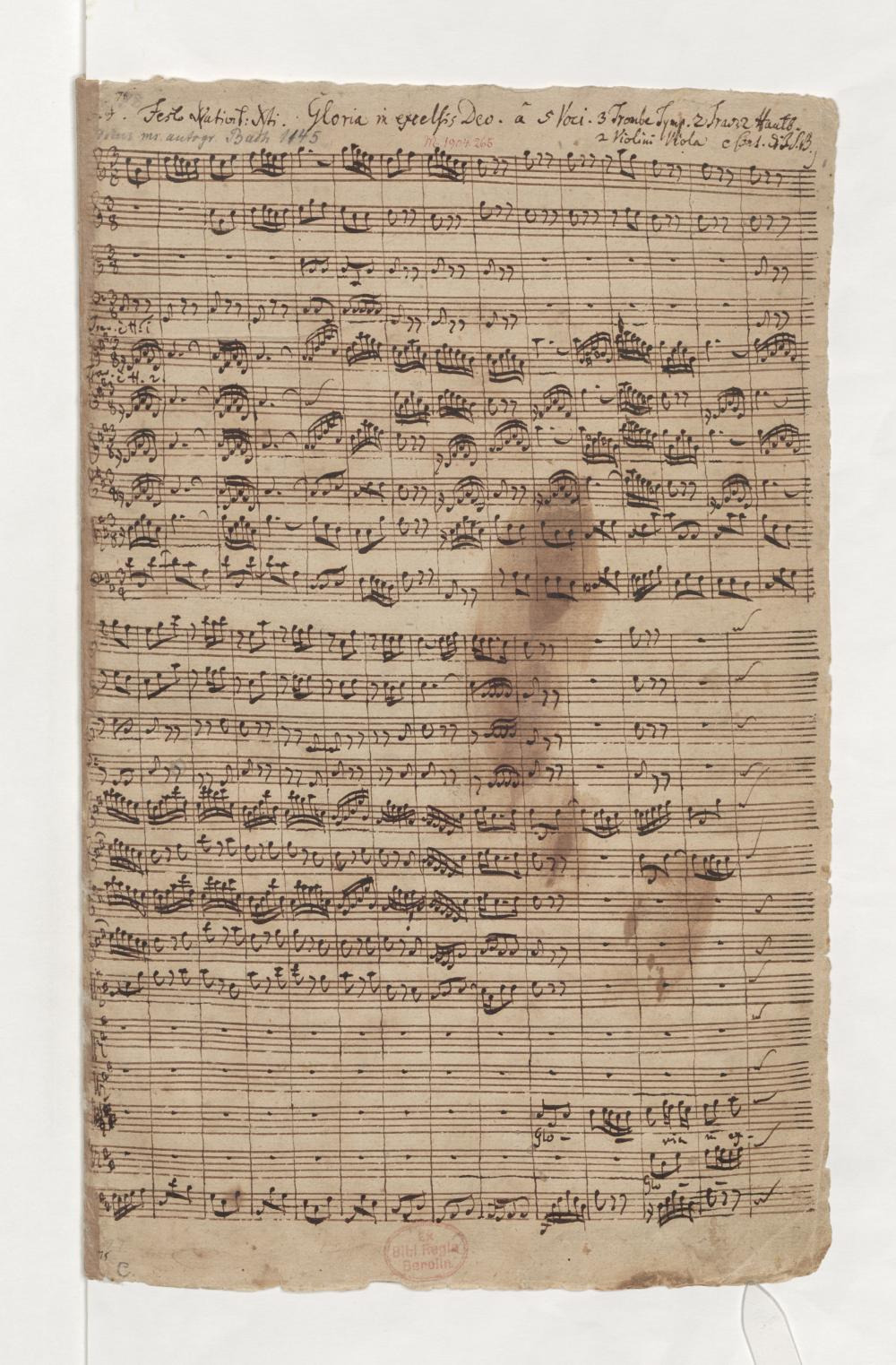
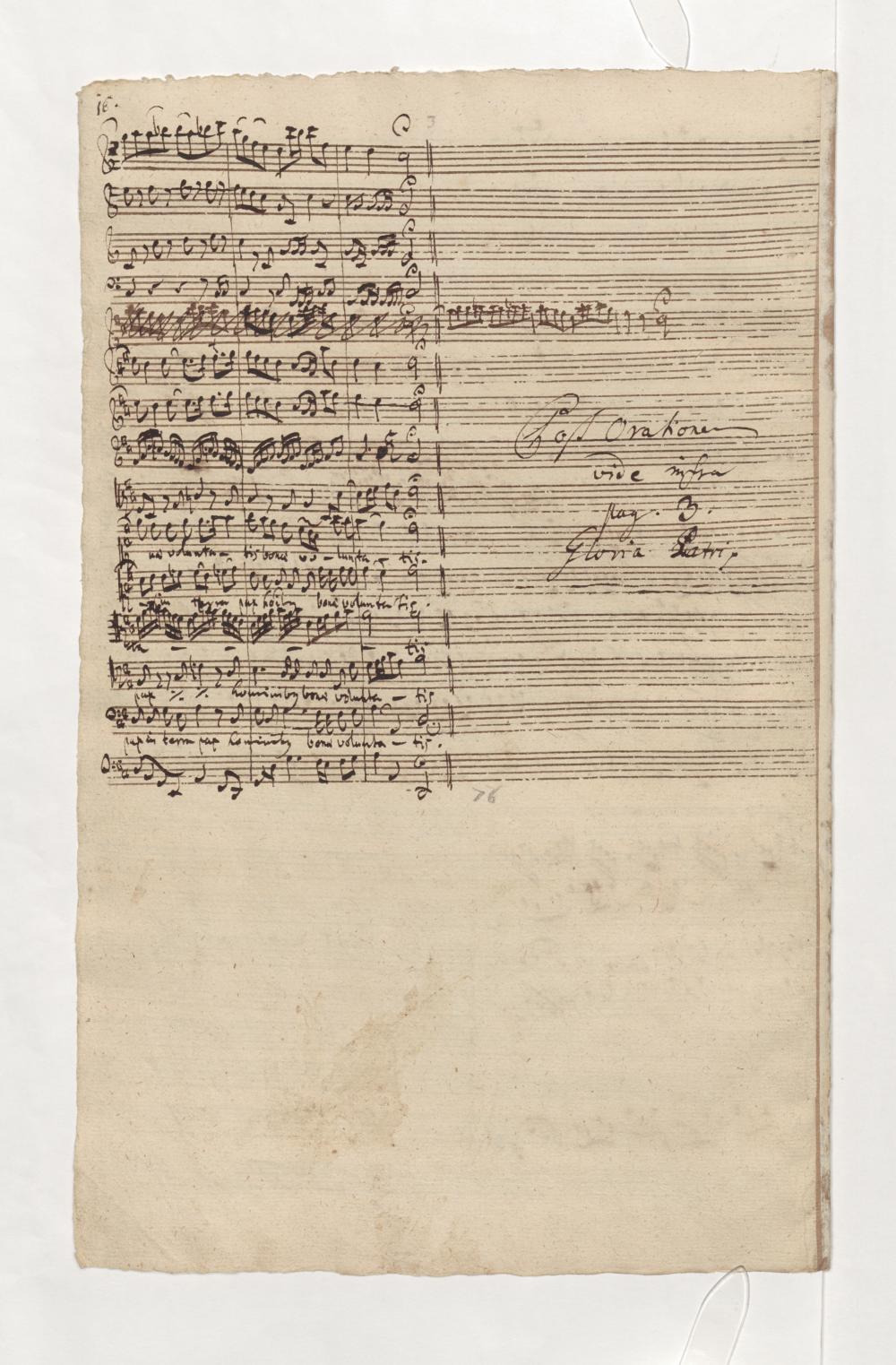
The address itself is lost. What survives is the printed invitation that announced it – and that invitation is why the connection can be made at all, because the sixteen pages of Latin it carries are a learned commentary on Luke 2:14, the text Bach set. Markus Rathey and Robin A. Leaver made the case in Bach-Jahrbuch 99 (2013). This page gives the document they argue from, transcribed in full, with a summative translation and notes. The head-notes below cover the Bach question. But the treatise is a different and, on its own terms, an interesting thing: a piece of source criticism that sets out to demolish a cherished tradition – that the world lay at peace when Christ was born, and that Augustus closed the temple of Janus to mark it – written in a Saxony that had come out of a war five months earlier, in a week when the fighting in Bohemia was two days' travel away.
Background
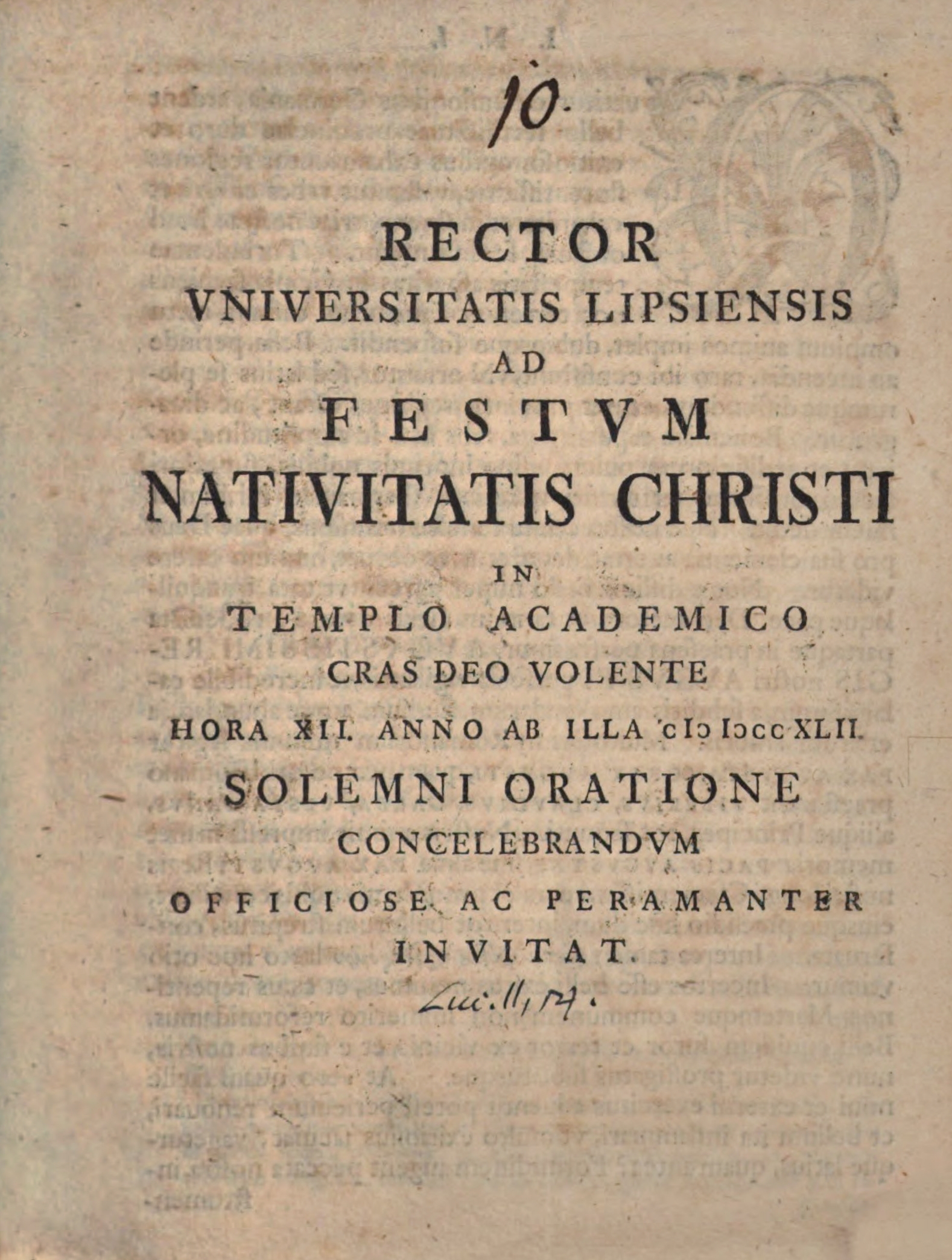
The invitation brochure. Leipzig University held an academic address at noon in the Paulinerkirche on the first day of each high feast: Christmas, Easter, Whitsun, and on Reformation Day. The written address was a substantial treatise by one of the professors, published in advance together with the invitation; the spoken address was delivered on the day itself. The invitation named the speaker but not the author. Here the treatise occupies pp. II–XVI and dwarfs the invitation proper, which is confined to the last ten lines of p. XVI; the announced speaker is Johann Heinrich Leich (1720–1750), Master of Arts. The topic: de erroribus veterum circa Natalem Christi. The title does not carry the name of the Rector, but for the winter semester 1742/43 it is Johann Christoph Gottsched. The commentatio is by Salomon Deyling (1677–1755), professor of theology and Superintendent in Leipzig, who supplied the learned texts for a run of these invitations. (Leaver 2013). Deyling reprinted this text, slightly revised, in Observationum sacrarum pars V (Leipzig 1748), pp. 142–159, as ΕΙΡΗΝΗ ΕΠΙ ΤΗΣ ΓΗΣ, Lucae II, 14. The 1748 version drops the invocation I. N. I., is divided into eleven numbered sections with a breviarium at the head. In it Deyling added two footnotes, and omits the last lines of the 1742 print (i.c. the announcement of Leich's address) I added a short discussion of the differences to my 'footnotes' at the end of this document.
The academic service and BWV 191. Bach's Latin cantata Gloria in excelsis Deo (BWV 191) probably framed this address. The autograph score (D-B, P 1145) is headed J. J. Festo Nativit: Xsti – without the liturgical Feria 1 that Bach uses in all his other Christmas scores – and carries at the end of the first movement the note Post Orationem, vide infra pag. 3 Gloria Patri etc., (see images above). In 18th Century usage oratio means an academic address, not a sermon; Since Bach's text and Deyling's treatise both start from Luke 2:14, the two are very probably for the same occasion. For this, see Markus Rathey and Robin A. Leaver in Bach-Jahrbuch 99 (2013) – Rathey on the occasion and the sources, Leaver on the tradition of these addresses and on Deyling's authorship.
Dating. Kobayashi dated the hand of P 1145 to um 1743 bis um 1746. 25 December 1742 lies just at the edge of that range, which Rathey accepts, given how approximate such datings are. He weighs one alternative: on 25 December 1748 Magister David Gottlieb Döring spoke de hymno angelico Luc. II. 14, but rejects it because Bach's hand in the score is still too vigorous for his penultimate year.
Historical setting (for orientation). When the emperor Charles VI died in October 1740, the Habsburg lands passed to his daughter Maria Theresa, and several rulers saw an opening. Frederick II of Prussia seized Silesia that December; France and Bavaria pressed claims of their own. Saxony – Leipzig's own state – joined that side in the autumn of 1741, hoping for Bohemian territory. Saxon troops helped take Prague late in November 1741, where the elector of Bavaria had himself proclaimed king of Bohemia and was elected emperor, as Charles VII, in January 1742. It went wrong quickly. The winter campaign in Moravia collapsed; Prussia made a separate peace with Vienna, agreed at Breslau in June 1742 and confirmed at Berlin on 28 July; and Saxony withdrew its troops and came to terms at the same time. Its elector, Friedrich August II – as king of Poland, August III – is the AVGVSTISSIMVS REX noster AVGVSTVS praised on p. II. Saxony gained nothing: this was a peace negotiated, not won. Hence e difficili bello nuper egressi, and hence the oddly narrow praise that follows – no victory, no territory, only the ruler's care in sparing his subjects further harm, and a peace that is conciliata partaque rather than conquered. Bohemia was still at war, and Leipzig lay some two days' travel from Prague across the Erzgebirge. The French garrison broke out of the besieged city on the night of 16/17 December 1742; the remainder surrendered on 26 December. This sheet was printed on 24 December. The storm in vicinia saeuiens might well have made the headlines of that week. The author's apprehension proved justified. Frederick II opened a second war in 1744, and Prussian troops occupied Leipzig in November 1745. That occupation ended with the Peace of Dresden, signed on Christmas Day 1745 – which is why Gregory Butler (1992) proposed that BWV 191 was first heard at a Leipzig thanksgiving for that peace. Rathey's objection is that the celebration of 25 December 1745 was the ordinary annual one, which merely happened to fall a few days after the treaty; the actual peace celebration took place on 9 January 1746. Neither the invitation nor the address of 1745 touches on peace at all: both concern Exodus 3, the burning bush.
Facsimile
Digitised by the Bayerische Staatsbibliothek, Munich (4 Diss. 2315#Beibd.10).
1. Transcription
Conventions. The transcription follows the print. Nothing is emended, and no conjecture is introduced into the text; where a printed reading seems doubtful, the observation is made in §3 and the text left as it stands. Long s normalised; u/v and i/j kept exactly as printed (hence vrbes, auertat, diuinitus, VNIVERSITATIS). Printed spaced-out capitals of proper names rendered as CAPITALS; italics as italics. Line-end hyphenation silently resolved; catchwords omitted. Page numbers in [ ] follow the printed signature-numbering (the title is unnumbered = p. I; the first text page, headed I. N. I., is p. II, unnumbered). Two places on p. II (et ardor amoris, PAX AVGVSTA) lose a letter into the gutter of the scan and are given in full. The print uses the old Greek ligatures for ‑ου‑ and for στ‑; these are resolved throughout, and no ligature form is reproduced here. Greek accentuation, which is irregular in the print, has been normalised to standard polytonic. A strictly diplomatic Greek text would have to be made from the images. ⟦ ⟧ marks a remark of mine, never a change to the text.
[I] Title page
RECTOR
VNIVERSITATIS LIPSIENSIS
AD
FESTVM
NATIVITATIS CHRISTI
IN
TEMPLO ACADEMICO
CRAS DEO VOLENTE
HORA XII. ANNO AB ILLA cIɔIɔccXLII.
SOLEMNI ORATIONE
CONCELEBRANDVM
OFFICIOSE AC PERAMANTER
INVITAT.
⟦Manuscript additions: “10.” (Beiband number) above the title; “Luc. II, 14.” below INVITAT.⟧
[II] I. N. I.
Quatitur dissensionibus Germania, ardent bello fertilissimae prouinciae duro et exitioso, opibus exhauriuntur regiones florentissimae, vastantur vrbes et agri, et calamitates in fines patriae nostrae haud obscure se infundunt. Turbulentae tempestatis asperitas in vicinia saeuiens nos terret, et futurorum casuum metu omnium animos implet, dubiosque suspendit. Bella, perinde ac incendia, raro ibi consistunt, vbi oriuntur, sed latius se plerumque diffundunt, et per proximas regiones errant, ac diuagantur. Bohemiae caput, Praga, vrbs situ ac amplitudine, ornatu et aedificiorum pulcritudine inprimis nobilis, superiori seculo dirissimae tricennali vastationi Germaniae initium et finem dedit. Nec nostra aetate funestis ominibus, quae Deus pro sua clementia auertat, detestetur, ac obruat, omnino carere videtur. Nos e difficili bello nuper egressi, vt tuta tranquillaque pace, Deo auctore, et tanti muneris datore, conciliata partaque in praesens perfruamur, AVGVSTISSIMI REGIS nostri AVGVSTI perfecit vigilantia, ac incredibile calamitatum, a subditis amoliendarum, studium, atque abundantia et ardor amoris.
Multoties in Romanorum nummis legitur PAX AVGVSTA, et PAX AVGVSTI, quam nempe orbi Romano praestarent TIBERIVS, CLAVDIVS, GALBA, VESPASIANVS, aliique Principes, eos sequuti. Nostris animis impressa manet memoria PACIS AVGVSTAE, siue alma PAX AVGVSTI Regis nostri longe Clementissimi cura et prouidentia nobis conciliata, eiusque praesidio huc dum, inter tot bellorum strepitus, conseruata. Interea tamen μετὰ φόβου καὶ τρόμου laeto hoc otio vtimur. Incertos esse belli exitus nouimus, et casus repentinos, Martemque communem non immerito reformidamus. Belli equidem furor et terror ex vicinia, et e finibus nostris, nunc videtur profligatus sublatusque. At vero quam facile noui et externi exercitus aduentu potest periculum renouari, et bellum ita inflammari, vt multo exitiosius saeuiat, vageturque latius, quam antea? Formidinem augent peccata nostra, in‑
[III]
strumenta bellorum, et faces ac tubae, quae poenas diuinitus immissas alunt, augentque. In spem fundatae, perpetuaeque pacis, quae non pactio seruitutis, nihilque habitura insidiarum, sed vera, et Ecclesiae ac Reip. salutaris, atque, confectis exstinctisque dissensionum scintillis, aeterna sit, nunquam veniemus, nec firma impetrabitur pax, nisi resipiscamus serio, ac Christo pacificatore confisi, eodemque deprecatore vsi, Deo scelerum vltori reconciliemur, eiusque praesidio ab iniuriis et interitu defendamur. Hunc malorum auerruncum, et salutis publicae auctorem, ac fundatorem pacis, quam de seipso praestare nemo potest, multo rectius colimus et veneramur, quam ciues Romani suos Principes, qui illos PACATORES, et PACIFICATORES ORBIS, ET PACIS FVNDATORES in nummis, quorum permulti etiamnum prostant, adulandi studio adpellabant.*
In otio et pace veteres, Graeci perinde ac Romani, omnem salutem, et felicitatem ab omni laude summam, ponebant, exclamantes, Nulla salus bello, pacem te poscimus omnes, hac ratione a BACCHYLIDE, poeta Lyrico, et PINDARI aemulo, reddita, in Paeanibus:
Τίκτει δέ τε θνατοῖσιν εἰρήνη μεγάλα Res maximas mortalibus producit pax.
Prisci eam velut cunctae felicitatis matrem sub variis symbolis repraesentarunt, ac imprimis sub imagine stantis mulieris, arma comburentis. Quo ipso perbelle illustrari potest non tantum locus Esa. IX, 4. vbi vestimenta, siue saga, in sanguine volutata, et inquinata, in combustionem fore dicitur; sed et Psalm. XLVI, 9, 10, vbi pax describitur ex cruento praelio et victoria orta, cuius consequens, perinde ac Iosuae XI, 6, scutorum ac curruum combustio erat.** In nummis legitur εἰρήνη pax, Cereris instar, spicis coronata, et cum prominentibus e sinu spicis repraesentata, ad indicandam agrorum in pace et otio cultorum fertilitatem. Sed veram
* Videatur EZECH. SPANHEMIVS de Vsu et Praestantia Numism. T. II. f. 641. et 642. ** In nummis Vespasiani et Domitiani pacem, quae victoriae fructus esse solet, ita videas expressam, vt altera manu face ardente ignem spoliis et armis, scutis, pharetris, et aliis instrumentis bellicis, in magnum aceruum congestis, iniiciat. Sic in nummo gazae Arschotanae pax re‑
[IV]
veram pacem, eiusque conciliatorem, et auctorem, homines illi profani, et superstitiosi falsorum Numinum cultores, ignorarunt. Nos pacem non caducam, et breui, vti fieri solet, tempore euanituram, sed aeternam, fundatamque, cui nullum inuolutum est bellum, petimus a solo Deo Trinuno, a quo πᾶσα δόσις ἀγαθὴ καὶ πᾶν δώρημα τέλειον Iac. I, 17 descendunt, et qui generi humano pacem in vetustis vatum diuiniorum oraculis cumulate promisit, a Christo pacis Principe Es. IX, 5, in carne apparituro, promerendam, conferendamque. In eius quippe diebus pax sine fine, et iustitia cum abundantia pacis dicitur exoritura l. c. et Psalm. LXXII, 7. Hoc Rege regnaturo gentes dicuntur gladios suos conflaturae in vomeres, et lanceas in falces. Non leuabit eo tempore gens contra gentem gladium, nec exercebuntur vltra ad proelium Es. II, 4. Perinsignis haec est fundandae pacis altissimae pollicitatio, et peremphatica descriptio, paullo post a vate Cap. Esa. XI. ita repetita, et oratione figurata confirmata, vt lupus dicatur habitaturus cum agno, et pardus cum hoedo sit accubiturus. Posterioris Templi gloriam descripturus Iehoua, ample pollicetur, pacem se daturum esse in isto loco Hagg. II, 7. Haec aliaque vaticinia de pace Iudaeae non tantum genti, sed vniuerso terrarum orbi aduentu Christi impertienda, post natam mundi salutem continuo fuerunt rata atque impleta. Genius coelestis, fecialis velut orator, pacem, felicitatem atque gaudium, ex Christi natiuitate ortum, omnique populo profuturum, pastoribus Bethlehemiticis, insolito lucis adspectu attonitis, denunciat, eorumque perterrefactos animos confirmat. Antea angeli ἐπιθυμοῦντες παρακύψαι, reconciliationis arcana Deum inter et homines lapsos ardenter, et inclinato quasi capite, veluti cherubi super arca positi in adyto Templi, cupiebant inspicere, 1 Petr. I, 12. Nunc ἐνσάρκωσιν τοῦ λόγου τοῦ Θεοῦ propius contemplati, ἐν τῷ σωτῆρι, qui est ὁ Χριστὸς ὁ Κύριος, exsatiantur, vehementerque laetantur. Nato
praesentatur Tab. XLVII. Num. 13. p. 225. Typum et inscriptionem eandem exhibuere MEDIOBARBVS, et EZ. SPANHEMIVS l. c. qui PACEM AETERNAM cum symbolo pacis, arma comburentis, in M. Antonini nummo ex Regia Gallorum gaza descripsit. Videatur etiam Cl. LIEBII Gothae Nummariae Caput III. f. 73.
[V]
Nato Seruatore vniuersus geniorum coelestium chorus, siue πλῆθος στρατιᾶς οὐρανίου, coelo se effundens, confestim aderat, et celebrata diuini Numinis gloria, congratulaturus pacem, vniuerso terrarum orbi partam, suauiter accinebat: Δόξα ἐν ὑψίστοις, siue ἐν τοῖς οὐρανοῖς, Θεῷ. ΚΑΙ ἐπὶ τῆς γῆς εἰρήνη, Deo in coelo sit laus honor et gloria, QVANDOQVIDEM nunc in terris est pax, Luc. II, 14. Idem est, ac si dixissent, ἐπὶ γῆς ΓΑΡ εἰρήνη νῦν γέγονε, interprete THEOPHYLACTO, antistite Bulgarorum.* Legimus in nummis Imperatorum Rom. PACEM VBIQVE florentem dilaudatam, et VNIVERSO TERRARVM ORBI promissam, sed vanissime. Sub Gallieno nusquam pax erat, sed tumultuationes populorum, et bella per vniuersum Romanum orbem vbique saeuiebant, prouinciis foedum in modum afflictis, et tyrannorum ferocia dilaceratis.** Hac occasione quaesiuerunt viri eruditi, an tempore nati Seruatoris alta in vniuerso terrarum orbe pax fuerit? Et an pacis a Prophetis et angelis denunciatae, nomine, reconciliatio Dei, eiusque sola beneuolentia erga homines; an simul pax temporalis intelligi debeat? Pacem spiritualem, diuinam, aeternamque Christi aduentu, et natiuitate, allatam esse, et vetustis vatum oraculis respondisse euentum, ex Christianorum coetu nemo dubitat, postquam illa aduersus Iudaeos recentiores toties vindicata fuerunt et illustrata. Haec est illa pax sub Messiae regno, donec luna auferatur, duratura, Psalm. LXXII, 7, cu‑
* Sic THEOPHYLACTVS voculam ΚΑΙ exponit αἰτιολογικῶς, quod Graecis non est infrequens. Saepe καὶ est caussalis, et pro ENIM vsurpatur. Recte hoc notauit IO. ZONARAS in Scholiis ad Canonem LXXIV. Concilii Constantinopolitani in Trullo habiti, T. I. Synodici Beuereg. f. 244. in hunc sensum hymnum angelicum interpretatus. ** Veteres nummi Galbae e. g. et Othonis pacem orbis terrarum denunciantes, vana pacis iactatione mortales turpiter fefellerunt. Quod etiam de obuiis illis Neronis nummis dicendum, in quibus cum templo Iani signata legitur inscriptio: PACE P. R. VBIQVE PARTA TEMPLVM CLVSIT. Eadem vanitate in nummo Gallieni aureo, quem ad Iuliani Caesares attulit EZ. SPANHEMIVS p. 103. legitur VBIQVE PAX. Cum tamen orbis Romanus eo tempore, ob Principis ignauiam, vbique bellis dilaceratus, prouinciarum et Praesidum defectionibus miserum in modum concuteretur.
[VI]
ius nullus erit finis, Esai. IX, 7, quam Seruator, vinculis constringendus, et vltimo crucis supplicio subiiciendus, paullo ante mortem discipulis reliquit, εἰρήνην, inquiens, ἀφίημι ὑμῖν· εἰρήνην τὴν ἐμὴν δίδωμι ὑμῖν· οὐ καθὼς ὁ κόσμος δίδωσιν, ἐγὼ δίδωμι ὑμῖν, Ioh. XIV, 27. Haec pax dissidia, Deum inter et homines, horum defectione et lapsu orta, tollit, et amorem mutuum, atque concordiam, Mediatore et conciliatore Christo Iesu, cum peccatoribus poenitentibus restaurat.
In praesens autem de eo disquiritur, an vetera diuiniorum vatum oracula praeter spiritualem pacem, etiam temporalem promiserint, et coelestes nuncii decantauerint, illaque etiam illata sit orbi terrarum per Filii Dei ἐπιφάνειαν, et φανέρωσιν ἐν σαρκί, 1 Tim. III, 16. Vtramque pacem beatos angelos cantibus celebrasse vir illustris P. D. HVETIVS, Praesul quondam Abrincensis in Gallia eruditissimus, putauit.* Et aeternam quidem ac coelestem his verbis: Gloria in altissimis Deo; Terrenam vero ac temporariam istis: Et in terra pax hominibus bonae voluntatis. Eandem hanc pacem etiam post Christum diu perseuerasse sibi persuadet. Suffragantur multi alii viri eruditi. Etsi enim cum HVETIO non prouocant ad annales Sinensium, in quibus proditum sit, eo tempore, cui ortum Christi adsignamus, altam pacem per illos tractus floruisse; existimant tamen, ex Romanorum fastis, et veterum Ecclesiae Doctorum monimentis, id abunde probari posse. Hanc sententiam prodiderunt ANTON. PAGIVS,** IS. CASAVBONVS, ANT. BYNAEVS, et NANVS TILLEMONTIVS, qui res ab Imperatoribus gestas enarraturus, Augusti imperium, sub quo Christum Iesum natum esse constat, vniuersalis pacis praeconio exorditur, putatque, pacem illam externam, Seruatore in his terris apparituro, vbique constitutam, elegantem pacis
* P. D. HVETIVS in Demonstr. Eu. Prop. IX. Cap. VIII. §. III. p. m. 730. ** ANT. PAGIVS in Apparatu Chronolog. ad Criticam Anti-Baron. §. CXXIX. f. 31. ISAAC. CASAVBONVS in notis ad SVETONIVM in Vita Augusti Cap. XXII. p. m. 146. edit. Graeuii. ANT. BYNAEVS de Natali Iesu Christi L. I. Cap. IV. §. XXI. p. 433. NANVS TILLEMONTIVS statim initio praestantissimi operis: Histoire des Empereurs T. I. p. 1. Le Fils de Dieu étant prest de se faire homme, pour
[VII]
pacis spiritualis ab eo allatae imaginem fuisse. H. NORISIVS, Princeps R. E. purpuratus, sed eruditionis gloria multo illustrior, persuasus, traditione Patrum constare, pace vbique florente, natum esse Dei Verbum, in similitudinem hominum factum, KEPPLERVM, peregregium et exercitatissimum in siderali scientia et erudito puluere magistrum, id negantem, refellit.* Omnes isti viri eruditi prouocant ad testimonia Doctorum veteris Ecclesiae. Sic IO. MARTIANAEVS, Presbyter Congregationis S. Mauri, nouissimus Operum HIERONYMI editor, T. III. f. 23. adnotauit, veteris Ecclesiae vno consensu firmatum esse, quod scilicet antea adseuerauerat, tempore nati Christi altissima pace genus humanum fruebatur. Iani enim templum paullo ante obserauerat Augustus, teste SVETONIO. Singulatim prouocatio fit ad EVSEBIVM, AMBROSIVM, AVGVSTINVM et HIERONYMVM, nec non ad fastos Martyrum Romanos, in quibus ad diem XXV Decembr. notatur, Iesum Christum, toto orbe in pace composito, natum esse. Tandem rem confici posse opinantur auctoritate et fide PAVLLI OROSII*, Hispani, presbyteri Tarraconensis, discipuli D. AVGVSTINI, quo hortante condidit aduersus paganorum calumnias opus historicum, sub cuius initium natalem Christi describens ait**, eo tempore, facta cum Parthis pace, Iani portas clausas esse, et bella toto orbe Romano cessasse. Copiosius illam Iani clausuram et pacem deinceps praedicat, et ita dilaudat, vt putet, Christum natum Caesari regnum tranquillissimum dedisse. Quin et ipsum CORNELIVM TACITVM, pacis huius, quam Augustus sanxerit,
[continuation of the Tillemont note] nous apporter du Ciel la paix veritable et avec Dieu, et avec nous même, et avec les autres hommes a voulu donner en même temps une image de cette paix interieure, en établissant sur la terre une paix exterieure et visible. * H. NORISIVS in Cenotaph. Pis. Diss. II. cap. X. f. 200. Scripserat KEPPLERVS Cap. II. de Anno Natiuitatis Christi, frustra nos niti auctoritate OROSII, nec vllum momentum situm esse in pace orbis, Ianoue clauso, ad inuestigandum annum Christi natalitium. Sed in his KEPPLERVM deceptum esse putauit NORISIVS. Nam pacem, in Orbe Romano praesertim, fuisse, Christo nascente, Patres concordi sententia tradidisse ait. ** PAVLLVS OROSIVS Libro I. Cap. I. p. m. 7. Postea L. VI. Cap. XXII. p. 448. et L. VII. Cap. II. et III. p. 456. edit. Hauercamp.
[VIII]
rit, diuturnitatem in eo fragmento, quod OROSIVS ibidem promit, commemorasse, HVETIVS monet et vrget. Vbi tamen obserues, neminem ex Patribus, praeter OROSIVM, Iani, Christo nascente occlusi, vllam fecisse mentionem. Plerique redditam illo tempore orbi Romano pacem laudant, nequaquam autem inficiantur, anno Christi Iesu natali vllum vsquam bellum fuisse. Nonnulli solam respiciunt pacem aeternam ac spiritualem, vetustis prophetarum oraculis decantatam, atque promissam, et a Christo conciliandam. Quando ex veteris Ecclesiae Doctoribus vnus et alter praedicat tranquillitatem externam, in Imperio Romano eo tempore sancitam, respiciunt tempestates motuum ciuilium, quibus Iulii Caesaris et Pompeii, Antonii item et Caesaris Octauiani dissensionibus antea, vsque ad Actiacam victoriam, orbis terrarum concussus fuit, quam rerum summa vni Augusto deferretur. Haec temporum felicitas, et publica quies sub illo Principe orbi reddita, peropportunam legatis Seruatoris nostri occasionem dedit Euangelii per cultiores Rom. Imperii prouincias tranquille, et cum successu, diuulgandi. Hoc ipsum est, quod dilaudat HIERONYMVS,* quando ait: Antequam nasceretur Christus, totus orbis plenus erat sanguine. Postquam autem ad imperium Christi, singulare imperium Roma sortita est, Apostolorum itineri peruius factus est orbis, et apertae sunt eis portae vrbium ad praedicationem vnius Dei. Nunquam enim antea tanta felicitas cum omnium bonorum abundantia Romanis obtigerat, quantam Caesar Augustus, administris filiis Tiberio, Druso, Germanico vsus, praestitit, testibus STRABONE** et DIONYSIO*** HALICARNASSENSI. Huc pertinet testimonium ORIGENIS† cum CELSO disputantis, qui obseruat, in diebus nati Iesu Christi exortam esse iustitiam καὶ πλῆθος εἰρήνης, et abundantiam pacis. Hoc Doctor Adamantius singulari Dei prouiden‑
* HIERONYMVS Comment. ad Michae IV. T. III. Oper. f. 1523. edit. Benedict. ** STRABO L. VI. Geograph. sub finem f. 441. edit. Almelov. *** DIONYS. HALICARNASS. L. I. f. 3. † ORIGENES Libro II. contra CELSVM §. XXX. T. I. Op. f. 412. edit. CAROLI DE LA RVE.
[IX]
uidentiae adscribit. Neque enim pacificam Iesu doctrinam putat potuisse inualescere, εἰ μὴ τὰ τῆς οἰκουμένης τῇ Ἰησοῦ ἐπιδημίᾳ μετεβέβληντο πανταχοῦ ἐπὶ τὸ ἡμερώτερον, nisi toto orbe aduentus Iesu placatis animis dissidia composuisset. Huc respexit EVSEBIVS*, quando ait, εἰρήνη διελάμβανε τὴν σύμπασαν γῆν, pax vniuersam terram occupauit sub aduentum Domini, imperium in orbis nationes obtinente Augusto. Sic D. AVGVSTINVS,** ad quem dissentientes etiam prouocare solent, nihil aliud dixit, quam imperante Caesare Augusto, et per eum orbe pacato, natum esse Christum. Similiter D. AMBROSIVS*** commentator Psalmi XLV, 10, quaerens vaticiniationis implementum, illud inuenit in natiuitate Iesu Christi, quo tempore Deus bella vsque ad fines terrae abstulerit, sedatis in orbe Romano praeliis intestinis. Et paullo post monet, Dominum abstulisse bella, quae mouebat nobis nequitia spiritualis, et deuicto Diabolo, pacem suam, h. e. spiritualem atque aeternam, nobis reliquisse. Prolixius haec enarrat HIERONYMVS, illustraturus Caput secundum Esaiae, Veteres, inquit, reuoluamus historias: et inueniemus vsque ad vicesimum octauum annum Caesaris Augusti, in toto orbe terrarum fuisse discordiam, et singulas nationes contra vicinas gentes arsisse studio praeliandi, ita vt caederent, et caederentur. Orto autem Domino Saluatore, tunc omnia bella cessauerunt, videlicet ciuilia et intestina: Et nequaquam per oppida et vicos exercebantur ad praelia, sed ad agrorum cultus, militibus tantum legionibusque Romanis contra barbaras nationes bellandi studio delegato, quando impletus est angelorum ille concentus, Lucae II, 14. et Psalm. LXXII, 7. Quaedam his similia habet asceta ille Bethlehemiticus, in Commentario ad Micham, nunc non exscribenda. Ex his aliisque Patrum testimoniis adparet, nullum eorum adfirmasse, Iani fanum eo anno, quo Seruator natus est, ab Augusto clausum fuisse. Dilaudarunt illi pacem aeternam et spiri‑
* EVSEBIVS in Dem. Eu. Libr. VII. cap. II. et III. f. 345. ** S. AVGVSTINVS Libr. XVIII. de Ciuit. Dei cap. XLVI. Op. T. VII f. 400. edit. Bened. *** D. AMBROSIVS Comment. in Psalm. XLV. §. XXII. T. I. Op f. 934. et 935. edit. Bened.
[X]
spiritualem, Christi natiuitate, et promeritis, Deum inter et genus humanum partam conciliatamque. Praeconio extulerunt publicam tranquillitatem, et felicitatem, Augusti auspiciis, ductuque, stabilitam. Nec aliud dixit EVSEBIVS, in prima acie ab HVETIO l. c. collocatus. Verba eius digna sunt, quae recitentur: Cum Christus se primum ostendisset, de quo Prophetae olim cecinerant, orietur in diebus eius iustitia, et multitudo pacis, Psalm. LXXII, 7, et Es. II, 4. ἀκόλουθα ταῖς προῤῥήσεσιν ἐπηκολούθει τὰ ἔργα, oraculorum veritatem continuo rerum exitus comprobauit.* Effectum Caesareensis ille antistes doctissimus adscribit praeconio Euangelii, a Christi legatis inter barbaras et efferas gentes diuulgati. De reliquo fasti Martyrum, ad quos NORISIVS imprimis prouocauit, sunt recentioris aeui, ac lapsu temporis subinde mutati atque interpolati addendo detrahendoque, vt forte perpauca supersint, iudice NIC. RIGALTIO, quae praestare possimus sincera. Certe non ante seculi quarti finem Martyrologium illud Romanum, Gregorii XIII. iussu editum, et Vrbani VIII. auctoritate recognitum, est concinnatum, quia Christi natalis diei XXV Dec. adscribitur, quod festum antea isti diei non erat illigatum. Solus OROSIVS, qui quinto demum seculo post natam mundi salutem vixit, et quem emunctioris naris viri ταχυπηθείας, et nimiae credulitatis, dudum peregerunt reum. Hoc certum est, illum mirificam rerum Romanarum ignorantiam passim prodidisse, et multoties lapsum esse, quando praesertim res narrat a sua aetate nimium remotas, quae antiquiorum scriptorum testimoniis, et idoneis rationibus confirmari non possunt. Quo vel imprimis pertinent res aliae, ac θαυμάσια illa atque prodigia, quae circa Christi natiuitatem vulgo narrantur contigisse, et quarum scriptores nec αὐτήκοοι, nec αὐτόπται testes sunt. Qualis est narratio de oleo trans Tiberim e terra exundante, quod per totum diem defluxerit; De circulo ad speciem coelestis arcus orbem solis ambiente, significante scilicet, exoriturum nunc esse Solem iustitiae, et quae sunt alia futurorum bonorum prodigia, quae sub Augusto con‑
* EVSEBIVS de Praep. Eu. f. m. 10. et Demonstr. Eu. Libr. VII. Cap. II. et III. f. 345.
[XI]
contigisse, et Christi aduentus praemonstrandi caussa obuenisse a CAES. BARONIO §. XXVII. Apparatus ad Annales dicuntur. In hunc censum referre oportet narratiunculam de Iani fano Christo nascente occluso. Ianus apertus, LIVIO teste, index erat, ciuitatem esse in armis: Clausus significabat, populos esse pacatos, et pacem, post diuturna et difficilia bella profligata, terra marique redditam. Disputatum esse nouimus inter viros eruditos, quoties Augustus Ianum Quirini, orbe perpacato, clauserit? A SVETONIO, teste hac in re locuplete, et peridoneo, tres dumtaxat Iani κλήσεις Augusteae commemorantur. Digna nobis videntur TRANQVILLI verba, quae recitentur: Ianum Quirinum semel temporibus Numae, atque iterum T. Manlio Torquato, et M. Atilio Balbo Coss. a condita Vrbe, memoriam ante suam, ex Numae Pompilii instituto, clausum, in multo breuiori temporis spatio, terra marique pace parta, non semel tantum, sed TER clusit.* Hunc numerum et lectionem vulgatam confirmant vetusti codices, et DIO CASSIVS, et historia ipsa. Ex tribus hisce Iani clausuris, nulla ad natalem Domini pertinet. Quarta autem nusquam commemoratur. Prima vice post bellum Actiacum, victo Antonio, receptaque Aegypto, feliciter confectum, Romam redux anno V. C. DCCXXV circa mensem Sextilem, secundum vetus additamentum ad VICTOREM SCHOTTI, manu sua ipse clausit. Sed post bienne temporis spatium, rupta pace, belloque in Britannia Hispaniaque orto, Iani fores iterum reserauit, et non nisi domitis Cantabris, anno V. C. DCCXXX circiter medio, sanitati restitutus, et Romam reuersus, secundo clausit, ante Christum natum anno XXIX. postquam per quadriennium patuerat, et vltra. Supersunt hodiedum complures nummi apud GOLTZIVM, MEDIOBARBVM, et IO. MASSONVM,** quorum vnus templum Iani clausum conspiciendum exhibet, et globum cum duobus hinc inde ramis, et epigraphe: PAX ORBIS TERRARVM. Geminas has belli portas secunda vice clausas, Augustus in Parthos expeditionem parans, et iter in Syriam ingressurus, anno V. C. DCCXXXII iterum reserauit, quae continuo patuerunt
* SVETONIVS in Vita Augusti Cap. XXII. ** IO. MASSONVS in Libro de Iani Templo Christo nascente reserato Sect. III. Cap. III. p. 97.
[XII]
vsque ad annum V. C. DCCXLIV, quo anno demum, repressa Dacorum et Dalmatarum rebellione, cum Tiberio et Druso Romam reuersus, tertium obserauit, anno ante Christum natum aerae vulgaris decimo. Quae tamen proximo anno rursus reclusae, toto reliquo Augusti imperio ob bella maximi momenti in Germania, Pannonia, Dalmatiaque saeuitura, nusquam quarta vice leguntur occlusae. Inde satis manifestus est OROSII error, qui tertiam Iani κλῆσιν retulit ad annum Seruatoris nostri natalem, quae tamen integrum decennium, si rationes recte subducas, Christi natiuitatem antecessit. Eo tempore, quo ὁ Θεὸς ἐφανερώθη ἐν σαρκί, bella gerebantur in Arabia, ad Istrum, in Armenia, et finibus orientis, vbi Caius Caesar exercitum aduersus Parthos ducebat. Immensum etiam bellum in Germania exarserat a M. Vinicio per subsequens triennium fortiter administratum.
Missa igitur pace externa, qualem Seruator hanc in lucem Bethlehemi editus, non attulit, Matth. X, 34 et Lucae XII, 51, nec in orbe Romano inuenit, nos multo praestantiorem pacem, cuius praecones, post prophetas, coelestes genii fuerunt, intelligimus, nempe aeternam et spiritualem, nulla hostium ferocia nobis adimendam, a Christo allatam, quae tam late patet, quam ipsum humanum genus per vniuersum terrarum orbem diffusum, et quam late patet peccati labes ex Adami defectione contracta, indeque nata inimicitia hominum cum Deo offenso et irato. Quotquot premuntur supremi Numinis ira, tot etiam recreantur illo laetissimo Euangelicorum praeconum nuncio de pace per Christum conciliata. Pax quippe ab angelis denunciatur non Bethlehemi dumtaxat incolis, aut solis pastoribus ouium, nec terrae Iudaeae tantum, sed vniuerso terrarum orbi, et παντὶ τῷ λαῷ, Luc. II, 10, ita vt nulla sub coelis gens sit, ad quam haec pax non pertineat. Huius pacis cum hominibus ineundae fundamentum est ἡ εὐδοκία τοῦ Θεοῦ ἐν ἀνθρώποις, perbeneuola et gratiosa Dei voluntas, siue amicus et beneuolus Dei affectus, et serius amor erga homines, quo Deus humano generi fit propitius, et reconciliatus, per τὸν σωτῆρα* ἐν πόλει Δαβίδ, id est,
* Vanissime igitur Iupiter, Diana Ephesia, aliaque gentium profanarum Numina in nummis, et aliis veterum monimentis, dicebantur Σωτῆρες, apud EZECH. SPANHEMIVM in notis ad CALLIMACHVM p. 122. et 226.
[XIII]
id est, Saluatorem Bethlehemi natum, ὅς ἐστι Χριστὸς Κύριος. Quemadmodum Deus Pater ηὐδόκησεν ἐν Χριστῷ, Matth. III, 17, Prou. VIII, 17, Luc. III, 22, ita per Filii sui missionem, et natiuitatem, propalam declarauit, quod etiam ηὐδόκησεν ἐν ἀνθρώποις, et quod nunc κατὰ τὴν εὐδοκίαν τοῦ θελήματος αὐτοῦ, et propter Filium τὸν ἠγαπημένον, ἐν ᾧ ἔχομεν τὴν ἀπολύτρωσιν διὰ τοῦ αἵματος αὐτοῦ, cum hominibus in gratiam redire velit. Recte igitur IOAN. CHRYSOSTOMVS hanc εὐδοκίαν τοῦ Θεοῦ exposuit per καταλλαγήν, reconciliationem, et eius discipulus atque epitomator THEOPHYLACTVS per ἐπανάπαυσιν, requiem et adquiescentiam Dei, et bonum eius animum erga homines. Ἐπανεπαύθη γὰρ ὁ Θεὸς νῦν, καὶ ηὐηρεστάθη ἐν τοῖς ἀνθρώποις. Antea enim, et extra Christum, οὐκ ηὐδόκει, οὐδὲ ἠρέσκετο ἐν τοῖς ἀνθρώποις, huiuscemodi complacentiam et beneuolum affectum erga mortales perituros non habebat. Ex hac autem εὐδοκίᾳ, impetrata per fidem in Christum Iesum peccatorum venia, oritur εἰρήνη, quam δικαιωθέντες ἐκ πίστεως consequuntur apud Deum, διὰ τοῦ Κυρίου ἡμῶν Ἰησοῦ Χριστοῦ, Rom. V, 1. Et haec est illa εἰρήνη pax, ἡ ὑπερέχουσα πάντα νοῦν, Phil. IV, 7.
Concordiae instauratio supponit discordiam. Exoptatissima pax sequitur post durum et exitiabile bellum, quale Deum inter et semetipsos concitauerant male consulti peccatores. Perpendamus iustissimas virorum θεοπνεύστων hac de re querelas: Iniquitates vestrae disterminant inter vos et Deum vestrum; et peccata vestra faciunt, vt occultet faciem a vobis Esa. LIX. v. 2. Violatione legis diuinae mortales iacturam fecerant amicitiae et fauoris diuini, et inciderant in eius odium et iram, coelitus manifestandam, et ad instar ignis exarsuram aduersus omnem impietatem, atque iniustitiam, Rom. I, 18. Miseri diris deuoti a lege Deut. XXVII, et Gal. III, 15, et ad inferos damnati, teterrimis et sempiternis cruciatibus subiiciendi erant. Nefas habebatur, maledictum viuere. Eam laesi supremi Numinis iram persentiscebat peccator, et malae conscientiae furiis exagitatus, ad quamuis iudicis vocem trepidabat, Genes. III, 8. Vicissim homo ψυχικὸς desperabundus, et in omne vitii genus proiectus, a Dei amore, et eo omni, quod sanctum et iustum est, abhorrens, nefando odio ferebatur aduersus Deum, Rom. I, 30, suorum scelerum vindicem. Quid‑
[XIV]
quid hodiedum huiusmodi homo θεοστυγὴς sapit et cogitat, hostilitas est contra Deum, Rom. VIII, 7. Inita cum malignis geniis societate, sub eorum signis et ductu militat. Extendit aduersus Deum fortem manum suam, et ausu plusquam giganteo aduersus fulminatorem, siue omnipotentem, confortat se. Currit aduersus illum ceruice, Hiob XV, 25 et 26. Diuina mandata contumeliose conculcat, et stolide optat, vel non existere Deum, sanctum videlicet ac iustum, vel non esse iudicem et peccatorum suorum vltorem. In tam funesto bello omnis spes pacis vnquam coaliturae prorsus videbatur decollasse. Nec vlla apparebat, aut excogitari poterat ratio, qua Deum inter et homines concordia sanciri posset. Deus iustissimus salua sanctitate peccatores in suam amicitiam, et communionem, recipere non poterat, Psalm. V, 5. Visus quippe fuisset quidam Vcalegon, et peccatoris similis, Psalm. L, 21. Iustitia diuina, atrociter laesa, spirabat vindictam, Rom. I, 32, Veritas dirissimam mortem, Gen. III, 3. Fieri non poterat, vt Deus se ipsum, suasque perfectiones abnegaret, II. Timoth. II, 13. Vicissim peccator ipse a pace cum Deo ineunda abhorrebat, suum exitium, velut mente captus, praeferens aeternae saluti. In hoc furore obdurabat, nec resipiscere poterat, a Satana excoecatus, II. Cor. IV, 4, et sub potestatem eius redactus, nec vnquam ex his vinculis euasurus, aut cum Deo in gratiam rediturus. Sic omni recuperandae gratiae et salutis spe euanescente, et rebus prorsus desperatis, ac conclamatis, Deus ipse πλούσιος ὢν ἐν ἐλέει διὰ τὴν πολλὴν ἀγάπην αὐτοῦ, Ephes. II, 4, ad miseros, qui φύσει erant τέκνα ὀργῆς, ex sempiterno interitu eruendos, inuenit viam omnes superandi difficultates. Erat quippe ἐν Χριστῷ κόσμον καταλλάσσων ἑαυτῷ II. Cor. V, 19, mittens Filium suum ἴδιον, καὶ τὸν μονογενῆ, Mediatorem, sponsorem et expromissorem, qui diuinae sanctitati et iustitiae, legis violatione laesae, exacte satisfaceret, Deumque, soluto ἀντιλύτρῳ, cum genere humano, aeternum perituro, reconciliaret, ac secum reduniret, sancitaque pace, homines sempiternae salutis participes redderet, quotquot fide finali Christo redemtori essent adhaesuri. Vnde apparet huius salutis et pacis auctorem ipsum esse Deum. Vnde et ἡ εἰρήνη τοῦ Θεοῦ, Phil. IV, 7. et au‑
[XV]
ctor ὁ Θεὸς τῆς εἰρήνης 1. Thess. V. 23. vocatur, quia pace per Christum facta omnia sibi reconciliauit Col. I, 20. In nummis antiquis PACATORES ORBIS celebrantur Imperatores Romani CARACALLA, POSTHVMVS, qui et FVNDATOR PACIS dicitur.* Sed temporaria, caduca et minus diuturna fuit illa pax post bella profligata, sed non exstincta, in nummis celebrata, et magna vanitate PAX FVNDATA, AETERNA, PERPETVA vocata.** Pacis vere aeternae diuinaeque, ac perpetuo duraturae, conciliator est Filius Dei, qui carne indutus, fuso sanguine piaculari, iram Dei in fauorem, et nostrum exitium in salutem commutauit. Quam ob caussam pacem hanc vocat suam pacem, credentibus abs se, tanquam pacis principe Es. IX, 5. conferendam Ioh. XIV, 27. Est quippe non tantum MELKIZEDEK, Rex iustitiae, sed et MELKISCHALOM Ebr. VII. 2, Rex pacis, et pax nostra, Eph. II, 14. Spiritus S. tantae felicitatis internuncius, instar columbae illius Noachicae cum ramo oliuae contritis, animoque deiectis, adest, hanc pacem in Euangelio offert, et in animis credentium obsignat, ac regnum Dei fundat, cuius insignis fructus dicitur εἰρήνη ἐν πνεύματι ἁγίῳ Rom. XIV, 17. Idem Spiritus legatos Christi donis instruit, eorumque vsus ministerio, homines blande inuitat, eosdemque enixe ac παθητικωτάτως obtestatur, καταλλάγητε τῷ Θεῷ, ne inuitationem, oblatumque salutis consequendae ordinem, spernant, aut praefracte resistant, sed cum Deo in gratiam redeant, qui data credentibus in Christum, omnium peccatorum venia, veterum offensarum memoriam deponit, iustos renunciatos in amicos, filios et heredes vitae aeternae, adoptat. Sic restaurata Deum inter et peccatorem pace, redditaque conscientiae tranquillitate, Dei amicis, et Spiritus S. gratiosa inhabitatione confirmatis, patent aulae coelestis fores, et liber‑
* Secundum SPARTIANI de eo testimonium apud EZ. SPANHEMIVM l. c. f. 641. ** Sic PACI PERPETVAE Templum Hexastylon cum ara in ingressu, opus tota Vrbe Roma maximum atque pulcerrimum, Herodiano teste L. I. cap. 14. VESPASIANVS exstruxit, cuius effigiem exhibent praeclari Vespasiani ac Titi nummi apud SPANHEM. T. II. f. 648. sed superbum illud Pacis Templum sub COMMODO incendio dirutum, et combustum, euanuit cum ipsa pacis et publicae tranquillitatis perpetuitate.
[XVI]
rimus ad thronum diuinum accessus in Christo Iesu Domino nostro, et deprecatore, in quo habemus τὴν παῤῥησίαν καὶ τὴν προσαγωγὴν ἐν πεποιθήσει διὰ τῆς πίστεως Eph. III, 12. Inde non potest non oriri ingentis solatii et gaudii copia Esa LXI, 3. et 10, cum omnium bonorum spiritualium abundantia, certaque fiducia, cuncta incommoda et mala piis immissa, iis insigniter profutura, et cooperatura εἰς ἀγαθόν Rom. VIII, 28. Deus enim omnipotens est illis Sol et clypeus, Psalm. LXXXIV, v. 12. Solis quippe imago olim in scutis solebat depingi. Amicitiam et beneuolentiam Dei comitatur amicitia omnium Dei amicorum, et angelorum, quin et ceterarum rerum conditarum, quarum nulla piorum saluti obest. Vera est Eliphazi adseueratio Hiobo V, 23. facta: Cum lapidibus agri erit foedus tuum, et bestiae agri erunt pacatae tibi. Et experieris, pacem inesse tentorio tuo. Idem quippe repetitur, Hos. II, 18. Loca horrida, situque aspera, ipsis non erunt infesta. Saxa mollescent, ne pedes offendant. Tenebrae, Christo praesente, mutabuntur in lucem, nox in diem, mors in vitam. Cumque amicorum ea sit indoles, vt idem velint, et idem nolint, danda nobis est opera, his praesertim diebus festis, memoriae natiuitatis Christi pie recolendae, ab Ecclesia destinatis, vt diuinae εὐδοκίας fiamus participes, et vt ciues εὐδόκιμοι, vel εὐδοκούμενοι, vel, quemadmodum codices quidam, et versiones antiquae, hymni angelici verba efferunt, vti ἄνθρωποι εὐδοκίας, viuamus, beneuolentia et amore Dei non indigni.
Coeamus igitur, CIVES, in Templa, laeto gratoque animo, procul profanis moribus, tanti beneficii magnitudinem celebraturi. Confluatis etiam nobiscum in aedem Academicam, ad audiendum oratorem sacrum, Virum Iuuenem Nobilissimum Ornatissimumque Dn IO. HENR. LEICHIVM, A. M. de erroribus veterum circa Natalem Christi, docte facundeque verba facturum. Ad quam panegyrin, ipso die Christi natali, hora XII. audita, instituendam ILLVSTRISSIMOS COMITES, GRAVISSIMOSQVE VTRIVSQVE REIPVBLICAE PROCERES, ac CIVES VNIVERSOS, ea, qua par est, ac decet, obseruantia atque humanitate inuitamus. P. P. pridie diei festi Natalitiorum Christi A. O. R. MDCCXLII.
EX OFFICINA LANGENHEMIANA.
2. Summative translation
[II–III] The present war, and the vanity of “Augustan peace”
Germany is being shaken by dissension; fertile provinces are ablaze with a hard and ruinous war; rich regions are drained, cities and fields laid waste, and the disaster is visibly seeping into the borders of our own country. Wars, like fires, rarely stay where they start. Prague – Bohemia's capital, a city of the first rank – gave the Thirty Years' War both its beginning and its end in the last century, and in our own age it seems not to lack grim omens either. That we have recently come out of a difficult war, and now enjoy a safe and quiet peace, is the work of our most august King Augustus: his vigilance, his extraordinary zeal to remove calamity from his subjects, his abundant and ardent love.
Roman coins repeatedly read PAX AVGVSTA and PAX AVGVSTI – the peace which Tiberius, Claudius, Galba, Vespasian and their successors claimed to give the world. We too keep the memory of an “Augustan peace,” secured for us by our own most clement King's care. Yet we enjoy this happy leisure with fear and trembling. The outcome of war is uncertain; a new army arriving from outside could easily rekindle the fire, and worse than before. And our own sins increase the fear: they are the instruments of war, the torches and trumpets that feed the punishments God sends.
We shall never reach a firm and lasting peace – not a peace that is a bargain of servitude or a mask for treachery, but a true one, healthy for church and commonwealth – unless we repent in earnest and are reconciled to God through Christ the peacemaker. Him we may rightly honour as founder of peace, far more rightly than the Romans flattered their emperors as PACATORES and PACIS FVNDATORES on their coins.
The ancients, Greek and Roman alike, put all well-being in peace: Nulla salus bello, pacem te poscimus omnes (Virgil) – a sentiment already expressed by Bacchylides, Pindar's rival, in his Paeans: “great Peace brings forth the greatest goods for mortals.” They pictured Peace as the mother of all happiness, above all as a standing woman burning weapons – an image that neatly illustrates Isa. 9:4, Ps. 46:9–10 and Josh. 11:6. On coins Εἰρήνη appears crowned with ears of grain, like Ceres, to signify the fertility of fields tilled in peace.
(Antiquarian documentation throughout from Ezechiel Spanheim, De usu et praestantia numismatum, and Mediobarbus.)
[IV–V] The prophecies of peace; the angelic hymn and the causal ΚΑΙ
But those pagans did not know the true peace or its author. We ask for a peace that is not fleeting but eternal and founded, from the Triune God alone, from whom “every good gift and every perfect gift” descends (Jas. 1:17) – the peace richly promised in the ancient oracles and to be won and conferred by Christ the Prince of Peace (Isa. 9:5): peace without end, swords beaten into ploughshares, nation no longer lifting sword against nation (Isa. 2:4), the wolf dwelling with the lamb (Isa. 11), the glory of the second Temple (Hag. 2:7). All these were fulfilled at once when the world's salvation was born.
A heavenly spirit, like a fetialis herald, announces peace, happiness and joy to the shepherds. The angels, who once “longed to look into” the mystery of reconciliation, bending over it like the cherubim above the ark (1 Pet. 1:12), now contemplate the incarnation of the Word at closer range and rejoice.
At the birth the whole heavenly host pours out of the sky and sings: Δόξα ἐν ὑψίστοις – or ἐν τοῖς οὐρανοῖς – Θεῷ, ΚΑΙ ἐπὶ τῆς γῆς εἰρήνη: “Let there be praise, honour and glory to God in heaven, SINCE there is now peace on earth” (Luke 2:14). It is as if they had said ἐπὶ γῆς ΓΑΡ εἰρήνη νῦν γέγονε – so Theophylact of Bulgaria, who takes the καί αἰτιολογικῶς, causally, a usage not rare in Greek, where καί often stands for enim; John Zonaras, in his scholia on canon 74 of the Council in Trullo, read the angelic hymn the same way.
Roman coins likewise praise peace as “flourishing everywhere” and promised “to the whole world” – quite vainly: under Gallienus there was no peace anywhere. Hence the learned have asked: was there in fact a deep peace over the whole world at the Saviour's birth? And does the “peace” proclaimed by prophets and angels mean God's reconciliation and goodwill alone, or also a temporal peace? That the spiritual, divine and eternal peace was brought by Christ's coming, no Christian doubts.
[VI–VIII] The learned debate: Huet, Norris, Kepler, Orosius
The question now under examination is whether the old oracles also promised, and the angels also sang, a temporal peace. P.-D. Huet, the learned bishop of Avranches, held that the angels celebrated both: the eternal in Gloria in altissimis Deo, the earthly and temporal in Et in terra pax hominibus bonae voluntatis; and he thought this peace persisted long after Christ. Many agree. They do not follow Huet in appealing to the Chinese annals (where a deep peace is said to have flourished in those regions at the time we assign to Christ's birth), but think the point amply provable from the Roman fasti and the Fathers: so Antoine Pagi, Isaac Casaubon, Antonius Bynaeus and Tillemont, who opens his Histoire des Empereurs with the proclamation of universal peace and holds the external peace to have been an elegant image of the spiritual peace Christ brought.
Cardinal Henricus Norisius (Noris), persuaded that the Fathers unanimously attest a universally flourishing peace at the Nativity, refuted Kepler, who denied it – Kepler had written that we lean on Orosius in vain, and that the peace of the world and the closing of Janus carry no weight for determining the year of Christ's birth.
All these appeal to the ancient Doctors, to the Roman martyrology (25 December: “Jesus Christ was born, the whole world being composed in peace”), and finally to Orosius, who at the opening of his history says that at that time, peace having been made with the Parthians, the gates of Janus were shut and wars ceased throughout the Roman world – and who goes so far as to say that Christ's birth gave Caesar a most tranquil reign. Huet also presses the point that Tacitus himself, in the fragment Orosius adduces, recorded the long duration of this Augustan peace.
But observe: no Father except Orosius mentions a closing of Janus at Christ's birth. Most praise the peace restored to the Roman world at that time, without in the least denying that there was war somewhere in the year of the Nativity. Some have only the eternal, spiritual peace in view. And when one or two of the Doctors do praise an external tranquillity under the Empire, what they have in mind is the contrast with the civil wars – Caesar and Pompey, Antony and Octavian, down to Actium – before supreme power passed to Augustus alone. That prosperity and public quiet gave the Saviour's envoys an excellent opportunity to spread the Gospel through the more civilised provinces. This is exactly Jerome's point (ad Mich. IV): before Christ's birth the whole world was full of blood; once Rome held sole rule, the world lay open to the Apostles' travels and the gates of the cities stood open to the preaching of the one God. Origen, against Celsus, likewise observes that at Christ's birth righteousness arose and abundance of peace.
[IX–X] What the Fathers actually say
Origen ascribes this to God's singular providence: the peaceful teaching of Jesus could not have prevailed unless the affairs of the world had everywhere been changed for the gentler at his coming. Eusebius says peace took hold of the whole earth at the Lord's advent, Augustus holding the empire. Augustine says no more than that Christ was born “under the rule of Caesar Augustus, the world being pacified by him.” Ambrose, on Psalm 45(46):10, finds the fulfilment of the prophecy in the Nativity, when God took away wars to the ends of the earth – and adds at once that the Lord took away the wars which spiritual wickedness waged against us and, the Devil defeated, left us his peace, i.e. the spiritual and eternal one. Jerome expands on Isa. 2: down to Augustus' 28th year the whole world was at discord; at the Saviour's rising all wars ceased – civil and internal wars, that is; men were no longer drilled for battle in towns and villages but for farming, only the Roman legions being assigned to fight barbarian nations. From these testimonies it appears that not one of them asserted that Janus was closed by Augustus in the year the Saviour was born. They praised the eternal and spiritual peace; they praised the public tranquillity established under Augustus. That is all Eusebius says, even though Huet puts him in the front line.
As for the martyrologies on which Norris chiefly relied: they are of later date, repeatedly altered and interpolated, so that – in Rigault's judgement – very little in them can be guaranteed genuine. The Roman Martyrology (issued by Gregory XIII, revised under Urban VIII) cannot have been compiled before the end of the fourth century, since it assigns Christ's birth to 25 December, a day to which the feast was not previously attached.
Orosius stands alone – and he lived only in the fifth century, and has long been arraigned by discerning critics for credulity. It is certain that he everywhere betrayed a remarkable ignorance of Roman affairs and often went wrong, especially about matters far removed from his own age. To the same class belong the marvels commonly told about the Nativity, for which the writers are neither ear- nor eye-witnesses: the oil that welled out of the ground across the Tiber and flowed all day; the halo like a rainbow around the sun, signifying that the Sun of Righteousness was now rising – and the rest of the prodigies Baronius collects.
[XI–XII] The closings of the temple of Janus: the chronology
The little story of Janus shut at Christ's birth belongs in that same class. An open Janus, Livy attests, meant the state was under arms; shut, that the peoples were pacified and peace restored by land and sea. How often did Augustus close it? Suetonius – a rich and entirely competent witness here – records three Augustan closings only: “Janus Quirinus, closed only twice since the founding of the City before his own memory, he closed three times in a far shorter space, peace having been won by land and sea.” The number and the vulgate reading are confirmed by old codices, by Dio Cassius, and by the history itself.
None of these three belongs to the Nativity, and a fourth is nowhere recorded.
- 1st: after Actium, Antony defeated and Egypt recovered, on his return to Rome in 725 A.U.C., about August – closed, on the old supplement to the Victor of Schott, with his own hand.
- Two years later the peace broke, with war in Britain and Spain, and the doors were reopened;
- 2nd: only after the Cantabri were subdued, about the middle of 730 A.U.C., when Augustus had recovered his health and returned to Rome – 29 years before Christ's birth, after it had stood open four years and more.
- Reopened in 732 A.U.C., as Augustus prepared the Parthian expedition and set out for Syria;
- 3rd: in 744 A.U.C., after the Dacian and Dalmatian revolt was put down and he returned to Rome with Tiberius and Drusus – in the tenth year before the birth of Christ, common era. Reopened the very next year, and never recorded as closed a fourth time for the rest of the reign, because of the major wars in Germany, Pannonia and Dalmatia.
Hence Orosius' error is plain: he referred the third closing of Janus to the year of the Nativity, whereas, if the reckoning is done correctly, it preceded it by a full decade. At the time when God was manifested in the flesh, wars were being waged in Arabia, on the Danube, in Armenia and on the eastern frontier, where Gaius Caesar was leading an army against the Parthians; and a huge war had flared up in Germany, vigorously conducted by M. Vinicius over the following three years.
(Numismatic corroboration: coins in Goltzius, Mediobarbus and Jean Masson, one of which shows the closed temple of Janus with a globe between two branches and the legend PAX ORBIS TERRARVM.)
[XII–XV] The peace that was actually brought: εὐδοκία and reconciliation
So let the external peace go. The Saviour, born at Bethlehem, did not bring it (Matt. 10:34; Luke 12:51) and did not find it in the Roman world. What we understand is a far better peace, heralded after the prophets by the heavenly spirits: eternal and spiritual, which no enemy's violence can take from us, and which reaches as far as the human race itself – as far as the stain of sin contracted from Adam's fall, and the enmity with an offended God that was born of it. The angels announce it not to Bethlehem's inhabitants alone, nor to the shepherds only, nor only to Judaea, but to the whole world, παντὶ τῷ λαῷ (Luke 2:10), so that there is no nation under heaven to which this peace does not belong.
Its foundation is ἡ εὐδοκία τοῦ Θεοῦ ἐν ἀνθρώποις – God's utterly benevolent and gracious will, his friendly disposition and earnest love towards men, by which he becomes favourable and reconciled to the human race, through the Saviour in the city of David, who is Christ the Lord. As the Father “was well pleased in Christ” (Matt. 3:17; Luke 3:22), so through the Son's mission and birth he publicly declared that he was also well pleased in men. Chrysostom rightly explained this εὐδοκία as καταλλαγή, reconciliation; his pupil and epitomator Theophylact as ἐπανάπαυσις, God's rest and settled satisfaction, his good disposition towards men: “for God has now come to rest and is well pleased in men.” Before Christ he was not. Out of this εὐδοκία, once pardon is obtained by faith, arises the εἰρήνη which the justified have with God (Rom. 5:1) – the peace that surpasses all understanding (Phil. 4:7).
The restoration of concord presupposes discord – and the rest of the piece (XIII–XV) is a compressed Lutheran account of it: the trespass that separates men from God (Isa. 59:2); the wrath revealed from heaven (Rom. 1:18); the curse of the law (Deut. 27; Gal. 3); the sinner's terror at any voice of the judge (Gen. 3:8) and, conversely, his hatred of God; the ψυχικός man who is God-hating in all he thinks (Rom. 8:7), who “stretches out his hand against God and runs against him with a stiff neck” (Job 15:25–26) and would rather there were no God, or no judge. In so deadly a war every hope of peace seemed dashed. No way could be found: a most just God could not, with his holiness intact, take sinners into friendship (Ps. 5:5) – he would have looked like some Ucalegon, indifferent, and “like the sinner himself” (Ps. 50:21). Justice breathed vengeance, Truth demanded death, and God could not deny himself (2 Tim. 2:13). The sinner, blinded by Satan (2 Cor. 4:4), could never have escaped those bonds.
With every hope gone, God himself, “rich in mercy, for his great love” (Eph. 2:4), found the way over all difficulties: he was “in Christ reconciling the world to himself” (2 Cor. 5:19), sending his own, only-begotten Son as Mediator, surety and expromissor, to satisfy divine justice exactly, and – the ransom paid – to reconcile and reunite mankind with God, and by that ratified peace make men sharers of eternal salvation, as many as cling in persevering faith to Christ the redeemer. Hence the author of this peace is God himself: the God of peace (1 Thess. 5:23), because “having made peace through Christ, he reconciled all things to himself” (Col. 1:20).
On ancient coins Caracalla and Postumus are hailed PACATORES ORBIS, and Postumus even FVNDATOR PACIS; and peace after wars beaten down but not extinguished was vainly styled PAX FVNDATA, AETERNA, PERPETVA. (Note: Vespasian's six-columned Temple of Peace, the greatest and most beautiful work in all Rome, burned down under Commodus – and the “perpetuity” of peace vanished with it.) The reconciler of the truly eternal peace is the Son of God, who by his expiatory blood turned God's wrath into favour and our destruction into salvation. He is not only MELCHIZEDEK, king of righteousness, but MELCHI-SHALOM, king of peace (Heb. 7:2), and “our peace” (Eph. 2:14). The Holy Spirit, herald of this happiness, comes like Noah's dove with the olive branch to the contrite and downcast, offers this peace in the Gospel, seals it in believers' hearts, and founds the kingdom of God, whose notable fruit is “peace in the Holy Spirit” (Rom. 14:17); and through Christ's envoys he entreats men most feelingly: καταλλάγητε τῷ Θεῷ.
[XVI] Peroration and invitation
With peace restored between God and the sinner, conscience quieted and the Spirit graciously indwelling, the doors of the heavenly court stand open and there is free access to God's throne in Christ (Eph. 3:12), with abundant consolation and joy (Isa. 61:3, 10), and the certainty that all hardships sent to the pious will work together for good (Rom. 8:28). For God is to them “a sun and a shield” (Ps. 84:12) – and indeed the image of the sun used to be painted on shields. With God's friendship comes the friendship of all God's friends, of the angels, and of all created things, none of which harms the salvation of the pious. Eliphaz spoke truly to Job (5:23): “your covenant shall be with the stones of the field, and the beasts of the field shall be at peace with you; and you shall know that peace is in your tent” (cf. Hos. 2:18). Rough and forbidding places will not threaten them; rocks will grow soft so as not to bruise their feet. With Christ present, darkness turns to light, night to day, death to life.
And since friends are of one mind in what they will and will not, we must take pains – especially on these festival days appointed by the Church for the devout remembrance of Christ's birth – to be made sharers of the divine εὐδοκία, and to live as citizens εὐδόκιμοι or εὐδοκούμενοι, or, as some manuscripts and the ancient versions render the angelic hymn, as ἄνθρωποι εὐδοκίας – not unworthy of God's goodwill and love.
Come together then, CITIZENS, into the churches, with glad and grateful hearts, far from profane ways, to celebrate the greatness of so great a benefit. Come also with us into the Academic church, to hear the sacred orator, the most noble and accomplished young man Mr Johann Heinrich Leich, M.A., who will speak learnedly and eloquently on the errors of the ancients concerning the Birthday of Christ. To this panegyric, to be held on Christmas Day itself at the twelfth hour, we invite the most illustrious Counts, the most weighty magnates of both commonwealths, and all citizens, with all fitting respect and courtesy.
Posted the day before the feast of Christ's Nativity, in the year of the world's redemption 1742.
From the Langenheim press.
3. Notes
- p. III,
Nulla salus bello…is Virgil, Aen. XI, 362 – the author attributes the sententia, not the line, to Bacchylides (hac ratione … a Bacchylide … reddita). - pp. XI–XII, κλήσεις / κλῆσιν. The sense is “closings” of the temple of Janus/
- p. X, ταχυπηθείας. Glossed by the following et nimiae credulitatis; ταχυπειθείας would give that sense.
- p. X, anacoluthon. “Solus OROSIVS, qui quinto demum seculo … vixit, et quem … dudum peregerunt reum.” The main verb is missing. Deyling supplied one when he revised the piece: the 1748 text continues in acie consistit.
- p. XIII, Prou. VIII, 17. Cited alongside Matt. 3:17 and Luke 3:22 for ηὐδόκησεν ἐν Χριστῷ. The reference makes no sense, but stands unchanged in 1748 (p. 155). 2 Pet. 1:17 would fit.
- p. XIII, Gal. III, 15. With Deut. 27 for the curse of the law, Gal. 3:10 (!) – which quotes Deut. 27:26 – would be the expected reference. It stands unchanged in 1748 (p. 156).
- p. XIV, Vcalegon. Virgilian name (Aen. II, 311) used for its Greek etymology, Οὐκ-ἀλέγων, “one who does not care”: God would have seemed indifferent to sin. The Ps. 50(49):21 citation (putasti … quod ero tui similis) confirms that this, not the Trojan neighbour, is the point.
- p. XV, MELKISCHALOM. Formed on the model of Melchizedek from the gloss βασιλεὺς εἰρήνης at Heb. 7:2; there is no such name in the biblical text.
- The pivot of the argument (p. V). The second clause of Luke 2:14 is taken as the ground of the doxology rather than as a second wish, and the peace in question turns out to be exclusively the spiritual peace. Everything from p. VI to p. XV rests on this single construal.
- The causal particles are typographically staged (p. V). Three of them, all in spaced capitals: the ΚΑΙ itself; QVANDOQVIDEM in the Latin rendering; and ENIM in the footnote (saepe καὶ est caussalis, et pro ENIM vsurpatur), alongside ΓΑΡ in the Greek paraphrase.Quandoquidem is an emphatic subordinator with no Vulgate baggage (Ciceronian Latin, or just academics?); enim, postpositive like γάρ, serves as a lexical equation.
- The Latin rendering of Luke 2:14 is a paraphrase, not a Vulgate text. Deo in coelo sit laus honor et gloria, QVANDOQVIDEM nunc in terris est pax departs from the Vulgate in vocabulary, word order and mood. Two additions carry the argument: nunc, which answers the νῦν of the Theophylact paraphrase but stands in no text of Luke, and est pax in the indicative, which turns the second half-verse from a wish into a statement of fact – and only a fact can serve as the ground of the Gloria.
- The text of the third member (eudokia): Deyling holds the nominative. At p. XVI the genitive εὐδοκίας is introduced as what quemadmodum codices quidam, et versiones antiquae … efferunt – what certain manuscripts and the old versions give: a variant, reported, not adopted. His own text is the nominative, as the citation at p. XII shows, ἡ εὐδοκία τοῦ Θεοῦ ἐν ἀνθρώποις, with the added τοῦ Θεοῦ fixing the sense as God's good pleasure rather than human good will. The 1748 footnote (see the head-note above) states the position outright: the nominative with the usual punctuation is longe receptior, and the genitive belongs to the Vulgate and those who follow it. So the hymn has three members for him, and the εὐδοκία is at once the third and, at p. XII, the fundamentum of the peace – the two are not alternatives. My discussion of the complex textual tradition can be read here (in Dutch)
- Leich's oration: not traced. Searches on the announced title return nothing, while Leich's other works (e.g. the 1748 Diatribe in Photii Bibliothecam) surface readily – which suggests it was either never printed or is catalogued only at volume level.
- Results from the comparison of the invitatio (1742) and the publication of the exegetical essay in 1758
-
in a footnote at p. 159 (at uti ἄνθρωποι εὐδοκίας - see above note 12) : Some, Deyling reports, held the whole phrase ἐν ἀνθρώποις εὐδοκία to be an interpolation, a marginal gloss drawn into the text – Beza's view; others preferred the genitive εὐδοκίας and rendered homines bonae voluntatis, the reading of the Vulgate, of the Gothic and Anglo-Saxon versions, and of Beza's old codex, later at Cambridge. His own position follows: verum casus primi lectio εὐδοκία et consueta interpunctio longe receptior est – the nominative with the usual punctuation is far the more received reading, supported by the oldest manuscripts and the authority of the ancient doctors, and rightly retained. He adds the oriental versions and the unpublished Coptic, on Thomas Marshall's authority, and John Mill; and remarks that most Roman Catholics keep the genitive because they follow the Vulgate.
- A footnote at p. 149 correcting his point on the 'wars' at the Dies natalis of Christ: At anno Christi Iesu natali ullum usquam bellum fuisse he now notes that Gaius Caesar stood against the Parthians on the Euphrates in that year, that this was unicum id bellum, the only war then being waged on the frontiers, and that it was settled shortly after, since Augustus' temperament and advancing age inclined him to peace.
- Smaller additions: Nos e difficili illo bello nuper egressi (§II); veteres, Hebraei et Graeci, perinde ac Romani (§III); quae praestare possimus sincera, et antiqua (§VII); Ibidem KEPPLERVM … refellit; and saepe καὶ est caussalis particula in the Theophylact note.
-
Text translated and annotated with the help of AI (Claude, Opus 5). A author I am responsible for the content. Dick Wursten, 14 september 2026.